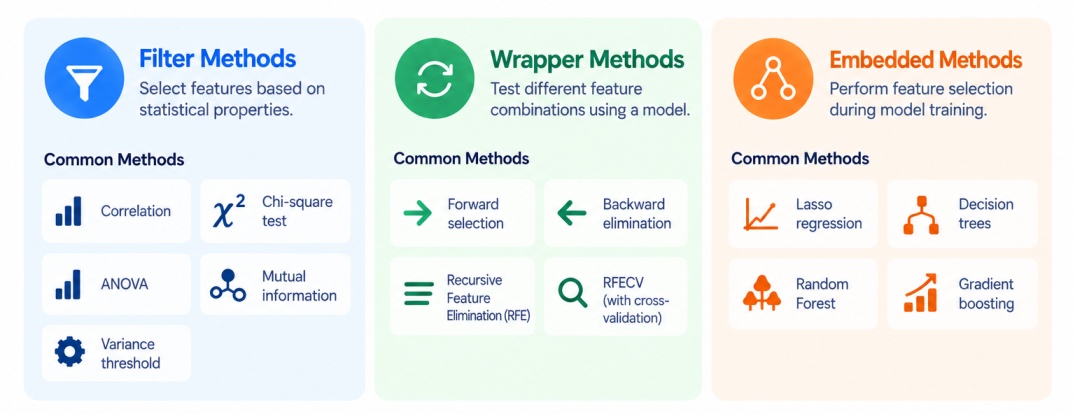
Filter Methods
Wrapper Methods
Embedded Methods
Each category uses a different approach to identify and select the most relevant features.
1. Filter Methods
Filter methods select features based on their statistical properties. They evaluate the relationship between features and the target variable without training a specific machine learning model.
Common Filter Methods
Correlation
Chi-square test
ANOVA
Mutual information
Variance threshold
Key Characteristics
Fast and simple to apply
Suitable for datasets with many features
Usually performed before model training
Do not depend on a specific machine learning algorithm
Now explore Filter feature selection methods in detail.
(a) Correlation-Based Feature Selection
Correlation measures the relationship between numerical variables. If two features are highly correlated, they may contain similar information. You can remove one of them to reduce redundancy.
Example:
A house price dataset may contain:
Both features represent almost the same information. Keeping both may not add much value.
Limitation: Correlation mainly captures specific types of relationships and may miss complex non-linear relationships.
(b) Chi-Square Test
The chi-square test is commonly used with categorical features in classification problems. It checks whether there is a statistical association between a feature and the target variable.
Example:
For a model that predicts whether a customer will purchase a product, features such as:
Payment method
Customer segment
Subscription type
Features showing stronger associations with the target can be considered for selection.
Also Read: Supervised vs Unsupervised Learning: Differences, Examples, and Applications
(c) ANOVA
ANOVA stands for Analysis of Variance. It can be used to examine the relationship between:
It checks whether the mean value of a feature differs significantly across different classes.
Example:
If a model predicts customer segments, ANOVA can help determine whether variables such as spending amount differ significantly between those segments.
(d) Mutual Information
Mutual information measures how much information one variable provides about another. Unlike simple correlation, it can identify certain non-linear relationships between a feature and the target.
Key point:
This makes mutual information useful when the relationship between a feature and target is not straightforward.
(e) Variance Threshold
Variance threshold removes features with very low variance. A feature that has almost the same value across all observations may provide limited information to the model.
Example:
If 99.9% of records have the same value for a feature, that feature may have limited predictive value.
2. Wrapper Methods
Wrapper methods select features by testing different combinations of features using a machine learning model.
Instead of evaluating each feature independently, they check how different feature subsets affect model performance.
Common Wrapper Methods
Key Characteristics
Evaluate feature combinations
Use a machine learning model during selection
Can produce feature subsets suited to a particular model
Usually require repeated model training
Can be computationally expensive for large datasets
Also Read: Classification vs Regression in Machine Learning
Now explore wrapper feature selection methods in machine learning in detail.
(a) Forward Selection
Forward selection starts with no features. The process works as follows:
Start with an empty feature set.
Test individual features.
Select the feature that gives the best improvement in model performance.
Add another feature that improves performance the most.
Repeat the process.
Stop when the desired number of features is reached or additional features no longer provide enough improvement.
(b) Backward Elimination
Backward elimination starts with all available features. The process works as follows:
Train the model using all features.
Identify the feature contributing the least to model performance.
Remove that feature.
Train the model again.
Repeat the process until the desired number of features remains.
(c) Recursive Feature Elimination (RFE)
Recursive Feature Elimination, or RFE, repeatedly trains a model and removes the least important features.
Example:
If a dataset contains 20 features and you want to select five:
Train the model using all 20 features.
Identify the least important features.
Remove the least important features.
Retrain the model.
Continue until five features remain.
RFE can work with different machine learning estimators.
(d) Recursive Feature Elimination with Cross-Validation (RFECV)
RFECV extends RFE by using cross-validation to determine a suitable number of features.
Instead of manually deciding how many features to keep, RFECV:
Removes less important features recursively.
Evaluates different feature counts.
Uses cross-validation to compare model performance.
Selects a suitable feature count based on the chosen evaluation metric.
Also Read: Reinforcement Learning (RL) in Machine Learning: How It Works, Algorithms and Types
3. Embedded Methods
Embedded methods perform feature selection during model training. The learning algorithm itself identifies which features contribute to the model.
Common Embedded Methods
Key Characteristics
Feature selection happens during model training
Usually more model-specific than filter methods
Can reduce the need for a separate feature selection step
Feature importance or model coefficients can help identify relevant features
(a) Lasso Regression
Lasso stands for Least Absolute Shrinkage and Selection Operator. It uses L1 regularisation to penalise model coefficients.
During training, some coefficients can become exactly zero.
Example:
If a model produces:
Feature A: 2.5
Feature B: 0
Feature C: -1.8
Feature D: 0
Features B and D can be excluded because their coefficients are zero. Lasso is mainly useful for feature selection in suitable linear models.
(b) Decision Trees
Decision trees perform feature selection while creating splits in the data. At each node, the algorithm searches for a feature and split that best separates the data according to its splitting criterion.
The trained tree can also provide feature importance scores. These scores help identify which features contributed to the tree's predictions.
(c) Random Forest
Random Forest combines multiple decision trees. It can provide feature importance scores that indicate how features contribute to the model.
Features with very low importance may be considered for removal.
The importance scores should be interpreted carefully because the results can vary based on:
Dataset characteristics
Correlated features
Importance measure used
Model configuration
(d) Gradient Boosting
Gradient boosting builds a sequence of models, with each new model working to improve the predictions made by earlier models.
Many gradient boosting implementations provide feature importance measures. These measures can help identify features that contribute to predictions.
Also Read: Hyperparameter Tuning in Machine Learning: Methods, Techniques, and Tools
As of now you have a clear understanding of feature selection method in machine learning. Now let’s compare these feature selection techniques in machine learning.
Feature Selection Techniques Compared
Different feature selection techniques have different strengths and limitations. Let’s understand the difference between these feature selection techniques:
Feature Selection Technique | Type | How It Works | Main Advantage | Limitation |
Correlation | Filter | Measures relationships between variables | Simple and fast | May miss complex relationships |
Chi-square | Filter | Measures association between categorical variables | Useful for suitable classification problems | Has data requirements |
ANOVA | Filter | Compares feature means across classes | Easy to apply | Limited to suitable feature-target relationships |
Mutual Information | Filter | Measures shared information | Can capture non-linear relationships | Can require more computation |
RFE | Wrapper | Repeatedly removes less important features | Model-specific selection | Can be computationally expensive |
Forward Selection | Wrapper | Adds useful features step by step | Easy to understand | Requires repeated model fitting |
Backward Elimination | Wrapper | Removes less useful features step by step | Considers the complete feature set | Expensive with many features |
Lasso | Embedded | Shrinks some coefficients to zero | Performs selection during training | Best suited to applicable models |
Tree-Based Importance | Embedded | Uses model-based feature importance | Captures non-linear relationships | Importance can vary by model and data |
After comparing these feature selection method in machine learning, let’s understand how to implement these using Python.
Also Read: Bias Variance Tradeoff in Machine Learning: Concept, Examples, and Techniques
Feature Selection in Python
Python provides several libraries for feature selection, with feature selection sklearn offering many commonly used techniques. You can apply these methods to a dataset, select the most relevant features, and use the reduced dataset for model training.
Below is a step-by-step example using a sample classification dataset.
Sample Dataset
Let's create a small dataset containing customer information. The target variable, Purchased, indicates whether a customer purchased a product.
import pandas as pd
data = {
"Age": [22, 25, 28, 35, 40, 45, 30, 27, 50, 38],
"Income": [25000, 30000, 35000, 50000, 65000, 70000, 45000, 32000, 80000, 55000],
"SpendingScore": [80, 75, 70, 60, 45, 40, 65, 72, 35, 55],
"VisitsPerMonth": [8, 7, 6, 5, 3, 2, 5, 7, 2, 4],
"Tenure": [1, 2, 2, 4, 6, 7, 3, 2, 8, 5],
"Purchased": [1, 1, 1, 1, 0, 0, 1, 1, 0, 0]
}
df = pd.DataFrame(data)
print(df)
Output:
Age | Income | SpendingScore | VisitsPerMonth | Tenure | Purchased |
|---|
22 | 25,000 | 80 | 8 | 1 | 1 |
25 | 30,000 | 75 | 7 | 2 | 1 |
28 | 35,000 | 70 | 6 | 2 | 1 |
35 | 50,000 | 60 | 5 | 4 | 1 |
40 | 65,000 | 45 | 3 | 6 | 0 |
45 | 70,000 | 40 | 2 | 7 | 0 |
30 | 45,000 | 65 | 5 | 3 | 1 |
27 | 32,000 | 72 | 7 | 2 | 1 |
50 | 80,000 | 35 | 2 | 8 | 0 |
38 | 55,000 | 55 | 4 | 5 | 0 |
Separate the input features and target variable:
X = df.drop("Purchased", axis=1)
y = df["Purchased"]
print(X.shape)
Output:
(10, 5)
The dataset has 10 records and 5 input features.
1. Feature Selection Using SelectKBest
For a classification problem, you can use f_classif to calculate ANOVA F-scores.
from sklearn.feature_selection import SelectKBest, f_classif
selector = SelectKBest(score_func=f_classif, k=3)
X_selected = selector.fit_transform(X, y)
print(X_selected.shape)
Output:
(10, 3)
The output contains 10 rows and the 3 selected features.
You can also find the names of the selected features:
selected_features = X.columns[selector.get_support()]
print(selected_features.tolist())
Output:
['Age', 'SpendingScore', 'VisitsPerMonth']
The exact selected features can vary depending on the dataset and scoring method.
2. Feature Selection Using RFE
Here, we use Logistic Regression as the estimator.
from sklearn.feature_selection import RFE
from sklearn.linear_model import LogisticRegression
model = LogisticRegression(max_iter=1000)
selector = RFE(
estimator=model,
n_features_to_select=3
)
X_selected = selector.fit_transform(X, y)
print(X_selected.shape)
Output:
(10, 3)
You can check which features were selected:
selected_features = X.columns[selector.support_]
print(selected_features.tolist())
Output:
['Age', 'SpendingScore', 'VisitsPerMonth']
You can also view the ranking assigned to every feature:
print(selector.ranking_)
Output:
[1 3 1 1 2]
A ranking of 1 means the feature was selected.
For example:
Age: 1
Income: 3
SpendingScore: 1
VisitsPerMonth: 1
Tenure: 2
3. Feature Selection Using Lasso
For this example, we use Lasso for a regression-style demonstration.
from sklearn.linear_model import Lasso
model = Lasso(alpha=0.01)
model.fit(X, y)
selected_features = X.columns[model.coef_ != 0]
print(selected_features.tolist())
Output:
['Age', 'Income', 'SpendingScore', 'VisitsPerMonth', 'Tenure']
The selected features depend on the value of alpha and the dataset.
You can also view the coefficients:
for feature, coefficient in zip(X.columns, model.coef_):
print(feature, ":", coefficient)
Output:
Age : 0.02
Income : 0.00
SpendingScore : -0.01
VisitsPerMonth : 0.04
Tenure : -0.03
Here, Income has a coefficient of 0, so it can be excluded based on this Lasso model.
The alpha parameter controls the strength of regularisation. You should generally select it using an appropriate validation strategy rather than choosing it arbitrarily.
4. Feature Selection Using SelectFromModel
SelectFromModel selects features based on model coefficients or feature importance scores. It can be used with models such as Random Forest that provide feature importance values.
from sklearn.feature_selection import SelectFromModel
from sklearn.ensemble import RandomForestClassifier
model = RandomForestClassifier(
n_estimators=100,
random_state=42
)
selector = SelectFromModel(model)
X_selected = selector.fit_transform(X, y)
print(X_selected.shape)
Output:
(10, 3)
You can identify the selected features using:
selected_features = X.columns[selector.get_support()]
print(selected_features.tolist())
Output:
['Income', 'SpendingScore', 'VisitsPerMonth']
You can also check the feature importance scores:
for feature, importance in zip(X.columns, selector.estimator_.feature_importances_):
print(feature, ":", round(importance, 3))
Output:
Age : 0.145
Income : 0.182
SpendingScore : 0.294
VisitsPerMonth : 0.247
Tenure : 0.132
SelectFromModel keeps features that meet its selection threshold. The selected features and scores can change when you use a different dataset, model, or threshold.
Feature Selection for Different Machine Learning Models
The appropriate feature selection method can depend on the machine learning algorithm. Below is a quick table for deciding the best feature selection methods based on your need:
Machine Learning Model | Suitable Feature Selection Methods | Reason |
Linear Regression | Correlation, Lasso, Mutual Information | Helps identify relevant variables and reduce redundancy |
Logistic Regression | RFE, L1 regularisation, Chi-square | Useful for selecting relevant classification features |
Decision Tree | Tree-based importance, Mutual Information | Can capture non-linear feature relationships |
Random Forest | Feature importance, permutation-based methods | Can identify features contributing to ensemble predictions |
Support Vector Machine | RFE, L1-based selection | Useful for high-dimensional datasets |
KNN | Correlation, Mutual Information, Variance Threshold | Removing irrelevant features can improve distance calculations |
Naive Bayes | Chi-square, Mutual Information | Can help identify relevant classification features |
Neural Networks | Variance Threshold, Mutual Information, model-based methods | Can reduce unnecessary input dimensions |
Gradient Boosting | Feature importance, Mutual Information | Can identify relevant features and non-linear relationships |
Also Read: Clustering in Machine Learning: Types, Algorithms, Examples, and How It Works
Now let’s understand how to choose the right feature selection method in machine learning.
How to Choose the Right Feature Selection Method?
Choosing the right feature selection method depends on several factors. The common factors includes:
1. Consider the Number of Features
If your dataset contains a very large number of features, filter methods can be a practical starting point because they are generally faster.
You can first remove clearly irrelevant features and then apply a more computationally expensive method if required.
2. Consider the Type of Data
The type of feature and target variable affects which technique is appropriate.
For example:
Correlation is commonly used with numerical variables.
Chi-square can be used for suitable categorical classification data.
ANOVA can evaluate numerical features against categorical targets.
Mutual information can capture certain non-linear relationships.
Also Read: Confusion Matrix in Machine Learning: Types, Metrics, and Examples
3. Consider the Machine Learning Algorithm
Some feature selection methods are model-independent, while others are closely connected to a particular model.
For example, Lasso-based selection works with models using L1 regularisation, while RFE can use a chosen estimator to rank and remove features.
4. Consider Computational Cost
Wrapper methods may require many rounds of model training.
If you have thousands of features, evaluating many possible feature combinations can become expensive.
Filter methods are usually more computationally efficient and can be useful for reducing the feature space before applying wrapper methods.
5. Consider Interpretability
If you need to explain model predictions to stakeholders, selecting a smaller set of meaningful features can make the model easier to understand.
For example, a model using five clearly defined business variables may be easier to interpret than one using hundreds of variables.
Conclusion
Feature selection helps machine learning models focus on useful features. It can reduce variables, simplify models, improve computational performance, and make results easier to interpret.
Filter, wrapper, and embedded methods offer different ways to select features. The right method depends on your dataset, model, feature types, and modelling goals.