

IndiaIndian Nationals
1800 210 2020
ForiegnForeign Nationals
+918068792934
logologo
Home
About
Director's Message
Blogs
HomeAbout
Director's MessageBlogs
Limited Seats Available

Classification vs Regression in Machine Learning

Key Highlights 

  • The key classification vs regression difference is the kind of output they predict. Classification predicts categories or labels, and regression predicts numerical values. 

  • Classification puts data into classes, and regression estimates a value from input variables. 

  • Choosing between classification and regression depends on the decision you want to make and the type of output you need. 

  • In this blog, you will discover the difference between classification and regression, their definitions, types, algorithms, examples, and how to pick the right method for your needs. 

Classification vs Regression: Key Differences 

Classification and regression are the problems of machine learning. The following table shows the classification vs regression differences between both; these pointers will help you to take a better decision about which approach to choose: 

Factors 

Classification 

Regression 

Definition 

Predicts a category or class 

Predicts a numerical value 

Type of output 

Discrete output 

Continuous output 

Main question 

“Which category does it belong to?” 

“What value should it be?” 

Example 

Predicting whether an email is spam or not spam 

Predicting the price of a house 

Output example 

Spam, Not Spam 

₹50 lakh, ₹75 lakh, ₹1 crore 

Common algorithms 

Logistic Regression, Decision Tree, Random Forest, SVM, KNN 

Linear Regression, Polynomial Regression, Decision Tree, Random Forest 

Evaluation metrics 

Accuracy, Precision, Recall, F1-score, ROC-AUC 

MAE, MSE, RMSE, R² 

Nature of prediction 

Assigns an observation to one or more classes 

Estimates a numerical value based on input variables 

Real-world use cases 

Fraud detection, disease classification, sentiment analysis 

Sales forecasting, house price prediction, demand forecasting 

Target variable 

Usually categorical 

Usually numerical 


What is Classification? 

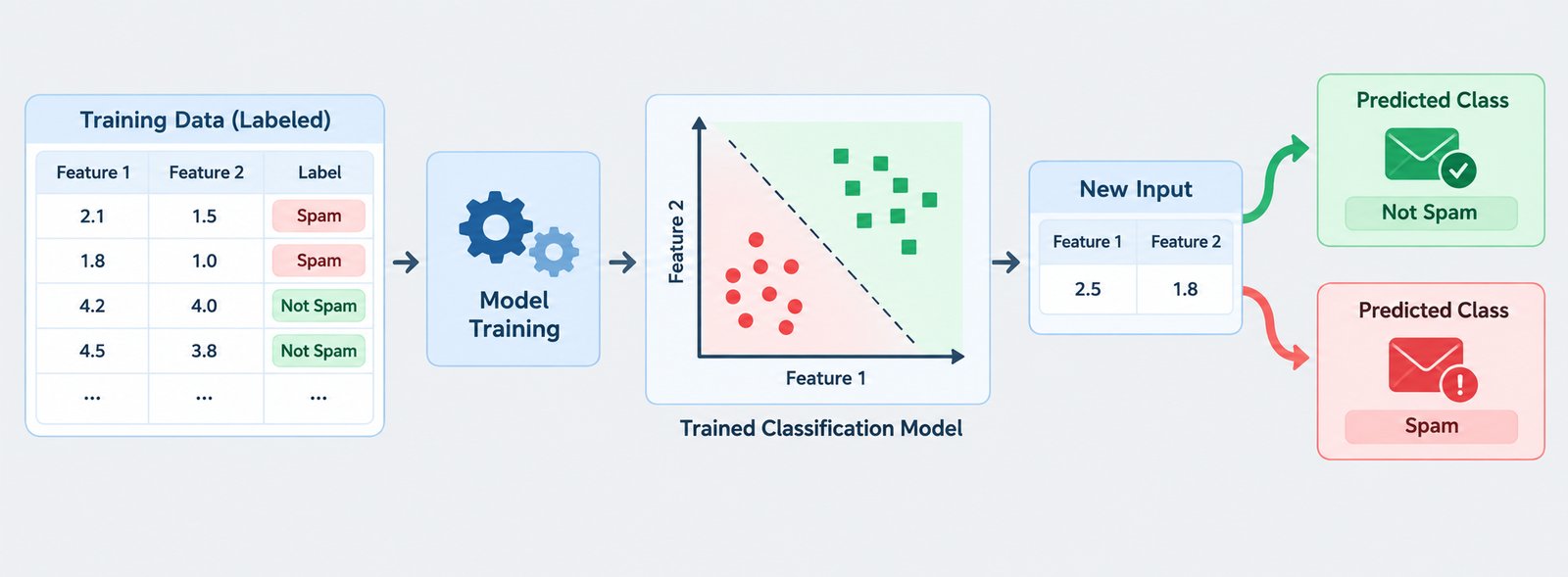
The classification is a part of supervised machine learning, in which it defines data into category or class based on the previous labeled data. These classes or labels are predefined.  

For example, if you want to know if a new email is spam or not spam. So, you train machine learning model based on the email data which is already labeled as spam or not spam. After learning the data, the ML model can classify the mail into one of the categories. 
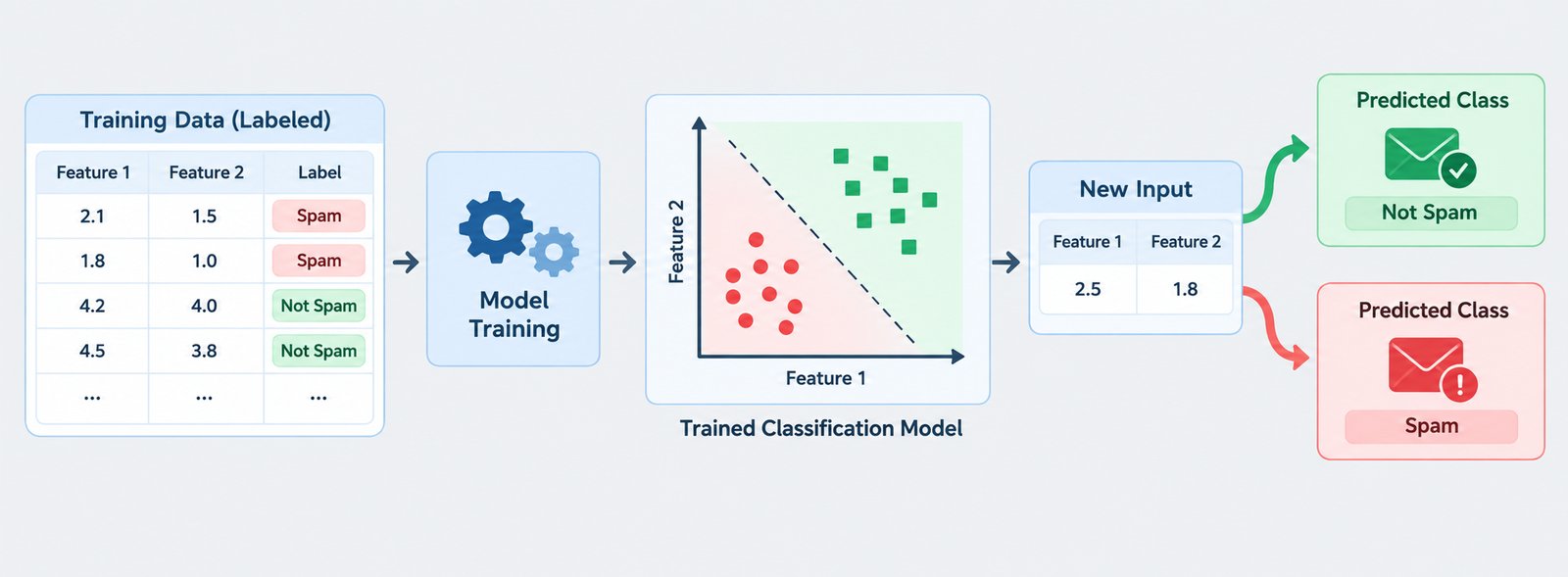

Classification in machine learning: labeled training data is used to train a classification model, which uses features and a decision boundary to assign a new input to a predicted class such as Spam or Not Spam.Classification in machine learning: labeled training data is used to train a classification model, which uses features and a decision boundary to assign a new input to a predicted class such as Spam or Not Spam.

Examples of Classification: 

  • Predicting whether a patient has a disease (yes or no) 

  • Recognize if the digits are hand-written 

  • Classify the images 


Types of Classification    

Classification tasks vary based on how many classes exist and how they relate to each other. Here are the main types: 


  1. Binary Classification: It classifies the input into two categories, like spam or not spam 

  1. Multi-Class Classification: Sorts inputs into 3+ mutually exclusive classes. Like digit recognition from 0 to 9. 

  1. Multi-Label Classification: Each input can belong to multiple classes simultaneously. Example putting a tag to movie "action" + "comedy". 

  1. Imbalanced Classification: A special case (of binary or multi-class) where one class vastly outnumbers others. Example fraud detection. 

  1. Ordinal Classification: Classes have a natural order but not have a continuous flow like regression. For example, give ratings from 1 to 5. 


Classification Algorithms Used in Machine Learning 

Following are the algorithms of classification in machine learning: 

  1. Logistic Regression: Uses a linear combination of features passed through sigmoid/softmax to estimate class probability. 

  1. Decision Trees: Splits data through a series of yes/no questions on features. Best for interpretable rules. 

  1. Random Forest: An ensemble of decision trees that vote together. Best for general-purpose, high-accuracy tasks. 

  1. k-Nearest Neighbors (k-NN): Classifies based on the majority class among the closest data points. Best for small datasets with clear clusters. 

  1. Support Vector Machines (SVM): Finds the boundary that maximizes the margin between classes. Best for high-dimensional data like text. 

  1. Naive Bayes: Applies Bayes' theorem, assuming features are independent. Best for text classification (spam filtering, sentiment analysis). 

  1. Neural Networks: Learns complex patterns through layers of weighted connections. Best for large, complex datasets like images or audio. 

  1. Gradient Boosting (XGBoost, LightGBM): Builds trees sequentially, each correcting the errors of the last. Best for structured/tabular data. 

What is Regression? 

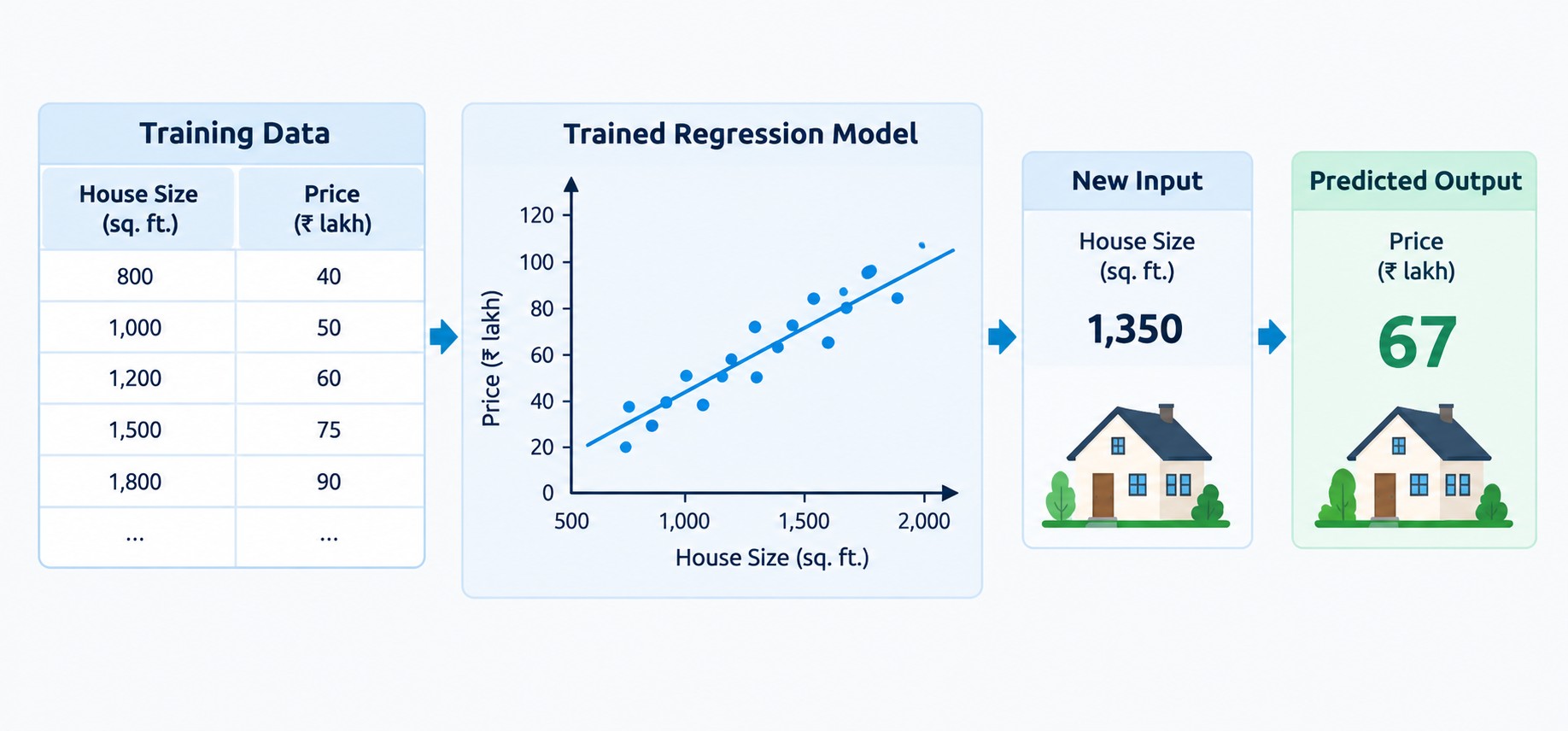
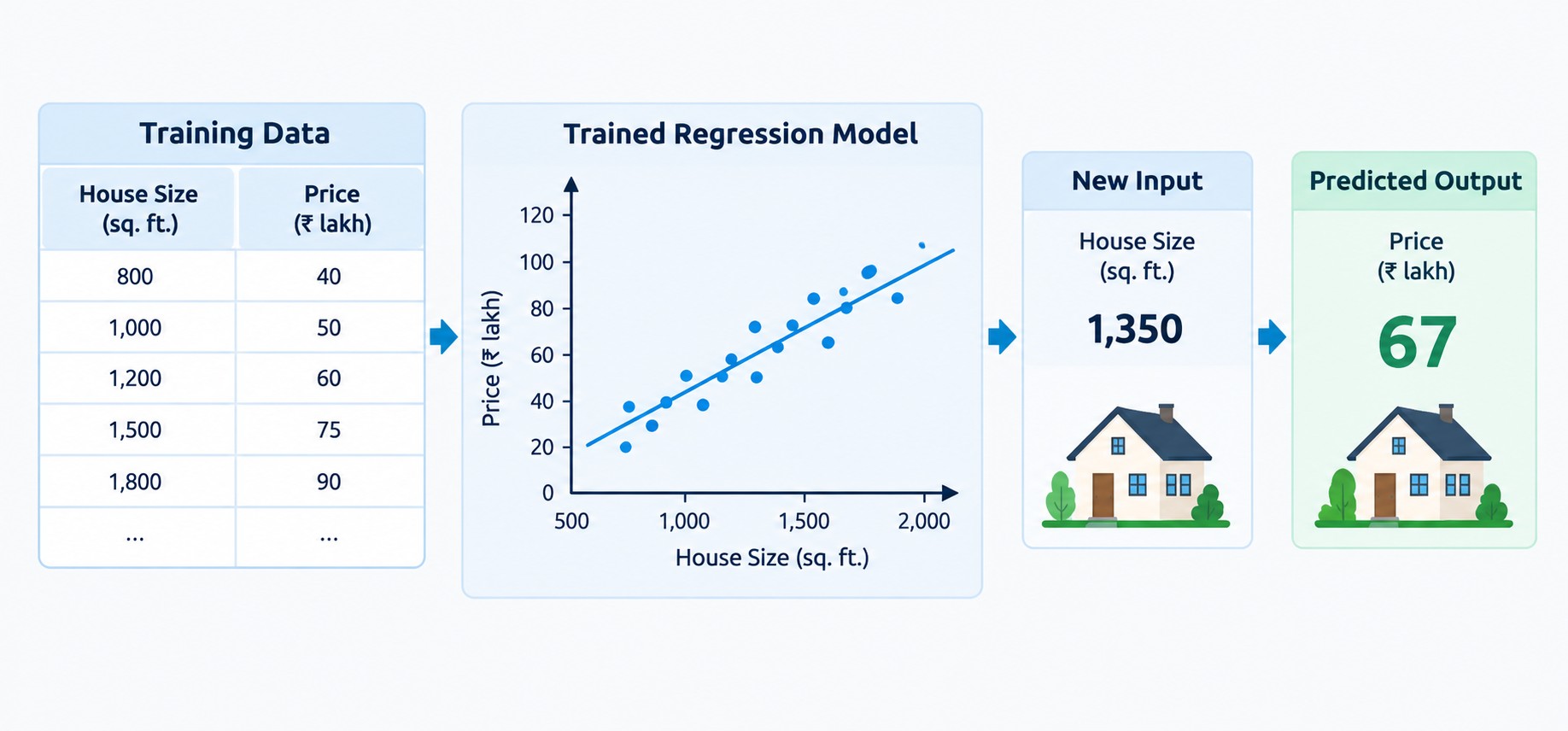
Regression is used to predict continuous numeric values based on one or more input variables. ML model predicts “how much” or “how many.” For example, you want to know the price of a house based on the size.  

Here, the house size and price are connected. The output is a number and not a category.

House Size 

Actual Price 

1,000 sq. ft. 

₹40 lakh 

1,500 sq. ft. 

₹60 lakh 

2,000 sq. ft. 

₹80 lakh 

2,500 sq. ft. 

₹1 crore 

Machine learning classification workflow showing labeled training data, model training, a trained classification model, new input, and predicted classes.Machine learning classification workflow showing labeled training data, model training, a trained classification model, new input, and predicted classes.

Types of Regression Algorithms 

Regression algorithms have some broad categories based on how they model the relationship between inputs and outputs. These are some types: 

  • Linear-based: Fits a straight line. Includes linear, multiple linear, ridge (shrinks values), lasso (shrinks and drops inputs), and elastic net (combines both). 

  • Non-linear/curve-fitting: Handles curved data. Polynomial regression bends the line; SVR fits curves while ignoring small errors. 

  • Tree-based: Uses yes/no splits to group data. Decision tree builds one tree; random forest averages many trees, gradient boosting builds trees that fix prior mistakes. 

  • Instance-based: Predicts via similarity to existing points. KNN averages the k nearest data points. 

  • Neural network-based: Learns complex patterns through interconnected layers; best for large, high-dimensional data. 

  • Specialized: Poisson regression predicts counts; logistic regression, despite the name, is actually for classification. 

Quick Summary of Regression Algorithm Types 

Category 

Key Trait 

Example Algorithms 

Linear-based 

Assumes straight-line relationships 

Linear, Ridge, Lasso, Elastic Net 

Non-linear/curve-fitting 

Captures curves 

Polynomial, SVR 

Tree-based 

Splits data via thresholds 

Decision Tree, Random Forest, Gradient Boosting 

Instance-based 

Predicts via similarity 

KNN 

Neural network-based 

Learns complex patterns 

Neural Networks 

Specialized 

Built for specific data types 

Poisson, Logistic (classification) 

Classification Problem vs Regression Problem   

To solve a machine learning problem, the first question you will ask is “whether I am predicting a category or number?” The answer to this question determines whether you are solving a classification problem or regression problem. 

Classification Problem 

In classification problems, prediction of category or class is involved. The output is discrete and limited to the fixed set of labels available.  

Examples of Classification Problem: 

  • Will this customer churn? (Yes/No) 

  • What type of animal is in this image? (Cat/Dog/Bird) 

  • Is this transaction fraudulent? (Fraud/Not Fraud) 

  • What disease does this patient have? (Diabetes/Hypertension/Healthy) 

Key to check, if the answer gives one option, then it’s a classification problem. 

Regression Problem 

In the regression problem, a continuous numeric value is predicted. The output can be any number from the range.  

Examples of Regression Problem: 

  • What will this house sell for? (₹245,000) 

  • How many units will we sell next month? (1,240 units) 

  • What will the temperature be tomorrow? (72.5°F) 

  • How long will this patient's recovery take? (14.3 days) 

You can identify the regression problem, if the output is a specific number like amount, price, or measurement.  

An Edge Case of Classification and Regression 

Sometimes a same question can be answered in both ways: 


  • Will it rain tomorrow? The options are (Yes/No). Then it is Classification. 

  • How much rain will fall tomorrow? If answer should be in mm. Then it is Regression. 

The algorithm depends on the decision you want to make with the predication. 

Quick Comparison Between Classification and Regression 

Aspect 

Classification Problem 

Regression Problem 

Output 

Discrete category/label 

Continuous numeric value 

Question type 

"Which one?" 

"How much/many?" 

Example 

Spam or not spam 

Predicted house price 

Evaluation 

Accuracy, precision, recall 

MSE, MAE, R² 


How to Choose Between Classification and Regression? 

It depends on the problem, what kind of output it needs. Here are steps to decide: 

1. Look at What You're Trying to Predict 

Ask: Is the answer a category or number? 

  • If the answer is one of a fixed set of labels (yes/no, type A/B/C) → Classification 

  • If the answer is a measurable quantity (price, temperature, count) → Regression 

2. Consider the Business Question You Need Answered 

On the same data, you can use classification vs regression model; it totally depends on the decision you want to make.  

  • Need to flag/sort/approve something? → Classification 

  • Need to estimate an amount, forecast, or measurement? → Regression 

Example: A loan application system can use classification if needed prediction related to approve/rejector or regression if want to predict credit score.  

3. Check If the Target Variable Has a Natural Order or Scale 

Think about whether the numbers in your output actually mean something in terms of distance. 

  • If the difference between values matters, like ₹10 vs ₹1,000, this is a huge gap → Regression. 

  • If the values are just names or labels like "red" and "blue" → Classification. 

4. Think About How the Output Will Be Used 

  • If the output feeds into a binary or multi-option decision (approve loan, route ticket to a department) → Classification 

  • If the output feeds into calculations, comparisons, or forecasts (budgeting, inventory planning) → Regression 

5. Consider Converting Between Them 

You can reframe the problem if you want to fit in the tool you have: 

  • Regression → Classification: Group the continuous values into ranges (example, categorizing into low/medium/high risk instead of giving exact risk score) 

  • Classification → Regression: If you need probability estimates instead of hard labels, use a classifier that outputs probabilities (like logistic regression) instead of switching to regression 

Decision Checklist 

Ask Yourself 

If Yes → 

Is the output one of a few fixed labels? 

Classification 

Is the output a specific number/amount? 

Regression 

Does "how far off" the prediction matter? 

Regression 

Do you just need a decision, not a magnitude? 

Classification 

Conclusion 

Classification and regression are two important types of machine learning problems. Both differ on the basis of output they predict. Classification is used when the goal is to predict a category or class while regression is used to predict a value. Understanding this difference helps you choose the approach for your problem. 

If you need to identify a category, such as spam or not spam, classification is the choice. If you need to estimate a value, such, as a house price or sales amount regression is more suitable. 

Check the type of output before starting a project. By understanding the problem, the output, and the purpose of the prediction, you can select the approach that best fits your machine learning task. 


Frequently Asked Questions

General

Ready to Take the Next Step? Enroll Today!

Ready to Take the Next Step? Enroll Today!

© Copyright 2026 of IITKGP | All Rights Reserved Privacy Policy