IndiaIndian Nationals
1800 210 2020
ForiegnForeign Nationals
+918068792934
logologo
Home
About
Director's Message
Blogs
HomeAbout
Director's MessageBlogs
Limited Seats Available

Supervised vs Unsupervised Learning: Differences, Examples, and Applications

Quick Overview:

  • Supervised learning is a type of machine learning where an algorithm learns from labelled data to predict the correct output for new data.

  • Unsupervised learning is a type where algorithms find patterns, groups, or relationships in unlabelled data without predefined answers.

  • Supervised learning is mainly used for regression and classification, while unsupervised learning covers clustering, association rule learning, and dimensionality reduction.

  • In this blog, you’ll explore supervised vs unsupervised learning, their differences, working, types, examples, applications, selection criteria, and hybrid ML workflows.

Supervised vs Unsupervised Learning: Key Differences

The supervised vs unsupervised learning, side by side comparison helps you to find out the real difference between both before going in detail. The table below covers the factors that arises most when selecting the best algorithm for your ML project:

Factor

Supervised Learning

Unsupervised Learning

Data type

Labelled data with known outputs

Unlabelled data with no predefined outputs

Goal

Predict an outcome or category

Discover hidden patterns or groupings

Human involvement

High, since labelling requires manual effort

Low, since no labelling is needed

Output

A specific prediction (value or class)

Clusters, associations, or reduced features

Common algorithms

Linear regression, decision trees, SVM

K-Means, hierarchical clustering, PCA

Accuracy measurement

Straightforward, using labelled test data

Harder, since there is no ground truth

Training complexity

Generally simpler to train and validate

Can be harder to validate objectively

Data preparation effort

High, due to labelling requirements

Lower, but still needs cleaning

Use case examples

Spam detection, price prediction

Customer segmentation, anomaly detection

Interpretability

Often easier to explain to stakeholders

Can be harder to explain without labels

Scalability with data

Limited by availability of labelled data

Scales more easily with raw data volume

Risk of bias

Labels can introduce bias into the model

Bias can emerge from how clusters are formed

Real-time use

Well suited to real-time prediction tasks

Often used for exploratory or batch analysis

Model retraining

Requires updated labelled data

Can adapt to new data more flexibly

In short, the difference between supervised and unsupervised learning is: whether the data you are training a machine on already has the answer attached. Now after exploring supervised vs unsupervised learning through a quick comparison, explore each in detail.

What Is Supervised Learning? 

Supervised learning is a machine learning technique in which the algorithm learns and model trains on the labelled data. In the training data, each input contains an output. The model learns from this relationship and uses this information to predict the outcome for new and unseen data.

For example, when you train your model by giving emails labelled as either "spam" or "not spam." The model will predict new and unseen emails by building up the relationship between the previous given data.

How Does Supervised Learning Work?

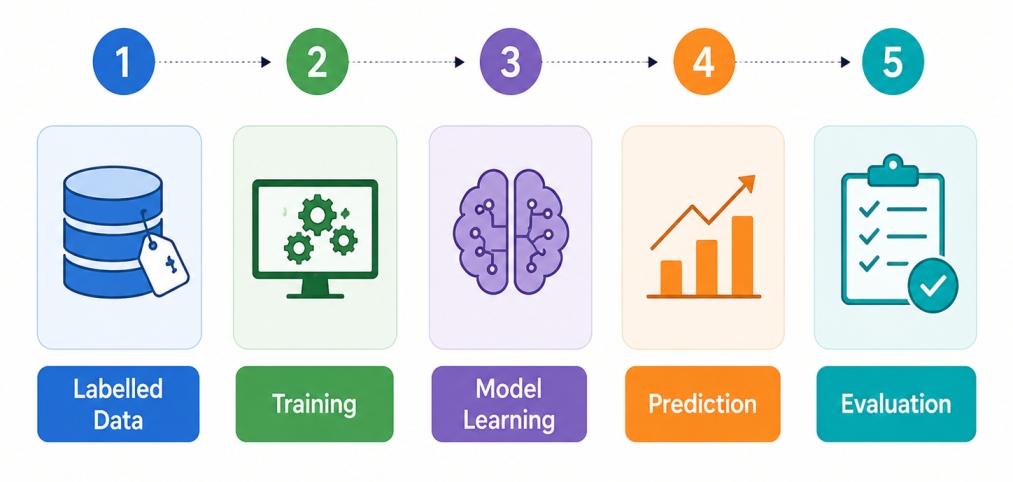
The supervised vs unsupervised learning process differs mainly because supervised learning has a known target already. Below are the steps involved in the working of supervised learning:

Five steps of supervised learning: labelled data, training, model learning, prediction, and evaluation.Five steps of supervised learning: labelled data, training, model learning, prediction, and evaluation.

1. Labelled Data: Every example given in the training phase was tagged with some output. For example, mails tagged as “spam” or “not spam”. 

2. Training: The algorithm processes the labelled data repeatedly and adjusts its internal parameters to reduce the gap between its predictions and the actual labels.

3. Model learning: After training the model multiple times, the model builds an internal representation of the relationship between input features and the target output.

4. Prediction: After the training and learning phase, you will pass some random inputs to the model and it predicts the outcome. For example, giving new emails to the model can now predict whether it falls in the category of “spam” or “not spam”.

5. Evaluation: The last step is the evaluation of the model, how the model is performing on unseen data using metrics such as accuracy, precision, recall, F1-score, MAE, or RMSE, depending on the task.

After knowing the workflow it is easy to understand supervised vs unsupervised machine learning. Now let’s see the different types of supervised learning. 

Types of Supervised Learning 

The supervised learning is mainly divided into two categories based on the nature of the output which are regression and classification. 

1. Regression: The regression algorithm is used when the target output is a numerical value.

Examples include:

  • Predicting house prices

  • Forecasting sales

  • Estimating salary

  • Predicting product demand

Common regression algorithms are Linear Regression, Decision Trees, Random Forest, and Gradient Boosting.

2. Classification: The classification is used when the target output belongs to a specific category. The email example which you have seen previously belongs to this category.

Examples include:

  • Spam or not spam

  • Fraudulent or legitimate

  • Approved or rejected

  • Positive or negative sentiment

Common classification algorithms are Logistic Regression, KNN, Decision Trees, SVM, Naive Bayes, and Random Forest. 

Now let’s see some examples of supervised learning to get more clarity of supervised vs unsupervised learning.

Examples of Supervised Learning

Supervised learning is used when you have past data with known answers or outcomes.

  • Healthcare: Predicting disease risk using patient information

  • Finance: Predicting loan default

  • Banking: Identifying potentially fraudulent transactions

  • E-commerce: Predicting customer churn

  • Marketing: Predicting whether a customer will respond to an offer

  • Image processing: Classifying images into predefined categories

Advantages and Limitations of Supervised Learning

In the discussion of supervised learning vs unsupervised learning, it is also important to know about the advantages and limitations of supervised learning, so now let’s see them with a quick table below:

Advantages

Limitations

Produces measurable predictions

Requires labelled training data

Works well with labelled data

Labelling large datasets can take time and resources

Suitable for classification and regression

Poor-quality labels can affect performance

Performance can be checked against known outcomes

May perform poorly on data that differs greatly from the training data

One common issue beginners face while training a model is incorrect labels in the training data. What should you do if your training data contains incorrect labels? Let’s check how to solve this issue.

What Happens When Training Data Has Incorrect Labels?

Incorrect labels can teach the model the wrong relationships. If a large portion of the training data contains incorrect labels, the model may learn misleading patterns and produce false and unexpected predictions. 

You can reduce this problem by:

  • Reviewing questionable labels

  • Removing duplicate or inconsistent records

  • Checking labels against reliable sources

  • Using multiple reviewers for difficult cases

  • Monitoring model performance after training

Now when you get a clear picture of what supervised learning is, it is time to explore what is unsupervised learning in detail as it makes the supervised learning vs unsupervised learning difference more clear.

What Is Unsupervised Learning?

Unsupervised learning is a machine learning approach in which there is not labelled data at all. Instead of predicting outcomes, it totally relies on structure, similarity, or relationships hidden within the data itself. In the broader supervised vs unsupervised learning conversation, this is the approach teams reach for when labelling every record simply is not realistic.

For example, an e-commerce company may have customer purchase data but no predefined customer groups. An unsupervised algorithm can analyse purchasing behaviour and group customers with similar characteristics. 

How Does Unsupervised Learning Work?

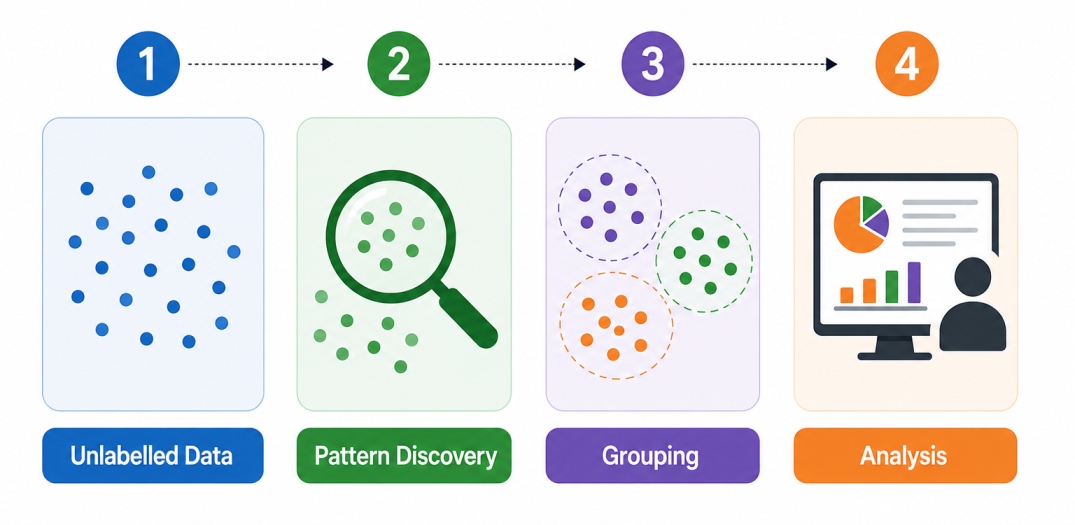
The supervised learning vs unsupervised learning working differs a lot as, unsupervised learning works by analyzing unlabelled data to discover hidden patterns, structures, or relationships without any human intervention or predefined correct answers. Key steps involved are:

Four steps of unsupervised learning: unlabelled data, pattern discovery, grouping, and analysis.Four steps of unsupervised learning: unlabelled data, pattern discovery, grouping, and analysis.

1. Unlabelled data: The data given for the training has no predefined categories or correct answers attached to any example. 

2. Pattern discovery:  The algorithm then analyzes the statistical properties of the data to identify similarities, distances, or relationships between data points.

3. Grouping: Based on the pattern the algorithm finds, it organizes data points into clusters, associations, or a reduced set of features. For example, it will group customers with similar buying habits into the same group.

4. Analysis:  The resulting groups or patterns are then interpreted by a human analyst or fed into downstream systems to guide decisions.

After knowing the workflow of unsupervised learning it is now more easy to understand supervised vs unsupervised machine learning. Now let’s see the different types of unsupervised learning. 

Types of Unsupervised Learning

The main types of unsupervised learning are clustering, association rule learning, and dimensionality reduction. 

1. Clustering: Clustering algorithms group similar data points together, such as segmenting customers by purchasing behavior.

Common methods include:

  • K-Means

  • Hierarchical Clustering

  • Gaussian Mixture Models

Applications include customer segmentation, document grouping, and image analysis.

2. Association Rule Learning: This technique identifies relationships between variables in large datasets, commonly used to find which products are frequently bought together.

Common techniques include:

  • Apriori

  • FP-Growth

  • Association rule mining

3. Dimensionality Reduction: Dimensionality reduction techniques simplify data by reducing the number of features while preserving as much meaningful information as possible.

Common techniques include:

  • Principal Component Analysis (PCA)

  • t-SNE

  • UMAP

Now let’s see some examples of unsupervised learning to get more clarity of supervised vs unsupervised learning.

Examples of Unsupervised Learning

Unsupervised learning is useful when you have large amounts of data but do not have predefined labels.

  • Customer segmentation: Group customers based on purchasing behaviour

  • Anomaly detection: Identify observations that differ from common patterns

  • E-commerce: Discover products frequently purchased together

  • Healthcare: Identify groups of patients with similar characteristics

  • Document analysis: Group documents based on content

  • Data exploration: Discover hidden structures within complex datasets

Advantages and Limitations of Unsupervised Learning

In the discussion of unsupervised learning vs supervised learning. Now let’s explore some pros and cons of unsupervised learning by a quick table below:

Advantages

Limitations

Does not require labelled training data

Results can be harder to understand

Can find previously unknown patterns

There may be no single correct grouping

Useful for exploring data

Choosing the right number of clusters can be difficult

Can process large amounts of unlabelled data

Found patterns may not always have practical meaning

The unsupervised learning vs supervised learning choice often depends on whether you already know what outcome you want the model to predict.

How to Choose Between Supervised and Unsupervised Learning?

Choosing between the two approaches starts with your data and the outcome you need. The supervised vs unsupervised machine learning decision should not be based only on the algorithm you prefer.

1. Choose Based on Data Availability

Use supervised learning when your dataset contains reliable labels for the target you want to predict. On the other hand, use unsupervised learning when you have useful data but no predefined target labels.

Example:

  • Customer churn labels available: Supervised learning

  • Customer purchase data without predefined groups: Unsupervised learning

2. Choose Based on the Problem

Your objective can help determine the right approach.

Goal

Suitable Approach

Predict a numerical value

Supervised learning

Predict a category

Supervised learning

Group similar observations

Unsupervised learning

Discover item relationships

Unsupervised learning

Reduce the number of features

Unsupervised learning

Predict a known outcome

Supervised learning

Explore unknown patterns

Unsupervised learning

This is one of the clearest ways to understand supervised learning vs unsupervised learning in practical projects.

3. Choose Based on Dataset Size and Quality

Dataset size alone does not determine the learning method. Data quality, label availability, feature quality, and the complexity of the task also matter.

A large dataset with unreliable labels may not be suitable for supervised learning until the labels are reviewed. A large unlabelled dataset may be more useful for clustering or representation learning.

4. Consider Evaluation and Accuracy Requirements

Supervised learning generally provides a clear target against which predictions can be measured.

For classification, you can use:

  • Accuracy

  • Precision

  • Recall

  • F1-score

For regression, you can use:

  • MAE

  • MSE

  • RMSE

  • R²

Unsupervised models require different evaluation methods depending on the task. For clustering, measures such as silhouette score can help assess how well-separated groups are.

5. Consider Human Labelling Effort and Resources

Labelling can require significant human effort, especially when datasets contain images, audio, documents, or specialised information.

If obtaining reliable labels is difficult, unsupervised methods can help you explore the available data before investing heavily in manual labelling.

How Much Labelled Data Do You Need?

There is no fixed amount of labelled data that works for every supervised learning project.

The required amount depends on:

  • Number of features

  • Complexity of the problem

  • Algorithm used

  • Data quality

  • Expected performance

  • Diversity of the data

You should start with a representative dataset and evaluate model performance using validation data. If performance is weak, increasing the quantity and quality of labelled examples may help.

Can Supervised and Unsupervised Learning Be Used Together?

Yes. Supervised and unsupervised learning can be combined in the same machine learning workflow. This can be useful when you have limited labelled data but a much larger pool of unlabelled data.

For example, an organisation may first use clustering to identify groups in a large unlabelled dataset. It can then use selected labelled examples from those groups to train a supervised model.

This approach connects supervised vs unsupervised learning rather than treating them as completely separate methods.

Hybrid ML Workflow: From Unlabelled Data to Predictions

A hybrid workflow can follow these steps:

Unlabelled Data → Pattern Discovery → Data Grouping → Labelling Selected Data → Supervised Training → Prediction

For example:

  1. Collect a large unlabelled customer dataset.

  2. Use clustering to identify customer groups.

  3. Analyse the groups and select representative samples.

  4. Add reliable labels to selected records.

  5. Train a supervised classification model.

  6. Test the model using unseen labelled data.

  7. Use the model to predict outcomes for new customers.

This approach can reduce the amount of manual labelling required while still producing a predictive model.

When Should You Use a Hybrid Approach?

A hybrid approach can be useful when:

  • You have a large amount of unlabelled data.

  • Only a small portion of the data can be labelled.

  • Labelling requires specialised human knowledge.

  • You want to explore patterns before defining categories.

  • You need predictions after discovering meaningful groups.

The unsupervised learning vs supervised learning decision does not always have to be either-or. Your workflow can use both methods at different stages of the same project.

Conclusion

Supervised vs Unsupervised Learning depends mainly on your data and the problem you want to solve. Supervised learning is suitable when labelled data is available and you need predictions or classifications, while unsupervised learning helps discover patterns and groups in unlabelled data.

You can also combine both approaches in a hybrid workflow when you have limited labelled data but a large amount of unlabelled data. 

Frequently Asked Questions

General

Ready to Take the Next Step? Enroll Today!

Ready to Take the Next Step? Enroll Today!

© Copyright 2026 of IITKGP | All Rights Reserved Privacy Policy