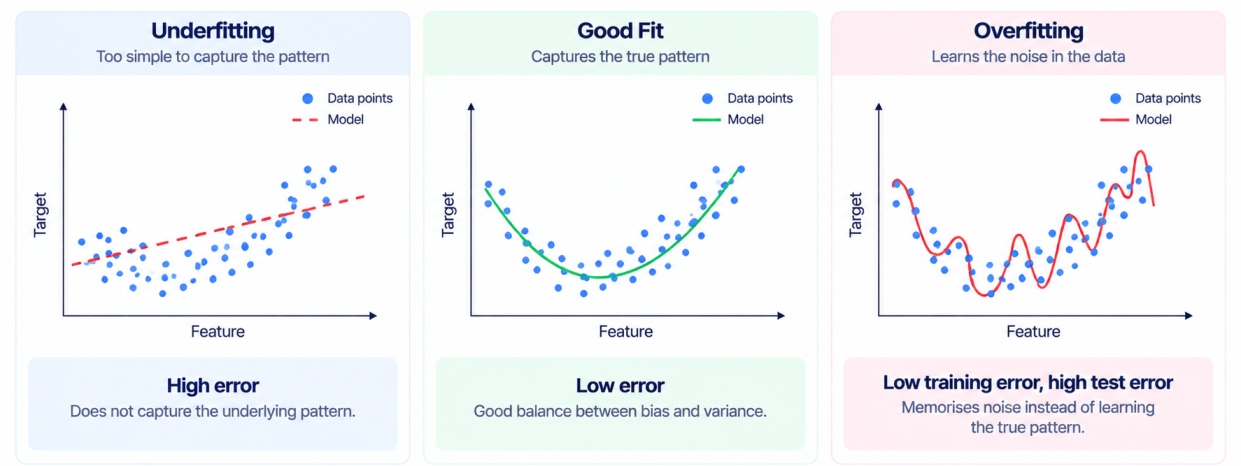
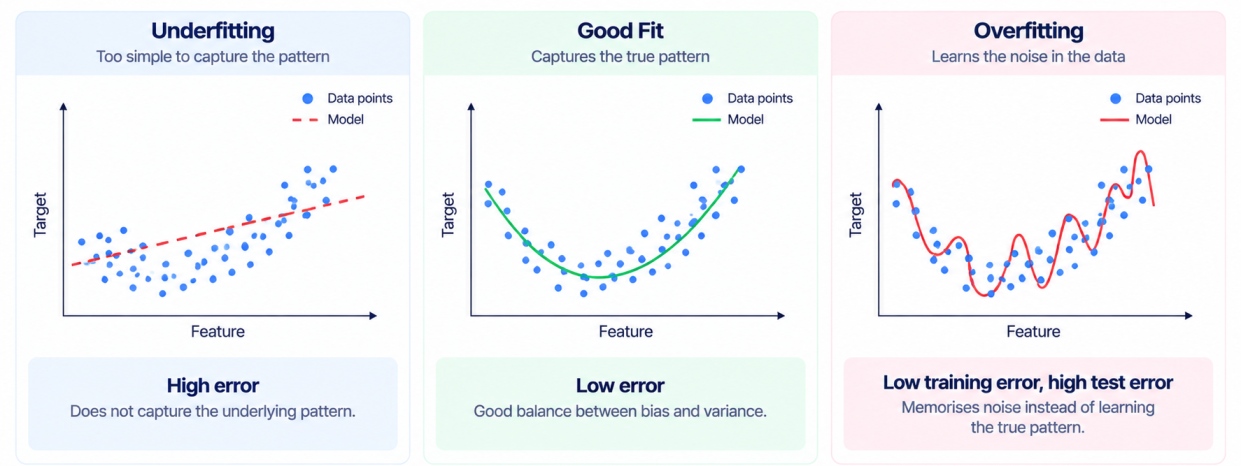
Now let’s explore each overfitting vs underfitting in machine learning in detail.
Also Read: Linear Regression in Machine Learning: Types, Algorithm, and Implementation
What Is Overfitting in Machine Learning?
Overfitting occurs when a machine learning model learns the training data too slowly. It will not just capture the genuine underlying pattern but also the noise, random variations or other details which are not required for the data.
The result is a model that performs extremely well on the data it was trained on but fails to generalize to new, unseen data, since it has essentially memorised the training set rather than learned from it.
Also Read: Supervised vs Unsupervised Learning: Differences, Examples, and Applications
Signs of an Underfitted Model
Some common signs of an underfitted model includes:
For example, if a ML model achieves only 65% accuracy on training data and 63% on test data, it may be underfitting because it has not learned the underlying patterns effectively.
Causes of Underfitting
Underfitting can occur because of:
Relationship Between Model Complexity and Overfitting
As model complexity increases, a model becomes capable of learning increasingly detailed patterns from the training data. Beyond an appropriate level of complexity, it may begin fitting noise rather than useful patterns.
This can cause training performance to keep improving while validation or test performance starts declining.
Also Read: Logistic Regression in Machine Learning: Algorithm, Types, Examples, and Applications
Training Accuracy vs Test Accuracy
A useful way to identify overfitting while discussing overfitting vs underfitting in machine learning is to compare training and test performance.
Example:
Training accuracy: 98%
Validation accuracy: 76%
Test accuracy: 74%
The large difference suggests that the model performs well on data it has already seen but struggles with unseen observations.
Real-World Impact of Overfitting
An overfitted model can be genuinely dangerous in production, since it often looks excellent during development and testing, only to underperform once it encounters real-world data that differs even slightly from the training set. This can lead to costly business decisions built on predictions that seem reliable in testing but do not hold up in practice, from mispriced financial risk models to medical diagnostic tools that fail on new patient populations.
Understanding underfitting in detail is also important while discussing the difference between overfitting vs underfitting machine learning. Let’s explore what is underfitting.
Also Read: Decision Tree Algorithm in Machine Learning: How It Works, Types, and Examples
What Is Underfitting in Machine Learning?
Underfitting occurs when a model is too simple to capture the important patterns in the training data. Because the model does not learn enough from the available information, it performs poorly on both training and unseen data.
In overfitting vs underfitting machine learning, underfitting represents the opposite problem: the model has insufficient complexity or information to represent the underlying relationship in the data.
Signs of an Underfitted Model
Some common signs of underfitting of a ML model includes:
For example, if a model achieves only 65% accuracy on training data and 63% on test data, it may be underfitting because it has not learned the underlying patterns effectively.
Also Read: Random Forest Algorithm in Machine Learning: Working, Types, Pseudocode
Causes of Underfitting
Underfitting can occur because of:
Relationship Between Model Complexity and Underfitting
A model with very low complexity may not have enough flexibility to represent relationships within the dataset. Increasing model complexity appropriately can allow the model to capture more meaningful patterns.
However, simply making a model more complex is not always the right solution. Feature quality, data preparation, and model selection also affect performance.
Also Read: Gradient Boosting Algorithm in Machine Learning: How It Works, and Practical Examples
Training and Validation Performance
An underfitted model generally performs poorly on both training and validation datasets.
For example:
Training accuracy: 68%
Validation accuracy: 65%
Test accuracy: 64%
Since the model cannot perform well even on its training data, it may not have learned enough useful information.
Real-World Impact of Underfitting
An underfitted model tends to be less dangerous than an overfitted one, since its poor performance is usually obvious early rather than hidden until deployment. Still, an underfit model provides little real business value, since it fails to capture the patterns needed to make useful predictions, which can mean missed opportunities, poor decision support, or simply wasted investment in a model that never becomes reliable enough to use.
Overfitting and underfitting are two sides of the bias-variance tradeoff. Understanding overfitting vs underfitting bias variance helps explain why these two problems occur in machine learning. So now let’s explore what is a bias-variance tradeoff.
Also Read: Support Vector Machine (SVM) in Machine Learning: Algorithm, Types, Kernels, and Examples
Bias-Variance Tradeoff in Machine Learning
The bias-variance tradeoff helps explain the relationship between model complexity, overfitting, and underfitting. A model needs to balance bias and variance to generalize effectively to unseen data.
What Is Bias?
Bias refers to error caused by overly simplistic assumptions in a model. A model with high bias may fail to capture important relationships in the data. This is commonly associated with underfitting.
What Is Variance?
Variance refers to how much a model's predictions change when it is trained on different datasets. A model with high variance can become overly sensitive to the training data and may learn noise or random variations. This is commonly associated with overfitting.
Also Read: Machine Learning Algorithms: Working, Types and Examples
High Bias and Underfitting
High bias means the model is too simple or makes overly restrictive assumptions about the data.
For example, using a simple linear model to represent a highly complex non-linear relationship may result in underfitting.
High Variance and Overfitting
High variance means the model is highly sensitive to the training data.
A highly complex decision tree, for example, may learn very specific patterns from the training dataset and perform poorly on new observations.
Bias vs Variance
Factor | Bias | Variance |
Associated problem | Underfitting | Overfitting |
Model | Usually too simple | Usually too complex |
Training error | High | Very low |
Test error | High | High |
Sensitivity to training data | Low | High |
Main concern | Failing to capture patterns | Learning noise and unnecessary details |
Conclusion
Now you know about overfitting vs underfitting in machine learning and how both affect model performance. Overfitting learns the training data too closely, while underfitting fails to learn important patterns.
By balancing model complexity, bias, and variance, you can build models that perform better on unseen data. Techniques such as regularisation, feature selection, and choosing the right model complexity can help achieve this balance.