IndiaIndian Nationals
1800 210 2020
ForiegnForeign Nationals
+918068792934
logologo
Home
About
Director's Message
Blogs
HomeAbout
Director's MessageBlogs
Limited Seats Available

Bias Variance Tradeoff in Machine Learning: Concept, Examples, and Techniques

  1. Home
  2. Blog
  3. Bias Variance Tradeoff in Machine Learning: Concept, Examples, and Techniques

Quick Overview:

  • The bias variance tradeoff is the balance between underfitting and overfitting to help a model perform well on new data.

  • High bias is generally associated with underfitting, while high variance is associated with overfitting. Model complexity plays an important role in finding a suitable balance.

  • It can vary across models such as linear regression, decision trees, random forests, KNN, SVM, and neural networks.

  • This blog covers the bias-variance tradeoff in detail along with its formula, examples, model complexity, underfitting, overfitting, and techniques to reduce high bias and variance.

Build future-ready AI expertise with the Executive Post Graduate Certificate in Applied AI & Machine Learning. Develop practical skills in AI and machine learning to solve real-world problems and advance your career.

What Is a Bias Variance Tradeoff?

The bias variance tradeoff is an important concept in machine learning which helps in explaining why a model is performing poorly on training data, unseen data or both. The bias variance tradeoff in machine learning describes the balance between bias, which comes from simple assumptions and variance which comes from a model which is too sensitive to training data.

A model with very high bias could be too simple to capture the important patterns. A model with very high variance may learn the training data too closely and then perform poorly on new data.

The goal while training a model is to not completely eliminate the bias or variance. Instead, the goal is to find a suitable balance which allows the model to learn the meaningful patterns while generalizing well to unseen data.

While bias and variance have long been studied in statistics, Stuart Geman, Elie Bienenstock, and René Doursat formally introduced the concept to machine learning in 1992 through their landmark paper, Neural Networks and the Bias/Variance Dilemma.

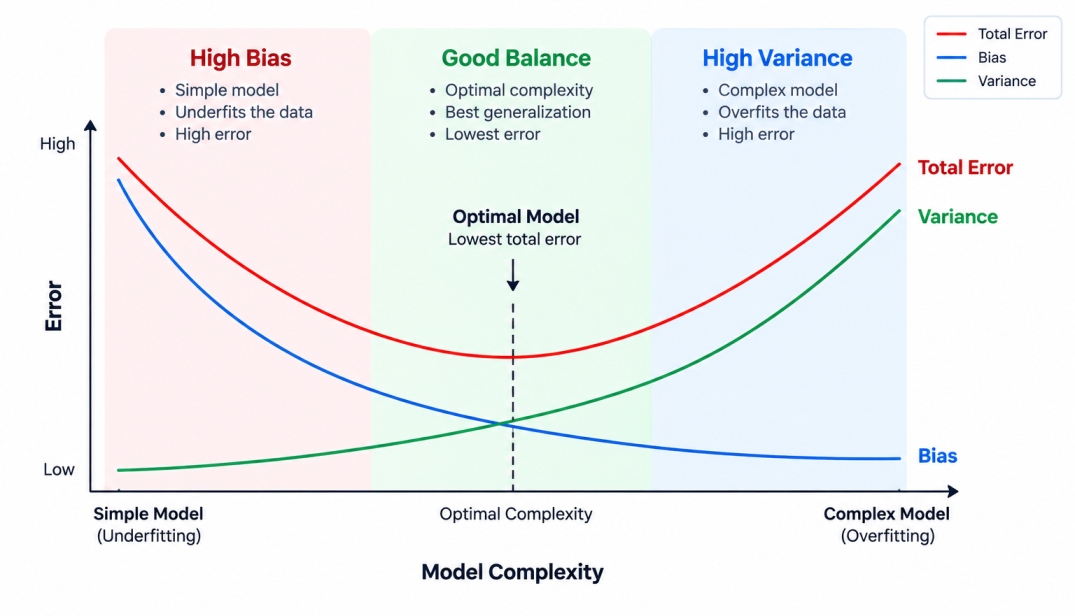
Let’s understand this through a bias variance tradeoff diagram​ below:

Bias-variance tradeoff graph showing high bias, optimal model complexity, and high variance as model complexity increases.Bias-variance tradeoff graph showing high bias, optimal model complexity, and high variance as model complexity increases.

Every model's total prediction error can be divided into three parts: bias, variance, and irreducible noise inherent in the data itself. Bias variance tradeoff formula is: 

Total Error = Bias^2 + Variance + Irreducible Error

Now let’s explore bias and variance in detail to understand the bias variance tradeoff in machine learning clearly.

Also Read: Overfitting vs Underfitting in Machine Learning

Understanding Bias in Machine Learning

Bias in bias and variance tradeoff​ refers to the error which is introduced when a machine learning model makes assumptions which are too simple to represent the underlying relationship in the data.

A high bias model makes similar errors across different training datasets because it does not have enough flexibility to capture important patterns.

For example, suppose the relationship between two variables is curved, but you use a simple linear model to represent it. The model may fail to capture the curve, resulting in high bias.

Common signs of high bias include:

  • Poor performance on training data

  • Poor performance on test data

  • Oversimplified model

  • Important patterns are missed

  • Underfitting

Understanding Variance in Machine Learning

Variance in bias variance tradeoff​ in machine learning refers to how much a model's predictions change when it is trained on different datasets.

A high variance model is highly sensitive to the specific observations in its training data. It may learn noise and small fluctuations instead of only learning the underlying pattern.

For example, a highly complex decision tree may fit almost every training observation perfectly but perform poorly on new observations.

Common signs of high variance include:

  • Very good training performance

  • Poor test or validation performance

  • Model is highly sensitive to training data

  • Noise may be learned as a pattern

  • Overfitting

Now let's explore the key differences between bias and variance to understand how they affect model behaviour.

Also Read: Classification vs Regression in Machine Learning

Bias vs Variance: Key Differences

The key difference between bias variance tradeoff machine learning​ is given below:

Factor

Bias

Variance

Meaning

Error from overly simple assumptions

Error from sensitivity to training data

Model complexity

Usually associated with simpler models

Usually associated with more complex models

Training error

Often high

Usually low

Test error

Often high

Can be high

Main problem

Underfitting

Overfitting

Sensitivity to training data

Low

High

Example

Linear model for a complex relationship

Very deep decision tree

A useful way to remember the difference between bias and variance tradeoff​ is: 

  • High Bias: Model is too simple (Underfitting)

  • High Variance: Model is too complex (Overfitting)

Now let's explore how model complexity affects bias variance tradeoff​ in machine learning and why finding the right level of complexity matters. 

Also Read: Supervised vs Unsupervised Learning: Differences, Examples, and Applications

Bias Variance Tradeoff and Model Complexity

A very simple model may not capture enough information from the dataset. This results in high bias and underfitting. 

As model complexity increases, the model generally becomes more flexible. A very simple model may not capture enough information from the dataset. This results in high bias and underfitting.

The general relationship of  can be represented as:

  • Low Complexity: High Bias + Low Variance

  • Balanced Complexity: Lower Generalization Error

  • High Complexity: Low Bias + High Variance

Underfitting and High Bias

As model complexity decreases, a model has less capacity to represent the true underlying relationship in the data, which pushes bias upward. This is underfitting: the model is too rigid to capture genuine structure, and that rigidity produces poor performance everywhere, on training data as well as new data. 

For example, using a linear model for data with a highly complex nonlinear relationship may result in underfitting.

The model generally has:

  • High bias

  • Low variance

  • High training error

  • High test error

Also Read: Gradient Boosting Algorithm in Machine Learning: How It Works, and Practical Examples

Overfitting and High Variance

As model complexity increases, a model gains the flexibility to fit increasingly intricate patterns, including noise that has no real predictive value. This is overfitting: the model becomes so tailored to its specific training set that it stops generalizing well to anything else, which pushes bias variance tradeoff​ upward. 

A highly complex decision tree is one possible example.

The model generally has:

  • Low bias

  • High variance

  • Very low training error

  • Higher test error

Good Fit

A model with an appropriate level of complexity captures important patterns without fitting unnecessary noise. In this situation, the model can perform well on both training and unseen data.

The objective is therefore to find a model that balances bias and variance rather than simply choosing the most complex or simplest model.

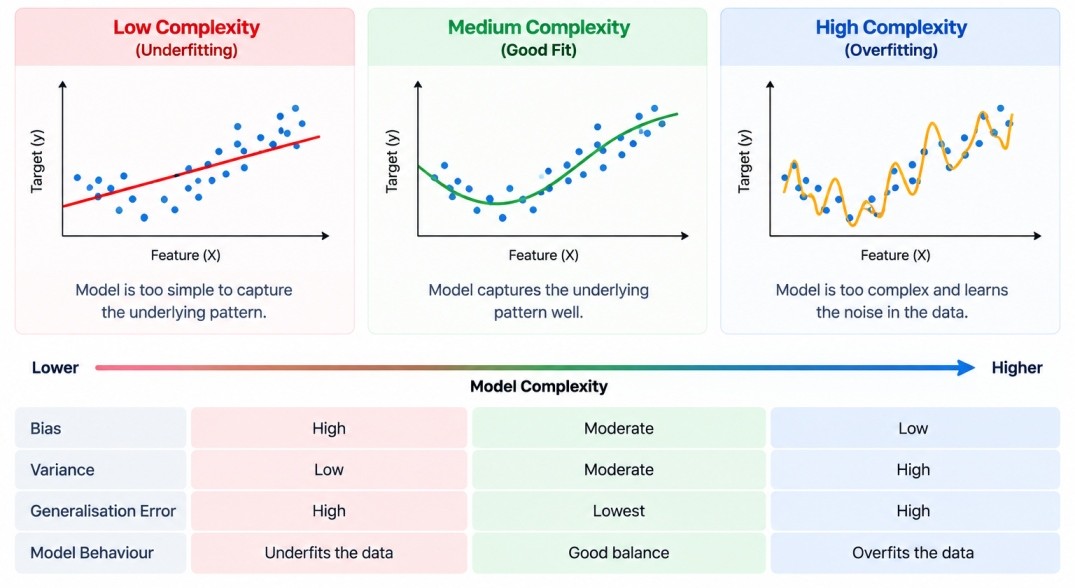
Model Complexity Curve

The bias variance tradeoff machine learning​ can be visualised using model complexity and prediction error. The bias variance tradeoff diagram​ for model complexity curve is:

Infographic comparing four ensemble learning methods: bagging trains models on random data subsets and averages predictions, boosting trains models sequentially to correct errors, stacking uses a meta-model to combine base model predictions, and voting coInfographic comparing four ensemble learning methods: bagging trains models on random data subsets and averages predictions, boosting trains models sequentially to correct errors, stacking uses a meta-model to combine base model predictions, and voting co

As complexity increases:

  1. Bias generally decreases.

  2. Variance generally increases.

  3. Total generalization error may first decrease.

  4. After reaching a suitable complexity level, generalization error may increase because of overfitting.

How to Choose Suitable Complexity?

You can use techniques such as cross-validation to compare models with different complexity levels.

For example, you can:

  • Train models with different complexity settings.

  • Measure their validation performance.

  • Compare training and validation errors.

  • Look for signs of underfitting or overfitting.

  • Select a model that performs well on unseen validation data.

Also Read: K Means Clustering in Machine Learning: Algorithm, Steps, Examples, and Applications

Now let's explore a simple bias variance tradeoff example to understand how high bias, high variance, and a balanced model can affect prediction performance. 

Bias Variance Tradeoff Example

Suppose you want to build a machine learning model that predicts house prices using factors such as area, number of bedrooms, location, and age of the house.

High-Bias Model

Imagine you use only the house area to predict its price.

  • The model is too simple.

  • It ignores important factors such as location and number of bedrooms.

  • It makes large errors on both training and new data.

  • This is high bias and underfitting.

High-Variance Model

Now imagine a very complex model that learns every small detail from the training houses.

For example, it may learn that a particular house sold for a certain price because of a specific street, seller, or unusual feature.

  • Training error becomes very low.

  • The model performs poorly on new houses.

  • It has learned noise and specific details from the training data.

  • This is high variance and overfitting.

Also Read: Clustering in Machine Learning: Types, Algorithms, Examples, and How It Works

Balanced Model

Now consider a model that uses important factors such as:

  • House area

  • Location

  • Number of bedrooms

  • House age

  • Nearby facilities

It learns the general relationship between these factors and house prices without memorising individual houses.

  • Training error is reasonably low.

  • Test error is also low.

  • It performs well on new houses.

  • It provides a better bias-variance balance.

Simple Comparison

Model

Example

Result

High Bias

Uses only house area

Underfitting

Balanced

Uses key factors

Good generalization

High Variance

Memorises individual house details

Overfitting

The key idea is that a good model should learn the important patterns in house prices without being too simple or memorizing the training data.

Also Read: Reinforcement Learning (RL) in Machine Learning: How It Works, Algorithms and Types

Now let's explore how the bias variance tradeoff can appear across different machine learning algorithms.

Bias Variance Tradeoff in Different Machine Learning Models

Different machine learning models have different levels of complexity. This affects how they handle bias variance tradeoff machine learning​. Let’s see how the tradeoff works across some common models. 

1. Linear Regression

Linear regression is relatively simple and can have high bias when the underlying relationship is strongly nonlinear.

Adding relevant features or using suitable transformations can increase model flexibility, but excessive complexity can introduce variance.

2. Decision Trees

Decision trees can demonstrate the bias variance tradeoff​ in machine learning clearly. A shallow tree may be too simple and underfit the data. Increasing the tree depth makes it more flexible, but a very deep tree may fit training data too closely and overfit.

Techniques such as limiting tree depth and pruning can help control complexity.

3. Random Forests

Random forests combine multiple decision trees and use techniques such as bootstrap sampling and random feature selection.

By combining multiple trees, random forests can reduce the variance associated with individual decision trees.

4. KNN

The value of K in K-Nearest Neighbors affects the model's complexity.

A very small K can make the model sensitive to individual training observations, increasing variance. A very large K can make the model too smooth and increase bias.

5. SVM

The bias and variance tradeoff​ behaviour of a Support Vector Machine depends on factors such as the kernel and hyperparameters.

A model with insufficient flexibility may underfit, while excessive flexibility can increase the risk of overfitting.

6. Neural Networks

Neural networks can model highly complex relationships and therefore have the capacity to achieve low bias. However, with insufficient data, excessive parameters, or inadequate regularization, they can also have high variance and overfit.

Also Read: Logistic Regression in Machine Learning: Algorithm, Types, Examples, and Applications

Now let's understand the techniques you can use to manage high bias and high variance in machine learning models. 

How to Reduce Bias and Variance in Machine Learning

When a model is too simple and underfits the data, you can use these techniques to reduce bias and variance:

Techniques to Reduce High Bias

If a model has high bias, you can consider:

  • Using a more complex model

  • Adding relevant features

  • Reducing excessive regularization

  • Training the model for longer when applicable

  • Using nonlinear features or transformations

  • Reducing overly restrictive model assumptions

Techniques to Reduce High Variance

If a model has high variance, you can consider:

  • Using a simpler model

  • Adding more training data

  • Applying regularization

  • Reducing the number of features when appropriate

  • Using cross-validation

  • Applying early stopping where applicable

  • Pruning decision trees

  • Using ensemble methods such as bagging

Conclusion

Now you have a good idea of the bias variance tradeoff in machine learning, you can see how model complexity affects a machine learning model's ability to learn patterns and generalize to unseen data. High bias can lead to underfitting, while high variance can lead to overfitting.

Understanding the bias variance tradeoff machine learning​ relationship, model complexity, examples, and techniques to reduce them can help you build models with better generalization and choose suitable approaches for different machine learning problems.



Frequently Asked Questions

General

Ready to Take the Next Step? Enroll Today!

Ready to Take the Next Step? Enroll Today!

© Copyright 2026 of IITKGP | All Rights Reserved Privacy Policy