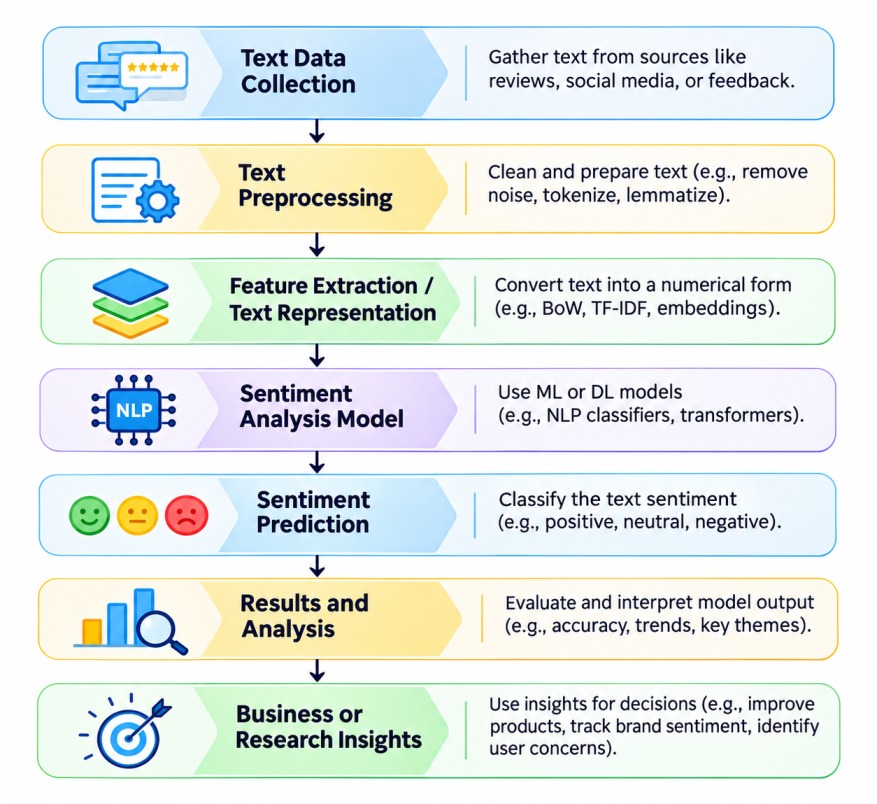
Step 1: Collect Text Data
In this step, one has to collect the text that needs to be analyzed. The data can be collected through customer reviews, survey forms, social networking sites, surveys, emails, and customer support sessions.
For example, a e-commerce company can use customer reviews, and there may be 10,000 reviews to analyze the views on the quality of products, prices, shipping time, and customer service.
Step 2: Preprocess the Text
The data collected will mostly have errors in terms of spelling mistakes, unnecessary characters like URL, HTML tags, and many other things like irrelevant word forms. Preprocessing cleans and prepares the text for analysis.
Preprocessing operations usually include:
Deleting unnecessary words, HTML tags, and unnecessary characters.
Breaking down the text into words or subword.
Normalizing the text to ensure consistency in the word form.
Dealing with emojis, Hashtags, and abbreviation.
Preserving words like "not", "never", that change the context of the whole sentence.
For example, if we look at the sentence, "The product is quite good," and remove the word "NOT" in the phrase "the product is NOT good!" completely changing the meaning of whole sentence.
Step 3: Extract Features or Generate Text Representations
The sentiment analysis model will require a numerical input and the system will perform this translation from text to a numerical format that sentiment analysis model can interpret.
Conventional machine learning models usually utilize methods such as Bag of Words (BoW) for text preprocessing or the Term Frequency-Inverse Document Frequency (TF-IDF) as text vectorization method to represent the documents.
Deep Learning and Transformer models use word embeddings and context-based representations to model the semantics of words in the sentence.
Step 4: Implement a Sentiment Analysis Model
Finally, the implemented model will be a mechanism that can accept a text representation and output its corresponding sentiment.
A plain sentiment analyzer may just split a text into one of three sentiment types:
Positive: This category indicates texts with happy mood, thankfulness, etc.
Negative: This category indicates the texts are expressing discontent, criticism, or disapproval, in general.
Neutral: This category describes an objective report. It does not include a negative or a positive view.
Step 5: Generate and Interpret the Results
An output in the form of the sentiment classification is generated. Businesses can analyze the results to know about the customers’ sentiments and identify the common trends.
For example, let us assume that online retailer analyzes 1,000 customer reviews. The model classifies the following reviews:
620 reviews as positive.
250 reviews as negative.
130 reviews as neutral.
Thus, out of the total analyzed reviews, 62 percent are positive and 25 percent are negative.
The retailer can perform further analysis of negative reviews and find the recurring issues related to delivery and product quality.
Now let’s explore the different types of NLP sentiment analysis which can be classified based on the level of detail and information a system need to identify.
Types of Sentiment Analysis
Three commonly used approaches are fine grained sentiment analysis, emotion detection, and aspect-based sentiment analysis. Let’s understand each of them below:
1. Fine Grained Sentiment Analysis
Fine grained sentiment analysis classifies text into more detailed sentiment categories than simply positive, negative, or neutral.
For example, a system may use a five-level scale:
Sentiment Category | Meaning | Example |
Very Positive | Strong satisfaction or praise | "This is the best product I have ever used!" |
Positive | General satisfaction | "The product works well." |
Neutral | No clear positive or negative opinion | "The product arrived yesterday." |
Negative | General dissatisfaction | "The product is difficult to use." |
Very Negative | Strong dissatisfaction | "This is a terrible product. I regret buying it." |
2. Emotion Detection
Emotion detection identifies specific emotions expressed in text rather than only classifying overall sentiment.
Depending on the model, it may detect emotions such as:
Happiness
Sadness
Anger
Fear
Surprise
Disgust
For example, the statement "I am extremely disappointed with the service" may be classified as sadness or anger, depending on the model's emotion categories.
3. Aspect-Based Sentiment Analysis
Aspect-based sentiment analysis (ABSA) identifies sentiment towards specific features, attributes, or aspects mentioned in a text.
Consider this review:
"The laptop has a great display, but its battery backup is disappointing."
An aspect-based system can produce the following results:
Aspect | Sentiment | Opinion |
Display | Positive | Great |
Battery backup | Negative | Disappointing |
Other Ways to Classify Sentiment Analysis
Sentiment analysis can also be grouped by the amount of text being analysed.
Level | What It Analyses | Example |
Document-level | Overall sentiment of an entire document or review | Classifying a complete product review as positive |
Sentence-level | Sentiment expressed in an individual sentence | Identifying a negative opinion in one sentence |
Aspect-level | Sentiment towards a particular feature or entity | Analysing opinions about a phone's camera |
Now let’s understand some sentiment analysis techniques and methods which are used to identify the opinions in a text.
Sentiment Analysis Techniques and Approaches
The main approaches include rule-based methods, traditional machine learning, deep learning, and Transformer-based models.
1. Lexicon-Based and Rule-Based Approach
The method mainly uses a dictionary of words that have been annotated with sentiment scores or labels.
In this approach, each word is assigned a specific polarity or a sentiment score. By using this information, the overall sentiment of a sentence or document is a rough estimate.
For example:
Word | Possible Sentiment |
Excellent | Positive |
Happy | Positive |
Disappointing | Negative |
Terrible | Negative |
Average | Neutral |
Negation, punctuation, and word stress are considered by some rule-based systems.
For example, "The service is not good" and "The service is good" should not have the same sentiment. A system that simply uses positive and negative word counts will be too simple-minded to detect such a contrast.
2. Traditional Machine Learning Approach
An ML model based on a traditional learning method acquires the ability to detect sentiments by being fed a dataset. This method enables sentiment class features to be learned.
A traditional process involves text preprocessing, feature extraction, model training, and prediction.
Some well-known methods are:
3. Deep Learning Approach
To get more insights using deep learning methods it is important not only to train the computer on large amounts of texts but also how to represent them as numbers (features).
Besides these, other deep learning structures are worth mentioning :
Recurrent Neural Networks (RNNs) have memory and can process input in sequence so that each element of the input refers to the previous one. Such models are very helpful for sentence-level sentiment classification.
Long Short-Term Memory (LSTM) is the variation of the recurrent neural network that learns how to store useful information in the time series of input tokens and outputs tokens by manipulating memory cells and gates.
Convolutional Neural Networks (CNNs) are kinds of neural networks that apply convolution filters on text samples so that they can detect small segments (such as words) that are most important, e.g., frequent word sequences.
4. Transformer-Based Approach
One of the major innovations in natural language processing is transformers and their attention mechanisms that provide the models with the capability to understand the relationship between the text tokens.
Models such as BERT, RoBERTa, and DistilBERT can be fine-tuned for sentiment classification.
For example, the word "cold" can express a temperature or describe someone's behaviour. A Transformer model can use surrounding words to interpret the intended meaning.
Popular Sentiment Analysis Tools & Models
A sentiment analysis model predicts sentiment categories or scores from text. A sentiment analysis tool provides a way to apply these models through a library, API, platform, or application.
Some commonly used options include:
Model or Tool | Approach | Common Use |
VADER | Lexicon and rule-based | Sentiment analysis of social media and short text |
TextBlob | Rule and lexicon-based features | Basic sentiment polarity and subjectivity analysis |
Naive Bayes | Machine learning | Classifying reviews, comments, and messages |
Support Vector Machine | Machine learning | Text classification using features such as TF-IDF |
LSTM | Deep learning | Learning sentiment patterns across sequences |
BERT | Transformer-based | Contextual sentiment classification |
RoBERTa | Transformer-based | Fine-tuned text and sentiment classification |
DistilBERT | Smaller Transformer model | Sentiment classification with a reduced model size |
Now let’s take a look that how you can implement sentiment analysis practically using Python.
How to Perform Sentiment Analysis in Python
Python provides several libraries for sentiment analysis, including NLTK, TextBlob, scikit-learn, and Hugging Face Transformers.
For a basic Sentiment Analysis Python example, you can use VADER, a lexicon and rule-based sentiment analysis tool available through NLTK.
Step 1: Install and Import NLTK
Install NLTK using pip:
pip install nltk
Import the sentiment analyser and download its lexicon:
import nltk
nltk.download('vader_lexicon')
from nltk.sentiment import SentimentIntensityAnalyzer
analyzer = SentimentIntensityAnalyzer()
Step 2: Prepare the Text
Create a sample customer review for analysis:
text = "The product works really well. The delivery was quick!"
You can use the same approach to process product reviews, social media comments, or customer feedback.
Step 3: Calculate Sentiment Scores
Use VADER's polarity_scores() method to calculate the sentiment scores:
scores = analyzer.polarity_scores(text)
print(scores)
Output:
{
'neg': 0.0,
'neu': 0.509,
'pos': 0.491,
'compound': 0.699
}
The output contains four values:
pos: Proportion of positive sentiment.
neg: Proportion of negative sentiment.
neu: Proportion of neutral sentiment.
compound: Normalised overall sentiment score ranging from -1 to +1.
The compound score provides a single measure of the overall sentiment intensity.
Step 4: Classify the Sentiment
You can use the compound score to assign a sentiment label. The following example uses commonly applied VADER thresholds:
compound = scores['compound']
if compound >= 0.05:
sentiment = "Positive"
elif compound <= -0.05:
sentiment = "Negative"
else:
sentiment = "Neutral"
print("Sentiment:", sentiment)
Output:
Sentiment: Positive
The positive compound score indicates that the review expresses positive sentiment.
These thresholds provide a starting point. For a specific dataset, test and adjust the decision boundaries based on labelled examples and the cost of different classification errors.
Step 5: Analyse Multiple Reviews
You can extend the example to analyse several customer reviews:
reviews = [
"The product quality is excellent.",
"The delivery was very late.",
"The product arrived yesterday.",
"The camera is good, but the battery is poor."
]
for review in reviews:
scores = analyzer.polarity_scores(review)
if scores['compound'] >= 0.05:
sentiment = "Positive"
elif scores['compound'] <= -0.05:
sentiment = "Negative"
else:
sentiment = "Neutral"
print(review)
print("Sentiment:", sentiment)
print("Scores:", scores)
print()
Sample Output:
The product quality is excellent.
Sentiment: Positive
The delivery was very late.
Sentiment: Negative
The product arrived yesterday.
Sentiment: Neutral
The camera is good, but the battery is poor.
Sentiment: Negative
This approach provides a basic way to classify multiple reviews. For more complex applications, you can use a Transformer model or train a machine learning classifier on labelled data.
Using BERT for Sentiment Analysis in Python
You can also perform NLP sentiment analysis using a pretrained Transformer model through the Hugging Face Transformers library.
For example, the DistilBERT model fine-tuned on the Stanford Sentiment Treebank 2 (SST-2) dataset can classify text into positive and negative sentiment categories. Hugging Face provides a pipeline interface for running this type of model.
Install the library:
pip install transformers torch
Load the model and create a sentiment analysis pipeline:
from transformers import pipeline
classifier = pipeline(
"sentiment-analysis",
model="distilbert/distilbert-base-uncased-finetuned-sst-2-english"
)
text = "The product quality is excellent, and I am happy with the purchase."
result = classifier(text)
print(result)
Sample Output:
[
{
'label': 'POSITIVE',
'score': 0.9998
}
]
The output contains a sentiment label and a model score. This example uses a binary sentiment model, so it returns positive or negative rather than a separate neutral category.
Conclusion
Sentiment analysis helps convert unstructured text into useful information about opinions, attitudes, and emotions. It supports applications such as customer feedback analysis, brand monitoring, product research, and social media analysis.
The choice of sentiment analysis technique depends on the task and the complexity of the text. Rule-based methods such as VADER work well for basic analysis, while machine learning, deep learning, and Transformer models can handle more complex language patterns.