


IndiaIndian Nationals
1800 210 2020
ForiegnForeign Nationals
+918068792934
logologo
Home
About
Director's Message
Blogs
HomeAbout
Director's MessageBlogs
Limited Seats Available

Attention Mechanism in Deep Learning: Types, Working, and Examples

  1. Home
  2. Blog
  3. Attention Mechanism in Deep Learning: Types, Working, and Examples

By Rahul Singh

Updated on Oct 19, 2026

Share:

Quick Overview:

  • The attention mechanism in deep learning helps neural networks in concentrating on different portions of the input by giving different importance to different inputs.

  • Attention‍‍‍ uses Query (Q), Key (K), and Value (V) as its three main mechanisms. A model performs attention by comparing queries to keys to get attention scores, changing the scores into weighting factors and using softmax function.

  • Types of attention mechanisms include self-attention, cross-attention, scaled dot product attention, additive attention, causal attention, global attention, and local attention.

  • In this blog you will learn about attention mechanisms along with how it works, its types, applications and limitations.

Understanding attention mechanisms is an important step towards learning how deep learning models process information and power modern AI applications. The Executive Post Graduate Certificate in Applied AI & Machine Learning from IIT Kharagpur helps you build practical knowledge of AI, machine learning, and deep learning techniques to solve real-world problems.

What Is Attention Mechanism in Deep Learning?

The attention mechanism in deep learning helps the neural network to focus on most relevant parts of the input while making predictions and generation outputs. Rather than treating every input equally, the mechanism helps the model to assign different levels of importance to different part of the input data.

For example in this sentence, “The animal did not cross the road because it was day time.” Attention helps a LLM to understand that “it” refers to “the animal” by understanding relationships between the words.

In 2014, while researching machine translation, the attention got popular and in 2017, researchers introduced the transformer architecture in their research paper “Attention Is All You Need”.

Why Is Attention Important in Deep Learning?

For handling relationships between different sections of an input in a deep learning model, attention mechanism helps a lot. 

Some benefits of deep learning mechanism in deep learning are:

  • Focus on only important information: It helps the model to give higher weights to useful input elements.

  • Capture long range relationships: Attention can connect items that are distant from each other in a sequence.

  • Improve contextual understanding: Attention mechanism helps in interpreting a word or element based on the information of other elements.

  • Support parallel processing: The Transformer model, which uses self-attention, is capable of parallel processing of the input elements during training, which is different from conventional recurrent models that process elements sequentially.

  • Work across data types: Attention can be incorporated into networks that process various data types, including text, images, video, audio, or a mix of these.

It is also important to note that the model will not more accurately work just because of the attention mechanism in AI, it also depends on architecture, training data, task, RAG and implementation.

Now let’s explore some of the most important components of attention mechanism in Transformers.

Query, Key, and Value in Attention

Queries, keys, and values are represented as Q, K, and V. Each of them have a different purpose in calculating how information should be combined.

Let’s understand each of them:

Component

Meaning

Role in Attention

Query (Q)

Represents what the current input position is looking for

Helps identify relevant information

Key (K)

Represents the information available at each input position

Helps determine how relevant each position is to a query

Value (V)

Represents the information that can be passed forward

Supplies the content used to calculate the attention output


The process is as follows:

  1. The model creates a query for the current position

  2. It compares it to the keys of all other positions, calculating the attention scores

  3. The scores are converted to attention weights (typically using a softmax operation)

  4. Finally, it calculates a weighted sum of the corresponding value vectors, using those weights

For example, the query for one word can be compared with the keys of all other words when dealing with a sentence containing multiple words. The resulting weights represent how much information to take when performing the weighted sum of the values.

Also Read: What Are Foundation Models? Types, Training, Examples & Uses

How Does an Attention Mechanism Work?

Let’s understand the working of attention mechanism in deep learning using the example sentence we discussed above.

“The animal was tired, so it rested.”

When the model analyzes this sentence, it can use the attention mechanism to connect the pronoun “it” with the subject “the animal.” Let’s take a look at how this process works.
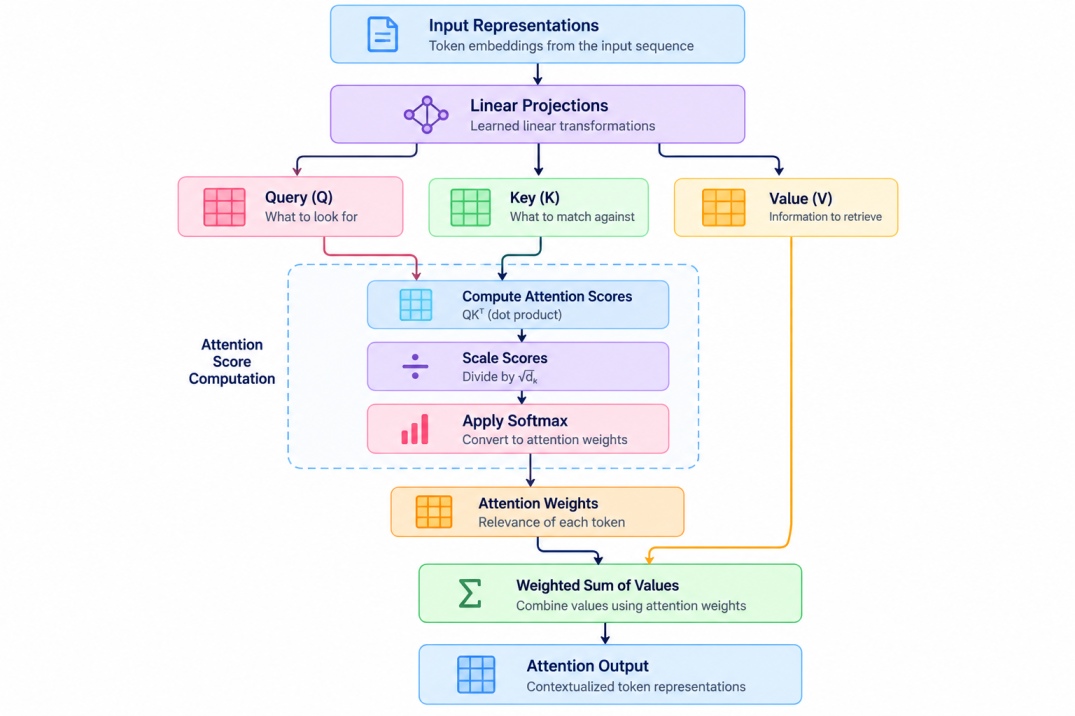
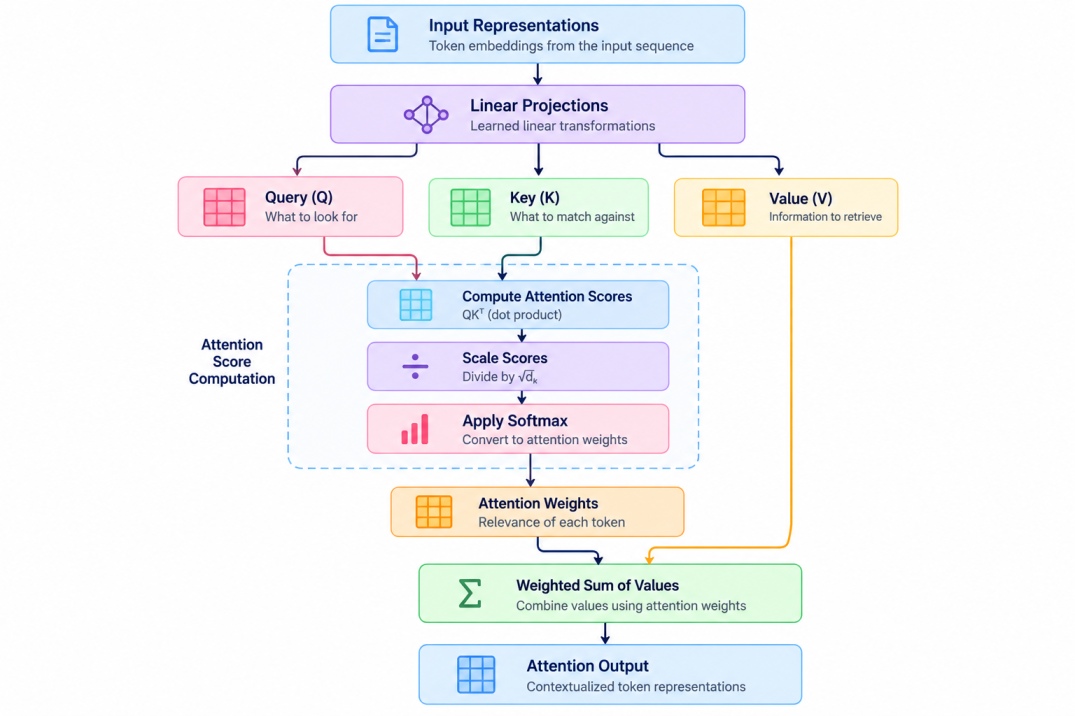
Flowchart illustrating scaled dot-product attention in a Transformer. Input token embeddings pass through linear projections to generate Query (Q), Key (K), and Value (V). The query and key are multiplied to compute attention scores, which are scaled by tFlowchart illustrating scaled dot-product attention in a Transformer. Input token embeddings pass through linear projections to generate Query (Q), Key (K), and Value (V). The query and key are multiplied to compute attention scores, which are scaled by t

Step 1: Convert Input into Numerical Representations

First, the model convert each word or token into a numerical form called an embedding. These numbers help the model process words and their relationships.

For example, the sentence “The animal was tired, so it rested” is broken into tokens. Each token receive an embedding and the model can add positional information to represent word order.

Step 2: Create Queries, Keys, and Values

The model transforms these embeddings into three vectors: Query (Q), Key (K), and Value (V).

Think of them this way:

  • Query: What information is this token looking for?

  • Key: What information can this token match with?

  • Value: What information can this token contribute?

For example, when processing “rested,” the model can compare its query with the keys of other tokens, such as “animal,” “tired,” and “it,” to identify relevant information.

Step 3: Calculate Attention Scores

The model compare the query with the keys to calculate attention scores. A higher score means a token has a stronger match with the query within the model's learned relationships.

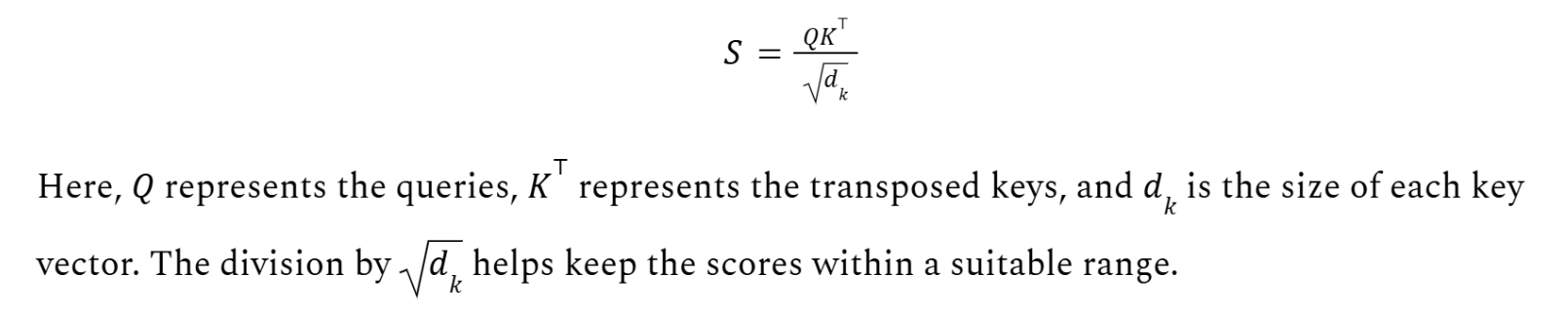
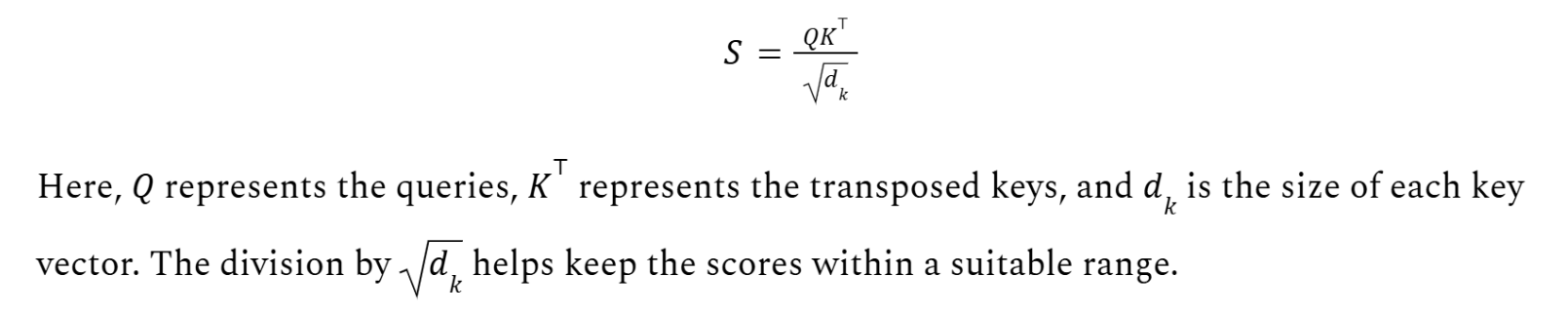
The standard scaled dot-product attention formula is:


standard scaled dot-product attention formulastandard scaled dot-product attention formula

For our example, the model may assign higher scores to words related to the action “rested,” such as “animal” and “tired.” These scores are illustrative, not actual values from a trained model.

Step 4: Convert Scores into Attention Weights

The model applies the softmax function to convert the scores into attention weights. These weights usually range from 0 to 1 and add up to 1 across the positions being considered.

For example, imagine the model produces these attention weights while processing the sentence:

Token

Illustrative attention weight

Animal

0.40

Tired

0.30

It

0.20

Other tokens combined

0.10

Total

1.00

In this example, “animal” receives the highest weight. This means its information contributes more to the attention output than the information from the other listed tokens.

Step 5: Combine the Values to Create the Output

The model multiplies each value vector by its attention weight and combines the results.

The final attention formula is:

final attention formulafinal attention formula

In our example, the resulting representation can include information from “animal,” “tired,” and “it,” weighted according to their relevance.

The model uses this representation in further processing to build a context-aware understanding of the sentence. This helps it identify relationships between words rather than processing each word in isolation.

Now as you have a good understanding of attention mechanism in deep learning, now let’s explore what are different types of attention mechanism based on task and model architecture.

Types of Attention Mechanisms in Deep Learning

There are different types of attention mechanism including Self-attention, Cross-attention, Global attention, etc. Let’s explore each of them in detail below:

Type

How It Works

Common Use

Self-attention

Calculates relationships between positions within the same sequence or input representation

Language understanding and text generation

Cross-attention

Uses queries from one representation and keys and values from another

Machine translation, text-to-image models, multimodal AI

Scaled dot-product attention

Calculates query-key dot products and scales them before applying softmax

Transformer architectures

Additive attention

Uses a learned scoring function to estimate compatibility between queries and keys

Sequence-to-sequence models

Causal or masked attention

Prevents a position from attending to future positions in an ordered sequence

Autoregressive language models

Global attention

Allows a query to attend to all permitted positions in the input

Full-context sequence processing

Local attention

Restricts attention to a nearby region or window

Long-sequence processing and some vision models

Hard attention

Selects particular input regions or positions rather than computing a fully weighted combination of all candidates

Tasks that use discrete selection or sampling


The important thing here is that these categories can also overlap. For example, self-attention can use scaled dot-product calculations and a causal mask at the same time.

Multi-Head Attention Explained

Multi-head attention is an extension of the attention mechanism that allows a model to learn different relationships from the same input.

Instead of calculating attention once, the model runs multiple attention operations, called heads, using different learned projections of the queries, keys, and values. It then combines the results.

Each head can learn different patterns. For example, in a language task, different heads may focus on grammatical relationships, nearby words, or connections between words that are far apart. These roles are learned during training and are not assigned manually.

How Multi-Head Attention Works

The process generally follows these steps:

  1. Create projections: The input representations are transformed into separate query, key, and value representations for each head.

  2. Calculate attention: Each head computes attention scores and combines value vectors independently.

  3. Concatenate outputs: The head outputs are joined together.

  4. Apply a final projection: A learned linear transformation combines the information from the different heads.

Self-Attention vs Multi-Head Attention

Basis

Self-Attention

Multi-Head Attention

Meaning

Relates positions within the same input representation

Runs multiple attention operations using different learned projections

Number of attention operations

One attention operation per layer, in its basic form

Multiple attention operations, one for each head

Relationships

Learns contextual relationships between input positions

Can learn different relationship patterns in parallel

Output

Produces a context-aware representation

Combines the outputs of multiple heads into a shared representation

Role in Transformers

A fundamental attention operation

A common way to strengthen the attention layer


Now let’s explore how the attention mechanism in deep learning is used in real world applications.

Applications of Attention Mechanisms

Attention mechanisms are used across several areas of deep learning including NLP, LLMs, Computer Vision, etc. Let’s explore each in detail below:

Application

How Attention Is Used

Example

Natural language processing

Helps models learn contextual relationships between tokens

Text summarization, sentiment analysis, question answering

Machine translation

Connects relevant source-language information with target-language generation

Translating English text into Hindi

Large language models

Helps model token relationships during training and text generation

(Gen AI) Chatbots, coding assistants, text generation

Computer vision

Helps models process image patches or focus on relevant visual features

Image classification and object detection

Speech recognition

Helps models relate audio features to speech or text representations

Converting spoken words into text

Text-to-image generation

Connects text instructions with visual representations

Generating an image from a written prompt

Video understanding

Helps models capture relationships between frames or video features

Video summarisation and action recognition

Time-series forecasting

Learns relationships between time steps or input features

Demand forecasting and sensor analysis

Healthcare AI

Helps models process relevant features from medical records or medical images

Clinical text analysis and medical image interpretation


Every technology comes with some pros and cons which attention mechanisms also have. So now let’s understand some of the limitations.

Limitations of Attention Mechanisms

Attention mechanisms can enable the model to incorporate contextual information; however, they can cause various technical and practical problems.

Some of the limitations with attention mechanisms are:

  • High Computational Cost: Fully self-attention involves computation that grows quadratically in the length of the sequence.

  • Expensive Memory Requirement: Attention scores and representation consume memory while handling long sequences. 

  • Latency Due to Long Sequences: Handling many tokens may lead to latency and resource consumption issues. 

  • Dependency on Data: Without appropriate training data, attention cannot perform well.

  • Lack of Explanation Ability: Attention gives a clue about the combination of information used by a model; however, it cannot reveal the reasoning process.

  • Position-specific Issues: Attention does not by itself carry the order of tokens.

  • Missed Context Possibility: The local or restricted attention mechanism might not associate the positions that lie beyond the permissible limit.

Conclusion

The attention mechanism has grown as one of the core concepts in modern-day deep learning, which helps models obtain the right data and contextual understanding. Although there are certain obstacles in the form of computing and memory problems, it still contributes to further progress in the field of AI, whether it is natural language processing or computer vision.

Rahul Singh

Rahul Singh

25+ of articles published


Current role in the industry :

Associate - Content Marketing

Education Qualification :

B.Tech in Computer Science & Engineering

Expertise :

Artificial intelligenceMachine Learning (ML)Data ScienceFull-Stack DevelopmentData Structures & Algorithms

Tools & Technologies :

PythonReact.js & Next.jsJavaScript (ES6+)SQLTailwind CSSNode.js & MongoDBGit & GitHubSEO Tools (SEMRush)Google Search ConsoleTableau / Power BIFigma

About

Rahul Singh is an Associate Content Writer, with a strong interest in Generative AI, Agentic AI and AI-Native Software Engineering. He combines technical development skills with data-driven strategies to build scalable applications and optimize digital content. Rahul specializes in simplifying complex concepts across AI, ML and software development into practical, easy-to-understand insights, helping learners understand how AI products, systems and services are built and applied. He focuses on real world applications and explains advanced topics in a clear, step by step manner so you can follow along without confusion. His work connects theory with hands-on examples, covering AI-assisted development, intelligent automation and AI integration in software applications. He aims to help you learn faster, create better projects, and apply your knowledge confidently in real scenarios.

Follow me on :

No blogs published yet.

Frequently Asked Questions

General

Ready to Take the Next Step? Enroll Today!

Ready to Take the Next Step? Enroll Today!

© Copyright 2026 of IITKGP | All Rights Reserved Privacy Policy