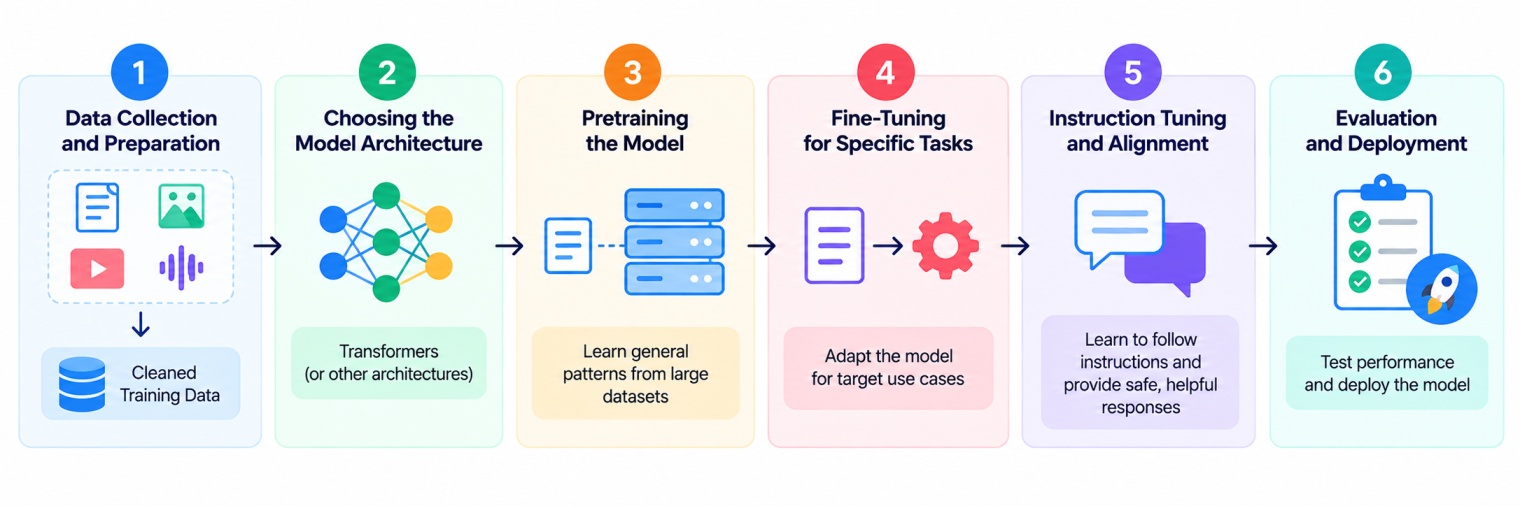
1. Data Collection and Preparation
A major task before any model training is to collect and prepare the data so that it's exactly what's needed for the training. While a language model would be fine with text or code, a multimodal one may require text with images, videos, and audios.
Then the developers clean data by removing duplicates, errors correction, and filtering unsuitable material.
For example, a DeepMind project called Chinchilla was training on 1.4 trillion tokens and this gives us a clue that data is one of the main factors determining the success of a large language model.
2. Choosing the Model Architecture
Then, the developers have to select one architecture based on the type of data and tasks that the model have to perform. They can use architecture such as:
Transformers: Commonly used for language processing and many multimodal tasks.
Diffusion models: Commonly used for image generation.
Other architectures: Used for specialized tasks involving particular data types.
Also Read: RAG Architecture Explained: Components, Workflow, Types & Python Implementation
3. Pretraining the Model
In the process of pretraining, the model is able to understand general patterns in a large dataset. Language models learn by predicting the next token or missing parts of the text.
For example, Google’s PaLM language model contained 540 billion parameters and was trained on 768 billion tokens using 6,144 TPU v4 chips.
4. Fine-Tuning for Specific Tasks
After the pretraining phase, the developers can also fine tune the model which adjusts the model parameters.
This is optional because developers can also use prompting or other methods to adapt a pretrained model.
5. Instruction Tuning and Alignment
Instruction tuning aims at the model to learn how to respond to the instructions that have been given to it. Alignment method can help the model to prefer certain responses and thus limit undesired ones.
Example: The model learns to respond to "Explain our refund policy" with a clear explanation instead of generating unrelated information.
6. Evaluation and Deployment
Before they come out with the actual product the developers check the model's abilities in different ways: correctness, logical abilities, safety, prejudices, bias and efficiency in the tasks it's supposed to handle.
Example: A customer support model can be tested on questions about refunds, delivery delays, product returns, and account issues.
Training large models also requires substantial resources. Stanford's 2025 AI Index Report estimated that the computing cost of training GPT-4 was around $79 million, based on cloud computing rental prices. This is an estimate, not the model's full development cost.
Also Read: What Is Semantic Search? How It Works, Benefits & Examples
Types of Foundation Models
There are different types of foundation models depending on the process and the task they support. Below are the common types of foundational models:
1. Language Foundation Models
Language foundation models learns from the patterns in text and code. A single model can support 3 tasks, such as summarising a report, answering questions, and translating text.
Example: You can upload a 20-page report and ask the model to summarise it in 5 key points.
2. Computer Vision Foundation Models
Computer vision models process the images and visual information. They can identify objects, classify images, and analyze the scenes.
Example: A retail application can use a vision model to identify 3 products in a photograph and separate them from the background.
3. Image Generation Models
Image generation models creates the images from text prompts and other inputs. You can describe a scene, specify its style, and generate visual options.
Example: A designer enter 1 prompt describing a modern electric car and generates 3 different design concepts.
4. Audio and Speech Foundation Models
Audio and speech models processes the spoken language and other audio signals. They are able to covert speech into text, translate the conversations, and generating the spoken responses.
Example: A 10-minute meeting recording can be converted into text and organized into 3 sections: key discussion points, decisions, and action items.
5. Video Foundation Models
Video foundation models are able to generate and analyze the moving visual content. They can create videos from text prompt or images.
Example: A marketer enters 1 prompt describing a new product and creates a short video with 3 scenes showing its design, features, and use.
6. Multimodal Foundation Models
Multimodal foundation models work with 2 or more types of data, including text, images, audio, and video. They can combine information from different inputs to answer questions or generate content.
Example: You upload 1 chart, ask 2 questions about its trends, and request a 3-point explanation in text. The model uses the visual information to prepare its response.
Now let’s explore some of the popular foundational models of the types we discussed above with their capabilities.
Also Read: Reranking in RAG: How It Works, Types, Models, and Tools
Popular Foundation Models and Their Capabilities
Several organizations have developed foundational models for different tasks. Some of the most popular models are:
Foundation model | Developer | Main capabilities | Common applications |
GPT family | OpenAI | Text generation, coding, reasoning, and capabilities that vary by model | AI assistants, content creation, coding, data analysis |
Gemini | Google | Multimodal understanding across supported text, image, audio, and video inputs | Document analysis, assistants, research, content processing |
Claude | Anthropic | Language understanding, writing, coding, and document analysis | Research assistance, software development, business workflows |
Llama | Meta | Language tasks, coding, and multimodal capabilities in supported variants | Chatbots, local AI applications, specialised assistants |
Gemma | Google | Text generation, reasoning, and multimodal capabilities in selected variants | Developer applications, local deployment, customised AI tools |
Imagen | Google | Text-to-image generation | Visual design, concept art, marketing assets |
Veo | Google | Video generation from supported prompts and inputs | Video production, creative workflows |
Stable Diffusion | Stability AI and its ecosystem | Image generation and customization | Digital art, design, image editing workflows |
Whisper | OpenAI | Speech recognition and transcription | Meeting transcripts, voice interfaces, audio processing |
There is a common confusion among the difference between foundation models vs LLM. So now let’s explore the key differences between both.
Foundation Models vs Large Language Models
Large language models are a subset of foundation models. They focus on language-related tasks, while the broader foundation model category also includes models built for vision, audio, image generation, video, and multimodal applications.
The key difference between these are:
Factor | Foundation Models | Large Language Models |
Definition | Broad category of pretrained AI models adaptable to different tasks | Models focused primarily on understanding and generating language |
Training data | May include text, images, audio, video, or combinations | Primarily text and code, with multimodal capabilities in some models |
Main capabilities | Depend on the model and its data modalities | Language generation, summarization, translation, coding, and question answering |
Types | Language, vision, image generation, audio, video, and multimodal models | General-purpose, specialised, and multimodal language models |
Typical output | May generate text, images, audio, video, or predictions | Commonly produces or interprets language and code |
Examples | Gemini, GPT, Imagen, Veo, Stable Diffusion | GPT, Claude, and language-focused variants of Llama and Gemma |
After exploring a lot about the foundational models in AI, let’s take a look at some of the real world applications of these models.
Applications of Foundation Models
Foundation models are used in wide range of applications such as customer support, healthcare, finance, etc.
Let’s explore each of the applications in detail:
Customer Support: Develop chatbots, assist customers with their questions or requests and summarize conversations.
Healthcare: Extract and summarize medical information, interpret and explain medical imaging supported with the foundation model.
Software Development: Write code, find and fix software bugs, write program manuals.
Education: Explain concepts, summarize lessons, and create practice questions.
Marketing and Media: Produce text, create pictures, and develop a wide variety of content creatively by the AI.
Finance: Examine a lot of different kinds of financial documents, for instance, the bank statements or budget plans, or summarize the financial reports.
Conclusion
As of now, it is clear to you that foundational models are a kind of reusable starting point for developing an AI application. They learn from the general patterns, from large datasets and can be adapted for language processing, computer vision, multimodal tasks etc.
Understanding how foundation models are trained and customised helps you to select an appropriate model for a particular application.