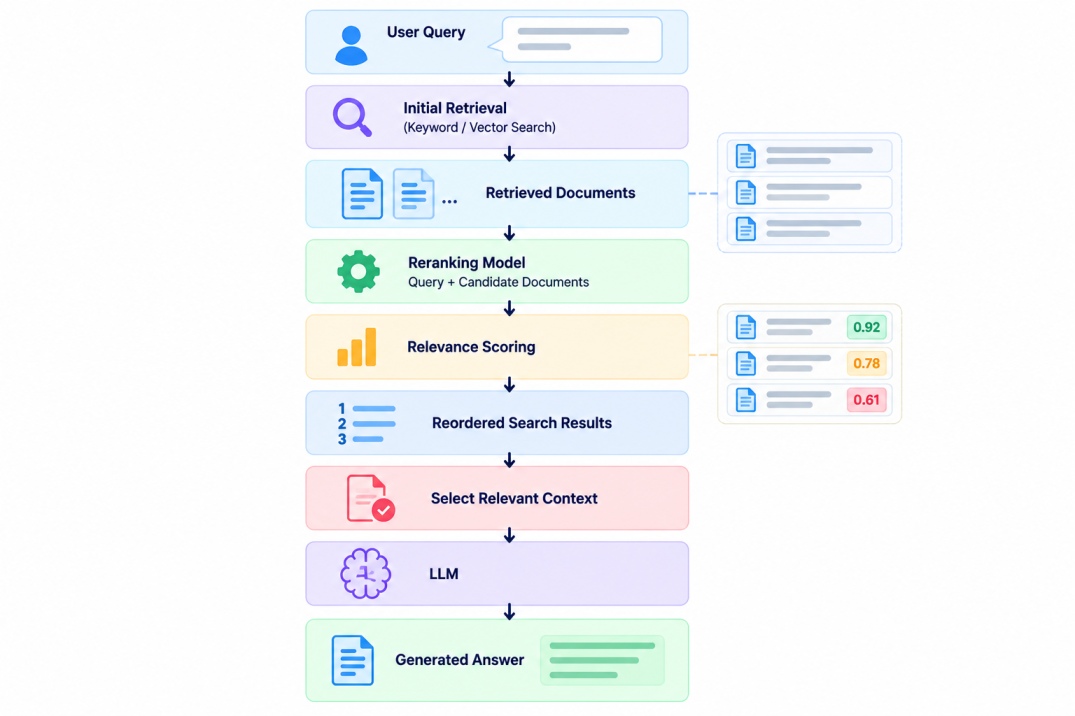
Let's understand each step through a reranking in RAG example.
Step 1: Receive the User's Query
Suppose a user asks: "How can I reset my company's login password?"
The RAG system receives the question and prepares it for retrieval.
Step 2: Retrieve Candidate Documents
The initial retriever searches the knowledge base using vector similarity, keyword matching, or a combination of methods.
It might return these five documents:
Initial rank | Retrieved document |
1 | General account security guidelines |
2 | How to register a new account |
3 | Employee login and access policy |
4 | Password reset instructions |
5 | How to change your profile details |
The documents are related to accounts, but they do not all answer the question equally well.
Step 3: Score the Documents
The reranking model is used to analyze the user’s query and each document separately. The cross-encoder works by analyzing the user’s query and the document at once and estimating their relationship.
This helps the model to analyze the factors that are not analyzed when ranking search results independently.
Also Read: Gradient Boosting Algorithm in Machine Learning: How It Works, and Practical Examples
Step 4: Reorder the Results
After scoring the documents, the reranker may produce a new order.
New rank | Retrieved document | Relevance to the query |
1 | Password reset instructions | Directly answers the question |
2 | Employee login and access policy | Provides related account information |
3 | General account security guidelines | Provides supporting information |
4 | How to register a new account | Related, but less relevant |
5 | How to change your profile details | Related, but less relevant |
Step 5: Pass the Best Results to the LLM
In the RAG pipeline, the most relevant pieces are chosen and included into the prompt.
The LLM can produce a response using the retrieved instructions rather than getting several documents that may not be fully related to the task.
Different Types of Reranking Methods in RAG
RAG systems use different reranking methods such as Cross-Encoder, LLM-Based, Pairwise etc. to improve the order of retrieved documents.
Let’s explore each of them in detail:
1. Cross-Encoder Reranking
A cross-encoder considers both the user query and the document. The relevance score is generated depending on whether the document fulfills the user’s query or not.
Example: For the query "How do I reset my password?", the model may give these scores:
Document | Relevance score |
Password reset guide | 0.95 |
Account security tips | 0.72 |
Profile settings guide | 0.35 |
The system ranks the password reset guide first because it has the highest score.
Also Read: Support Vector Machine (SVM) in Machine Learning: Algorithm, Types, Kernels, and Examples
2. LLM-Based Reranking
LLM-based reranking assesses the relevancy of the document. In this technique, the scores could be generated for documents, a pair comparison could be done, or the ranking could be established on the basis of relevancy.
Example: A legal research assistant retrieves 20 case summaries. The LLM reviews them and places the 5 most relevant summaries at the top.
3. Pointwise Reranking
In pointwise reranking, the document is individually assessed to assign the relevancy score. Then, the documents are ranked based on the relevancy score.
Example: A system evaluates 10 documents one by one. A password recovery guide gets a score of 0.92, while a profile settings guide gets 0.40.
The system ranks the first document higher.
4. Pairwise Reranking
Pairwise reranking includes comparing two documents at once and choosing the one that answers the query of the user.
Example: A system compares 2 articles about account access. If Article A is more relevant than Article B, it ranks Article A higher. It repeats this process with other pairs to create a ranked list.
Also Read: Decision Tree Algorithm in Machine Learning: How It Works, Types, and Examples
5. Listwise Reranking
Listwise re-ranking involves ranking a group of documents together based on their relevancy. This method takes into consideration more than one document simultaneously without considering each document individually.
Example: A system receives 10 retrieved documents and ranks them from position 1 to position 10. The most relevant document appears at position 1.
6. Late-Interaction Reranking
Late-interaction models compare individual query terms with document terms. This helps the system identify detailed matches that a single vector may miss.
ColBERT is a well-known example of this approach.
Example: A user searches for "Error 404 in Python API". The model checks how terms such as "404", "Python", and "API" match the content of each document.
Let’s explore the most popular reranking models and tools used in RAG pipelines.
Popular Reranking Models and Tools for RAG
Several models and frameworks such as Cohere Rerank, BGE Reranker, Qwen3-Reranker support reranking in RAG. Below are some of the most popular reranking in RAG models:
Popular Reranking Models
Model | Type / capability | Best suited for | Considerations |
Cohere Rerank | Hosted reranking API | Managed retrieval and production RAG | Requires API access and incurs usage costs |
BGE Reranker | Open-weight cross-encoder models | Local or self-hosted reranking | Requires suitable compute and licence review |
Jina Reranker | Hosted and local reranking options | Multilingual and specialised retrieval | Select the model based on task, licence, and deployment needs |
MS MARCO MiniLM Cross-Encoder | Compact cross-encoder | Lightweight reranking experiments | Balance speed against ranking quality |
Qwen3-Reranker | Open-weight reranking models | Local evaluation and multilingual retrieval | Check hardware and model requirements |
Tools for RAG Reranking
Tool | How it supports reranking |
LangChain | Integrates rerankers into retrieval workflows through document compressors and related components |
LlamaIndex | Uses node postprocessors to rerank retrieved passages before generating a response |
Sentence Transformers | Supports local cross-encoder models for relevance scoring |
Cohere API | Provides managed reranking of query-document candidates |
Jina AI | Provides hosted and model-based reranking options |
Hugging Face | Hosts models and supports local deployment of compatible rerankers |
Now you are at the point where reranking is clear to you, now let's know how to choose the right reranking model according to your choice.
Also Read: Logistic Regression in Machine Learning: Algorithm, Types, Examples, and Applications
How to Choose the Right Reranking Model
Choosing a reranking model involves more than comparing model names. Below are some factors on which you can compare the different models:
Selection factor | What to consider | Practical guidance |
Retrieval quality | How often the right answer appears near the top | Test models using real queries and relevant documents |
Latency | How quickly results need to return | Start with a small candidate set and measure response time |
Cost | API charges or local compute expenses | Compare cost per query at expected traffic levels |
Language support | Languages used in queries and documents | Test multilingual models if the knowledge base includes multiple languages |
Deployment | Hosted API or local infrastructure | Use hosted services for simpler setup or local models for greater deployment control |
Context length | Size of the query and candidate documents | Check model limits and whether long inputs are truncated or chunked |
Scalability | Number of queries and candidate passages | Evaluate throughput and concurrent request handling |
Integration | Compatibility with the existing RAG framework | Prefer supported integrations where possible |
Licensing and privacy | Model terms and data-handling requirements | Review usage licences, data retention, and organisational policies |
Conclusion
From the above you now know that Reranking in Retrieval Augmented Generation ensures that the order of retrieved documents becomes better. Through the analysis of the relevance between the query and document, the Reranker will ensure the retrieval of better context to be used in response generation by the LLM.
There are different cross-encoders, rerankers based on LLM, point-wise approach, list-wise approach, and late interaction approaches which have various strengths and weaknesses.