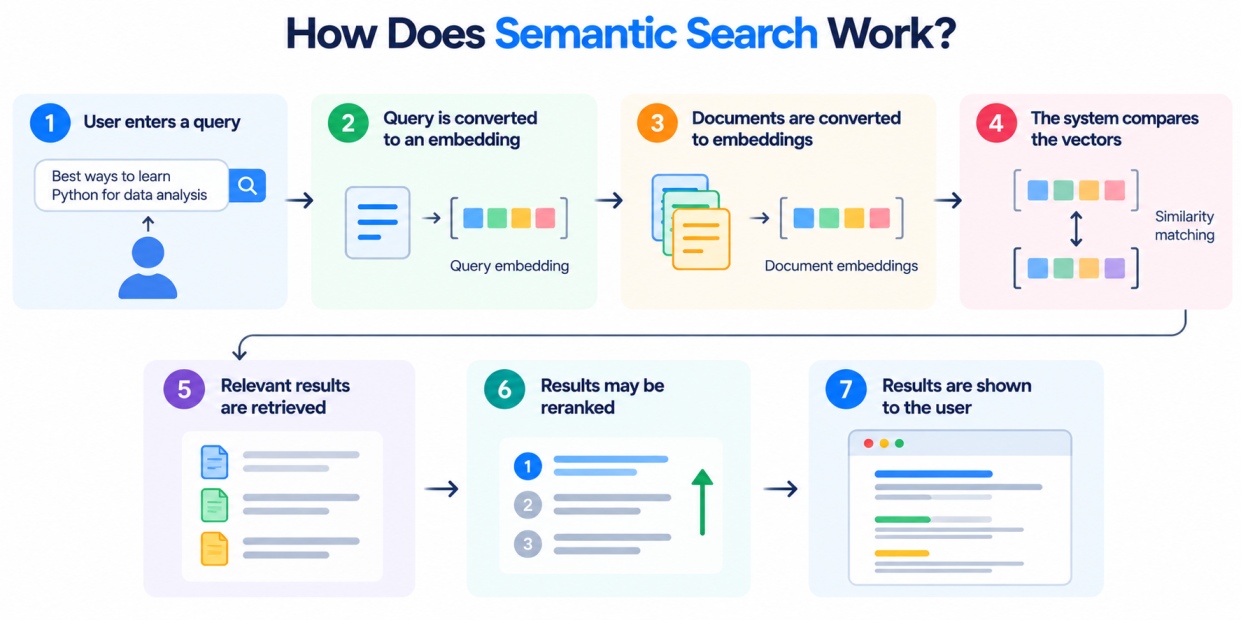
1. A user enters a query
When a search query is submitted by a user, the process begins.
For example: “Best ways to learn Python for data analysis”
After sending the query to the search system, the latter will do the pre-processing to make it ready for computation.
2. The query is converted into an embedding
A type of language model called the embedding generator takes the query text as input and creates an array of numbers that represents the meaning of the text.
The embedding of a word or phrase contains the semantic features of the word or phrase. Two meanings which are more alike will tend to generate vectors which are closer in the embedding layer.
Also Read: Logistic Regression in Machine Learning: Algorithm, Types, Examples, and Applications
3. Documents are converted into embeddings
The texts that have to be searched will also be converted into vector format.
In many cases, a knowledge base with tutorials, articles, product descriptions, or company documents will also have thousands to millions of embedded records.
4. The system compares the vectors
Following the translation of the query and the content into their vectors respectively, the matching of the query’s vectors with the ones in the database will take place.
The most relevant documents/text fragments related to the input query can be matched using techniques such as cosine similarity.
5. Relevant results are retrieved
The most closely matching documents or passages are displayed.
As an example, a query for "learn Python for data analysis" could result in returning content on Pandas, NumPy, data cleaning, and Python data analysis courses, even though their wordings are not exactly similar.
6. Results may be reranked
Post initial retrieval stage, some search platforms use a reranking algorithm.
Reranker examines all the results which have been recovered, and then ranks the most relevant ones highest in the overall results display.
7. Results are shown to the user
Presentation of end results depends on their relevance levels.
At times, when the information that users need is available through text retrieval engines, a language model can be supplied with that content to produce a natural language response based on the retrieved document.
Also Read: Decision Tree Algorithm in Machine Learning: How It Works, Types, and Examples
Key Technologies Powering Semantic Search
There are several technologies that work together to make semantic search possible which includes NLP, Vector Search, Reranking Models etc. Let’s explore each of these in detail:
1. Embeddings
Embeddings convert text into numerical vectors that capture meaning and relationships between pieces of content.
For example, “car”, “automobile”, and “vehicle” may have embeddings that are relatively close because their meanings are related.
2. Natural Language Processing
NLP assists in dealing with natural language for computers. Various operations like tokenization, text cleansing, language detection, and query understanding could be involved in the larger search process.
3. Vector Search
Vector search compares numerical representations to find similar content. It is one of the main technical methods used to build semantic search systems.
Also Read: Random Forest Algorithm in Machine Learning: Working, Types, Pseudocode
4. Vector Databases
Vector databases store embeddings and support similarity searches across large datasets.
They are commonly used when semantic retrieval needs to operate over large document collections.
5. Reranking Models
Initial vector retrieval may return several potentially relevant results. A reranking model can examine these results more closely and improve their order.
5. Hybrid Search
Hybrid search combines semantic retrieval with traditional keyword-based search.
This is useful when exact terms matter as well as meaning. For example, a product code, technical term, or person's name may require exact matching, while the rest of the query benefits from semantic understanding.
Also Read: Gradient Boosting Algorithm in Machine Learning: How It Works, and Practical Examples
Tools Used for Semantic Search
Different tools can be used depending on the size and complexity of the search application.
Tool or technology | Common use |
FAISS | Similarity search over vector embeddings |
Elasticsearch | Keyword, vector, and hybrid search |
OpenSearch | Search and vector retrieval |
Pinecone | Managed vector search |
Weaviate | Vector database and semantic retrieval |
Milvus | Large-scale vector search |
Chroma | Embedding storage and retrieval |
Qdrant | Vector similarity search |
Sentence Transformers | Generating sentence and document embeddings |
LangChain | Building retrieval and RAG workflows |
LlamaIndex | Connecting documents and data to AI retrieval systems |
Now let’s understand where is semantic search is used in real world.
Also Read: Support Vector Machine (SVM) in Machine Learning: Algorithm, Types, Kernels, and Examples
Applications of Semantic Search in Real-World
Semantic search is used in different sectors for different works such as e commerce, customer support etc. Let’s understand these use cases in detail:
1. E-commerce
Online stores can use semantic search to understand product intent.
A query such as “lightweight shoes for running” can return products described as “breathable”, “low-weight”, or “performance running footwear”.
2. Enterprise Search
Businesses often store their data in documents, wikis, emails, policies as well as internal systems. This information may be spread out.
One of the main advantages of using semantic search techniques is helping people locate important data even in case an employee's query word-by-word is not the same as an internal paper one would expect.
3. Customer Support
Support systems can match user questions with relevant knowledge-base articles.
For example, “my account is locked” may match an article titled “How to reset a blocked login”.
4. RAG Applications
In terms of Retrieval-Augmented Generation, you can say that semantic search plays a crucial role in this process.
For example, if someone is questioning, then the machine will look for the relevant documents in the library of the knowledge base to give that language mode extra clues so that it will be able to generate the most useful outputs, with support from that piece of information.
5. Healthcare Search
In the case of healthcare, by linking semantic queries, patient medical records can be used to obtain relevant medical documents and other related material.
In any such application, it's very important that data protection and validation are carried out since wrong retrieval can lead to severe harm.
While discussing semantic search, it is important to also understand the difference between Semantic Search vs Vector Search. So now let’s explore this difference in detail.
Semantic Search vs Vector Search
Semantic search describes the goal of understanding meaning and returning relevant results. Vector search refers to a technical retrieval method that compares vector representations.
Let’s understand the difference between both with a help of quick table:
Factor | Semantic Search | Vector Search |
Meaning | Search based on semantic relevance | Search using vector representations |
Main goal | Understand intent and meaning | Find mathematically similar vectors |
Scope | Broader search approach | Specific retrieval technique |
Keywords required | Not necessarily | Not necessarily |
Uses embeddings | Commonly | Usually |
Similarity calculation | May use several methods | Typically uses vector similarity |
Hybrid search | Can include it | Can be part of it |
Typical use | User-focused semantic retrieval | Technical similarity retrieval |
Conclusion
From the discussion above, now you are able to understand that a semantic search looks beyond the words in the query and understands the meaning of a query. It can use embeddings, vector databases, similarity search, and reranking to bring up more relevant information.
There has been a transition from a simple web search to the various enterprise knowledge systems, e-commerce applications, customer service platforms, AI agents, and RAG scenarios as the applications of semantic retrieval.