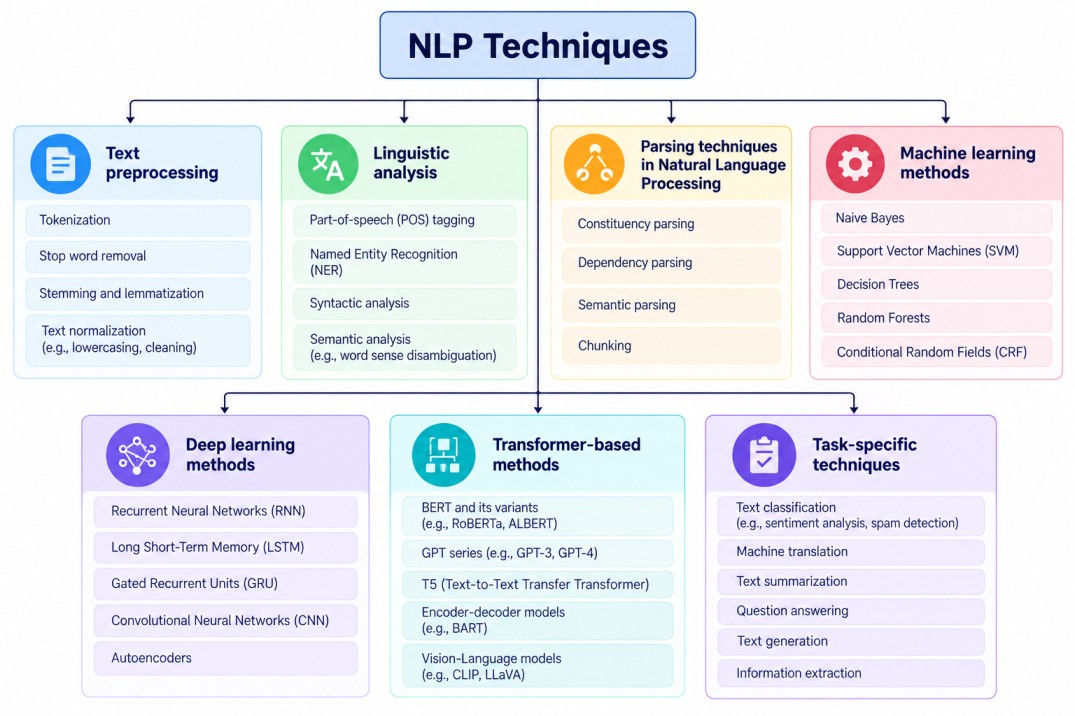
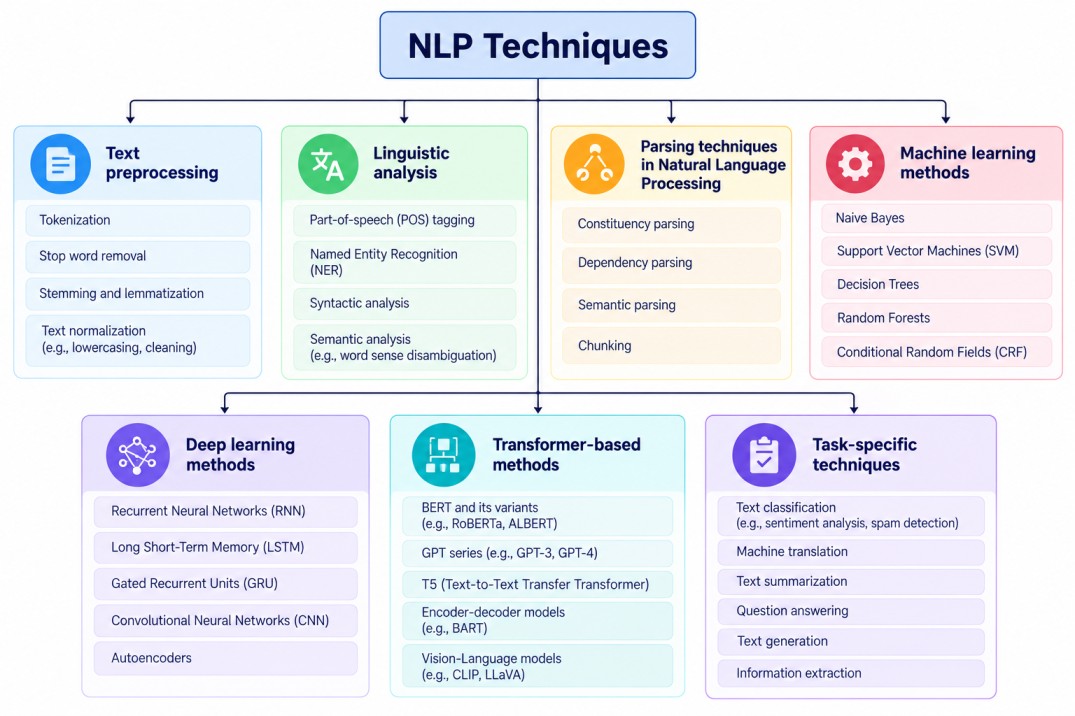
Now let’s understand what different types of natural language processing techniques are used in AI for different tasks.
Text Preprocessing Techniques in NLP
Most natural language processes techniques have to preprocess raw text because it is not clean, and that preprocessing results in the generation of something that a model can work with. Usually, these are the main steps:
Tokenization. The process of breaking a text into units, usually words or sentences. The newest language models have subword tokenizer that splits very rare words into smaller parts.
Lowercasing. Treating "Apple" and "apple" as the same token. This helps with word counts but can erase useful signals, such as the company Apple versus the fruit.
Punctuation and special character removal. Removes symbols that introduce noises in some tasks.
Stop word removal. Removes very common words, such as "the" and "is."
Stemming. Shortening the length of the words and reducing their complexity, it is a process that only results in words, that can be understood as the root of original ones.
Lemmatization. It uses grammar to put every given Word into its base form according to its meaning and syntax in different contexts.
Here's a quick run with NLTK on one sentence:
python
from nltk.tokenize import word_tokenize
from nltk.corpus import stopwords
from nltk.stem import PorterStemmer, WordNetLemmatizer
text = "Apple is opening three new stores in Bengaluru next March, and the customers were running to the launch!"
tokens = word_tokenize(text)
print("Tokens:", tokens)
lower = [t.lower() for t in tokens if t.isalpha()]
stop = set(stopwords.words("english"))
print([t for t in lower if t not in stop])
stemmer, lemmatizer = PorterStemmer(), WordNetLemmatizer()
for word, pos in [("studies", "n"), ("running", "v"), ("better", "a"), ("was", "v")]:
print(word, stemmer.stem(word), lemmatizer.lemmatize(word, pos=pos))
The tokenizer splits the sentence into 20 tokens, with the comma and exclamation mark as separate tokens. After lowercasing, dropping punctuation, and removing stop words, 11 words remain:
['apple', 'opening', 'three', 'new', 'stores', 'bengaluru', 'next', 'march', 'customers', 'running', 'launch']
The stemming and lemmatization results show why the two differ:
Word | Stem (Porter) | Lemma (WordNet) |
studies | studi | study |
running | run | run |
better | better | good |
was | wa | be |
Parsing Techniques in Natural Language Processing
Parsing techniques in natural language processing enable the identification of the grammatical structure of a sentence.
Consider the sentence:
"The student solved the problem."
A parser is capable of recognising that "the student" is the person doing the action ("the student" is the subject), "solved" is a verb describing the action of the subject and 'the problem' is the thing upon which the action is being performed.
1. Constituency Parsing
Constituency parsing is the process by which words in a sentence are grouped together (nested phrases) representing grammatical relations. This includes, for example, noun phrases, verb phrases, and prepositional phrases.
Taking the sentence "The young researcher presented the findings", a constituency parser might identify:
Noun phrase: "The young researcher"
Verb phrase: "presented the findings"
Noun phrase: "the findings"
The result of this sentence analysis is a parse tree that demonstrates how different parts of the sentence work together.
2. Dependency Parsing
Dependency parsing is used for finding what the relationship is grammatically between every single word of the texts involved in it.
One way to represent how these words depend on each other in such a context is by directing the head words to the related words which are their dependents through the links drawn.
Taking the sentence example: "'The researcher' is the person who is 'doing the presenting', and the main thing which is 'being presented' is 'the findings'", a parser may recognize "presented" as the main action or verb being done, "researcher" as the one subject acting, and "findings" the object the acting is done upon.
Basic Parsing Techniques in Natural Language Processing
Basic parsing techniques in natural language processing describe various methods that a parser can take to generate a grammar-based sentence representation out of the given grammar and input string.
Below are the comparison table of different types basic parsing techniques in natural language processing:
Technique | Direction | How it works | Strength | Weakness |
Top-down parsing | From the start symbol down to the words | Predicts what rules should apply, then checks them against the input | Never builds structures that can't lead to a sentence | Wastes effort on predictions the words don't support |
Bottom-up parsing | From the words up to the start symbol | Combines words into phrases, and phrases into larger phrases, until it reaches a sentence | Only builds what the input supports | Builds many partial pieces that never fit into a full parse |
Recursive-descent parsing | Top-down | Writes one function per grammar rule and backtracks when a choice fails | Simple to write and read | Loops forever on left-recursive rules, and backtracking can get slow |
Shift-reduce parsing | Bottom-up | Uses a stack. Shift pushes the next word on, and reduce replaces the top items with a rule's parent | Fast, and the basis for transition-based parsers | Greedy, so a wrong shift-or-reduce choice can end in no parse at all |
Linguistic Analysis Techniques in NLP
Linguistic analysis techniques allow us to examine various aspects of language. They include words in isolation, the meanings of complete sentences, and the broader context. These techniques support NLP systems by enabling them to represent grammar, recognize entities, and understand relationships.
The following natural language processing techniques are commonly used in linguistic analysis.
1. Lexical and Morphological Analysis
The process of breaking the language unit into its smallest possible building blocks is called lexical analysis. While the breakdown of language into its most minute meaningful units called morphemes is known as morphological.
For example, the word "unhappiness" can be analysed into the prefix "un-", the root "happy", and the suffix "-ness", with changes to the root's form.
These methods allow systems to analyze a word form, recognize grammatical patterns, and process semantically related words.
2. Part-of-Speech Tagging
Part-of-speech (POS) tagging determines the grammatical categories of words by how they operate in a sentence. Examples of such labels are noun, verb, adjective, adverb, pronoun, and preposition.
Consider the sentence:
"The company develops useful software."
The POS tags for the words here would be "company" as a noun, "develops" as a verb, "useful" as an adjective, and "software" as a noun.
However, a word's grammatical function can be different in the light of the context. For instance, while "book" as a noun in "Read the book" can be used as a verb "Book a flight".
3. Named Entity Recognition
NER is a process where systems detect and sort different kinds of names (people, institutions and so on) and other pieces of information (location, date, etc.), present in text. The entity categories will vary as per the model and the task.
Take the sentence for example, "Riya joined ABC Technologies in Bengaluru in 2025". The NER system might recognize:
Entity | Possible Category |
Riya | Person |
ABC Technologies | Organisation |
Bengaluru | Location |
2025 | Date or year |
NER is useful for document processing, news analysis, customer support, financial reports, and extracting structured information from unstructured text.
4. Semantic Analysis
Semantic analysis is the process of examining the meanings of words, phrases, and sentences in isolation. The focus is on capturing the meaning of a text beyond the literal identification of words or phrases.
For example, AI system is checking the relationship between these two sentences: "a doctor treats a patient" verses "a patient receiving a treatment from a doctor". They may use different grammatical structures but convey similar meaning.
By getting the meanings, semantic analysis is essential for various fields like answering a question, searching, retrieving of a document, and extraction of information.
5. Coreference Resolution
Coreference resolution deals with uncovering words or phrases different from one another that refer to the same subject or entity.
Imagine the sentence:
"Meera bought a laptop because she needed it for work."
Hence, a coreference resolution system can figure out that "she" is referring to Meera and "it" stands for the laptop.
The benefit of having this technique is that it leads to document level consistency, which in turn makes comprehension easier and allows tracing of references spread out across multiple sentences.
Task-Specific Natural Language Processing Techniques
Certain natural language processing techniques are meant for the tasks, not for the general linguistic analysis. These are the means of linguistic features, statistics, machine learning, deep learning, or fine-tuning the model.
1. Text Classification
Text Classification is a process in which text is placed into one or many of the categories based on the content.
Let's take an example of email filtering software, it determines whether the message is a spam or a legitimate message. Similarly, the help desk will sort customer inquiries into the category of billing problems, technical issues, or queries about their account.
Standard algorithms for this kind of problem are Naive Bayes, logistic regression, support vector machines, neural networks.
2. Sentiment Analysis
Sentiment analysis is capable of detecting an attitude or opinion expressed in a text. It can classify a text snippet as positive, negative, or neutral. Or else, it can even go further and discover more emotional states.
For example, "The service was excellent, but the delivery was late" contains both positive and negative sentiment.
Sentiment analysis is useful for customer feedback, product reviews, social media monitoring, and brand analysis.
3. Machine Translation
Machine translation is used to convert a text from one language into another while the intended meaning is preserved.
For example, an NLP system can translate an English customer query into Hindi or another supported language.
A common characteristic of machine translation nowadays is that most of them are backed by deep neural networks and Transformers (Attention Mechanism). Factors like languages supported, training data sets, length and complexity of sentences, and a model's ability to hold the context are what determine the translation quality of a machine translation tool.
4. Text Summarisation
Text summarisation shortens a document while keeping all the key points untouched.
Here are the two primary techniques:
Summarisation works great with papers, reports, news items, etc., as well as longer documents. However, abstract models must be carefully checked for they might miss some details or invent information that has no backing in the input document.
5. Information Extraction
Information extraction is the process of turning raw or unstructured data into structured text or database entries. Entities, events, facts, and their associations among others are all aspects information extraction can uncover.
For example, an information extraction system processing a business announcement may identify the companies involved, the announcement date, and the reported transaction value.
NER and relation extraction are common techniques used in information extraction workflows.
How to Choose the Right Natural Language Processing Techniques?
For choosing the right natural language processing techniques, you have to consider the following factors according to your requirements:
Requirement | Suitable NLP Techniques | What to Consider |
Clean and prepare raw text | Text cleaning, tokenization, normalization, stemming, lemmatization | Language, text quality, and downstream task |
Analyse sentence grammar | POS tagging, constituency parsing, dependency parsing | Grammar requirements and parsing accuracy |
Identify names, dates, and places | Named entity recognition | Entity categories and domain-specific vocabulary |
Classify documents or messages | Text classification | Label quality, class imbalance, and evaluation metrics |
Understand customer opinions | Sentiment analysis | Negation, sarcasm, mixed sentiment, and context |
Translate between languages | Machine translation | Supported languages, fluency, and meaning preservation |
Summarise long documents | Extractive or abstractive summarisation | Summary length, factual accuracy, and source coverage |
Extract facts from documents | Information extraction and NER | Required fields, relationship types, and data quality |
Answer questions using documents | Retrieval-based question answering or language models with RAG | Source relevance, factual grounding, and access controls |
Discover themes in document collections | Topic modelling and embedding-based clustering | Number of topics, interpretability, and document diversity |
Generate natural-language responses | Language models and text generation | Output quality, latency, cost, and safety requirements |
Conclusion
Natural language processing techniques help solve a wide range of language-related problems, from analysing sentence structure to extracting information and generating text. The right approach depends on the task, data quality, and accuracy requirements.
Combining suitable techniques can improve results, while careful evaluation helps identify limitations and ensure NLP systems perform reliably in real-world applications.