

























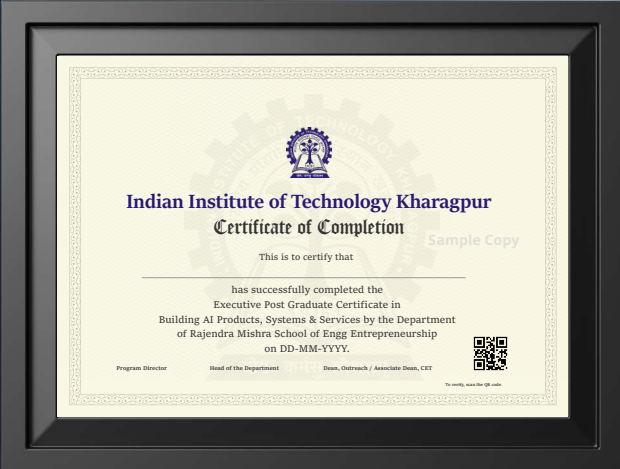

What Is the Executive Post Graduate Certificate in Building AI Products, Systems & Services?
Programme at a Glance
Below are the key highlights of IIT Kharagpur AI product manager course:
AI Product Managers: How They Do Their Jobs
Finding out where AI makes sense to use, defining the product experience, working with engineers and data scientists, evaluating model behavior, and considering the cost and risk of launching an AI product are just a few tasks that an AI Product Manager handles.
Scoping the product’s launch and ongoing operation spans the entire life cycle of an AI product manager’s job. These include ideation, specification definition, prototype validation, and result measurement.
Comparing AI Product Management to Traditional Product Management
Many of the responsibilities are the same as traditional product management, but AI adds a few new factors to think about.
The Executive Post Graduate Certificate in Building AI Products, Systems & Services includes these topics in its nine-module curriculum, from AI opportunity discovery to AI operations, safety and compliance.
Why Choose the IIT AI Product Management Course?
You can choose IIT Kharagpur AI product management course for the following reasons:
1. Learn to Identify the Right AI Opportunities
AI isn’t the solution to all business problems. Product managers have to ask themselves whether a model could solve the problem, whether the right data is available and whether the cost and risks are reasonable.
The AI product management course curriculum introduces the AI Suitability Matrix, TASQ Checklist and the AI Opportunity Canvas to assist learners analyze possible prospects for AI products.
2. Connect Product Strategy With AI Capabilities
Creating an AI product is more than simply adding an AI feature to an existing product. Product managers need to think about the AI behavior, feasibility, customer needs and commercial value of the proposed solution.
The best AI product management courses in India include AI-native product design, AI and Generative AI fluency, and rapid prototyping and validation.
3. Build a Working AI Product Prototype
The IIT product management course delivers a working AI product prototype with live LLM integration and production handoff documentation as a defined deliverable.
Learners also construct an AI product definition and behavior design, linking product requirements with desired responses of the AI system.
4. Learn RAG and Agentic Artificial Intelligence
AI products may make use of Retrieval Augmented Generation (RAG) to connect language models with relevant information. They may also make use of AI systems themselves to perform multi-step workflows.
The program offers: Artificial Intelligence Systems and Agentic Design, RAG and Agentic AI System Architecture: topics include RAG pipelines, agent workflows, autonomy boundaries, and overall AI System Architecture.
5. Measure AI Quality and Risks
AI product managers should evaluate whether an AI feature works as intended and identify the consequences of potential failure.
In the program AI Evaluation & Red Teaming are topics. The final deliverables include assessment pipelines, adversarial testing, quality thresholds and AI analytics frameworks.
What Will You Learn in the IIT Kharagpur Executive Post Graduate Certificate in Building AI Products, Systems & Services?
There are nine modules and a capstone in the curriculum of the IIT AI product manager course.
Module 1: AI Product Opportunity Discovery
Topics Covered:
AI product landscape - categories, business models, AI-native vs. AI-enhanced.
AI Suitability Matrix - probabilistic, learnable, recoverable, data-rich dimensions.
TASQ Checklist - Task ambiguity, Scale, Quality tolerance as first-pass filter.
AI Opportunity Canvas - data richness, failure recoverability, feedback loop potential.
Feasibility assessment - data availability, model capability, cost viability, regulatory risk.
Build vs. buy vs. prompt decision framework.
Skills Acquired:
Evaluating AI use cases and business opportunities.
Assessing data availability, model capabilities, costs, and risks.
Applying AI product frameworks and comparing build, buy, and prompt-based solutions.
Module 2: AI-Native Product Design
Topics Covered:
Behaviour specifications - constraints, failure modes, fallback paths, confidence thresholds.
AI PRD - eval criteria, hallucination risk tiers, data requirements, guardrail specifications.
Trust architecture - transparency, confidence calibration, user control.
Copilot-Autopilot spectrum as product design decisions.
AI UX/UI - chat, inline suggestions, ambient intelligence, co-creation canvas.
AI products vs. services vs. platforms - platform readiness decision.
Skills Acquired:
Writing AI product requirements and behaviour specifications.
Designing guardrails, fallback paths, and user controls.
Creating AI user experiences suited to different product needs.
Module 3: AI & GenAI Fluency
Topics Covered:
LLM architecture intuition - transformers, embeddings, tokenisation for product decisions.
Foundation model landscape - GPT-4o, Claude, Gemini, Sarvam AI, Llama.
Token economics in INR - cost-per-query at 1K, 10K, 100K users.
Prompt engineering as product design - system prompts, few-shot, chain-of-thought.
Build vs. buy vs. prompt vs. fine-tune decision framework.
Multimodal AI - vision, voice, and document models in product context.
Skills Acquired:
Understanding LLMs, transformers, embeddings, and tokenisation.
Applying prompt engineering and identifying multimodal AI use cases.
Estimating token costs and comparing model adaptation approaches.
Module 4: AI Prototyping & Rapid Validation
Topics Covered:
Prompt-to-app prototyping - Bolt.new, Lovable, v0 with live LLM API integration.
Multi-turn conversation design and structured output handling.
Structured peer review using the AI product review rubric.
Prototype audit - documenting 10+ production gaps.
Production handoff specification - architecture, security, engineering effort.
Prototype-to-production gap analysis and stakeholder presentation.
Skills Acquired:
Building AI prototypes using prompt-to-app tools and LLM APIs.
Designing conversational workflows and structured outputs.
Evaluating prototypes, identifying production gaps, and preparing handoff specifications.
Module 5: AI Systems & Agentic Design
Topics Covered:
RAG architecture - chunking strategy, vector databases, retrieval failure modes.
Agentic workflows - tool use, planning, multi-agent orchestration.
MCP (Model Context Protocol) as an integration standard.
HITL / HOTL / HOOTL autonomy taxonomy - designing agent boundaries.
India Stack as agent infrastructure - UPI, Aadhaar, Account Aggregator.
Data flywheel design and infrastructure literacy for PMs.
Skills Acquired:
Understanding RAG architecture, vector databases, and retrieval methods.
Designing agentic workflows, tool use, and multi-agent orchestration.
Applying MCP concepts and defining agent autonomy boundaries.
Module 6: AI Evaluation & Red Teaming
Topics Covered:
Test dataset construction - Gold, Operational, Adversarial, Safety datasets.
RAGAS metrics and LLM-as-judge methodology.
Quality gates - launch, target, and aspirational thresholds.
Adversarial red teaming - prompt injection, jailbreaks, Hinglish adversarial inputs.
Hallucination classification - factual, contextual, logical risk tiers.
Ship / No-Ship decision protocol based on evaluation evidence.
Skills Acquired:
Preparing evaluation datasets and applying RAGAS and LLM-as-judge methods.
Testing for prompt injection, jailbreaks, and hallucination risks.
Setting quality thresholds and making evidence-based launch decisions.
Module 7: AI Analytics & Experimentation
Topics Covered:
4-Tier AI Metrics Model - model, system, product, and business metrics.
AI-native metrics - acceptance rate, override rate, cost-per-correct-output.
A/B testing for non-deterministic outputs - shadow deployment, interleaving.
Model drift detection - performance monitoring and retraining triggers.
Feedback loop design as product operations.
Instrumentation spec and experiment design for AI products.
Skills Acquired:
Measuring AI performance across model, system, product, and business levels.
Designing experiments for non-deterministic AI outputs.
Tracking model drift, user feedback, and product performance metrics.
Module 8: AI Product Economics & Go-to-Market
Topics Covered:
LLM unit economics - token + infrastructure + orchestration costs in INR.
The whale user problem and cost governance strategy.
AI pricing playbook - consumption-based, outcome-based, seat-based models.
GTM for AI trust challenges - trust-first positioning and enterprise AI sales.
India market channels - WhatsApp, ONDC, GeM, IndiaAI Mission.
Change management and stakeholder alignment for AI products.
Skills Acquired:
Calculating LLM unit economics and AI infrastructure costs.
Developing AI pricing and cost governance strategies.
Planning go-to-market activities and aligning stakeholders.
Module 9: AI Operations, Safety & Compliance
Topics Covered:
DPDP Act 2023 - consent architecture, data minimisation, purpose limitation.
NIST AI RMF - risk tiering, documentation, governance framework.
EU AI Act risk tiers and prohibited use cases.
RBI FREE-AI framework for financial AI products.
Production monitoring, model drift response, go/no-go escalation.
AI incident response protocol and regulatory notification.
Skills Acquired:
Applying DPDP principles and understanding AI governance frameworks.
Monitoring production systems and responding to model drift.
Planning AI incident response and understanding regulatory requirements.
What Will You Build During the Executive Post Graduate Certificate in Building AI Products, Systems & Services?
This IIT product management course has six deliverables designed to help you build and defend an AI product.
How Does the Capstone Work In IIT AI Product Management Course?
The capstone, titled The Proof: IIT Faculty Defence, brings the programme's product development work together.
Learners select a real problem from a domain of their choice and develop an AI product over 24 weeks. The project progresses from the opportunity brief to the working prototype and business case.
The capstone includes:
A domain-focused product built around a real problem.
A working product prototype rather than a mock presentation.
A full-stack AI product involving LLMs, RAG, and agents.
Evaluation and defence of product decisions before an IIT Kharagpur faculty panel.
A real-time model-drift crisis injection during the live defence.
The assessment rubric, panel composition beyond the IIT Kharagpur faculty panel, and detailed scoring criteria are not included in the programme information.
Who Should Enrol in the Executive Post Graduate Certificate in Building AI Products, Systems & Services?
This IIT AI product management course fits you best if you are:
Current Product Managers
If you are already in product management, this curriculum covers AI native product design, AI evaluation, product economics and go to market. It can help you understand how AI capabilities influence product requirements and development decisions.
Aspiring Product Managers
The nine-module program offers AI product discovery, design, prototyping and evaluation for those in consulting, analytics, operations, growth or a business role who wish to pivot to product management.
Founders and Builders
For founders or startup team members, the program covers how to assess AI prospects, design and position AI-powered solutions, and plan product economics and go-to-market.
Technology Professionals
The program links technical work with product strategy, customer demands, AI product specs and business value for engineers, developers or tech leads interested in product ownership.
Tech-Adjacent Operators
If you are in marketing, strategy, operations or any other business team, the program introduces you to the product considerations that go into AI-driven decisions, including opportunity assessment, product design, evaluation, economics and compliance.
Who May Not Find This IIT Kharagpur Product Management Suitable?
The programme focuses on AI product management and developing AI products. Professionals whose primary goal is deep technical engineering may prefer the Executive Post Graduate Certificate in AI-Native Software Engineering.
Professionals focused on enterprise AI strategy, governance, and organisational transformation rather than product ownership may consider the Executive Programme in Technology & AI Leadership.
Eligibility Criteria for the Executive Post Graduate Certificate in Building AI Products, Systems & Services
To be qualified for this IIT Kharagpur Product Management course you need to follow the following conditions.
Executive Post Graduate Certificate in Building AI Products, Systems & Services Fees Structure
The Executive Post Graduate Certificate in Building AI Products, Systems & Services fees structure is as follows:
How to Apply for the Executive Post Graduate Certificate in Building AI Products, Systems & Services?
To enroll in the IIT Kharagpur AI product management course you must follow the following steps:
Complete the application: Fill up your details and submit the form.
Receive an offer letter: Applicants are shortlisted and receive an offer letter.
Block your seat: To proceed with the enrollment, finish the seat-blocking phase.