















What is Professional Certificate Programme in FinTech in the Age of AI?
Programme at a Glance
Below are some of the key highlights of this IIT Kharagpur Fintech course:
What Is FinTech, and Where Does AI Fit In?
FinTech (Financial Technology) is the application of technological solutions to provide, manage and optimize financial services. In the Indian context, examples of FinTech include online payment through UPI, account aggregators allowing consensual sharing of financial data, and platforms for online lending.
The application of AI adds to these services. Financial institutions utilize AI to process credit requests, detect suspicious transactions, assist in customer service operations and optimize compliance processes. There are three types of AI depending on the task to be accomplished.
Predictive AI leverages historical and current data to predict an outcome, detect patterns and estimate risks.
Generative AI assists in creating or summarizing data, performing information searches and working with financial data.
Agentic AI is capable of managing complex multi-stage tasks and workflows using appropriate tools according to pre-defined instructions.
Data regulation and protection are crucial in the realm of FinTech in India. Financial services rely on customers' personal data and secure digital environment. Businesses need to consider data collection, usage, processing and distribution when developing their financial services and AI-powered processes.
The IIT Kharagpur fintech certification course introduces these developments through a business and management lens. It connects India's digital public infrastructure with financial product design, unit economics, risk, regulation and AI maturity.
Why Choose the Professional Certificate Programme in FinTech in the Age of AI?
You should choose fintech course online from IIT Kharagpur for the following reasons:
1. Learn About India's Digital Financial Infrastructure
The AI in finance course provides insights into the Digital Public Infrastructure (DPI) framework and the India Stack. Here you will study about the layers of DPI and India Stack such as Identity, Payments, Data, Credit & Commerce and the role of public infrastructure and private platforms in shaping the fintech business model.
2. Understand AI in Financial Services
The fintech course online will provide you with an understanding of the predictive, generative and agentic AI in business terms. You will also learn how to interpret AI maturity by discerning between the production, pilots and hype. This is essential for a finance professional to evaluate AI advancements in the context of financial products.
3. Explore the FinTech Product Lifecycle
The seven modules in this AI in finance course include topics such as the Indian FinTech operating system, compliant lending, digital assets, WealthTech, risk, analytics and product management.
4. Learn Through Live Online Sessions
The 31 week IIT kharagpur fintech and AI programme is conducted entirely live online through over 90 live class hours. Classes are scheduled on Sundays during morning timings and targeted for working professionals.
5. Work on a FinTech Capstone
The capstone focuses on developing a case for your own fintech product. You will work on its unit economics, compliance approach and go-to-market plan across the programme.
6. Learn from IIT Kharagpur Faculty and Industry Experts
The fintech certification course is conducted by the Vinod Gupta School of Management, IIT Kharagpur. Live classes are conducted by faculties from IIT Kharagpur along with industry experts.
7. Receive an IIT Kharagpur Credential
Upon successful completion of the fintech course online programme, learners will be awarded a Professional Certificate from VGSoM, IIT Kharagpur along with IIT Kharagpur Executive Alumni credential.
What Will You Learn in the Professional Certificate Programme in FinTech in the Age of AI?
The Professional Certificate Programme in FinTech in the Age of AI covers seven modules. The curriculum moves from India's digital financial infrastructure to lending, digital assets, wealth and insurance technology, risk, analytics and fintech product management.
Module 1: The Indian FinTech Operating System
Topics Covered:
DPI and Fintech Business Models: public infrastructure vs. private platforms, and how fintech players actually make money
The India Stack, layered: Identity, Payments, Data, Credit, Commerce
The Artificial Intelligence Lens on Finance: from predictive to generative to agentic AI, in business terms
Reading AI maturity: production vs. pilot vs. hype
Skills Acquired:
Understand how digital public infrastructure and private platforms support FinTech business models.
Identify the key layers of the India Stack, including identity, payments, data, credit and commerce.
Differentiate between predictive, generative and agentic AI in financial services.
Module 2: Frictionless Credit & Compliant Lending
Topics Covered:
The Credit Infrastructure Stack: the Unified Lending Interface and cash-flow/alternative-indicator underwriting
Consuming Account Aggregator, GST, and land-record data through open APIs
Co-Lending Economics: the January 2026 retention floor and the Default Loss Guarantee cap
The Key Fact Statement (KFS), all-inclusive APR, and multi-lender neutrality
Skills Acquired:
Understand digital lending infrastructure and the Unified Lending Interface.
Evaluate alternative-data underwriting and co-lending models.
Assess lending terms, APR and borrower disclosures.
Module 3: Digital Assets, Settlement & Money
Topics Covered:
Sovereign and Institutional Digital Money: the e-Rupee and wholesale CBDCs
Offline capability and the distribution economics of a non-interest-bearing CBDC
Cryptocurrency as a Compliance Discipline: FIU and Virtual Digital Asset registration
Blockchain forensics: tracing hawala-linked and illicit flows on-chain
Skills Acquired:
Understand the e-Rupee, wholesale CBDCs and offline payments.
Identify cryptocurrency and Virtual Digital Asset compliance requirements.
Explore blockchain forensics for tracing illicit transactions.
Module 4: WealthTech, InsurTech & Investing
Topics Covered:
Regulated Micro-Investing and InsurTech: SM REITs and Online Bond Platform Providers
Embedded insurance and Account Aggregator-based underwriting
WealthTech and AI-Augmented Advisory: robo-advisory and portfolio optimisation Suitability guardrails, Relationship Manager approval, and hallucination controls
Skills Acquired:
Understand regulated micro-investing and embedded insurance.
Explore Account Aggregator-based underwriting and robo-advisory.
Evaluate AI-assisted investment advice using suitability and risk controls.
Module 5: Risk, Data Privacy & RegTech
Topics Covered:
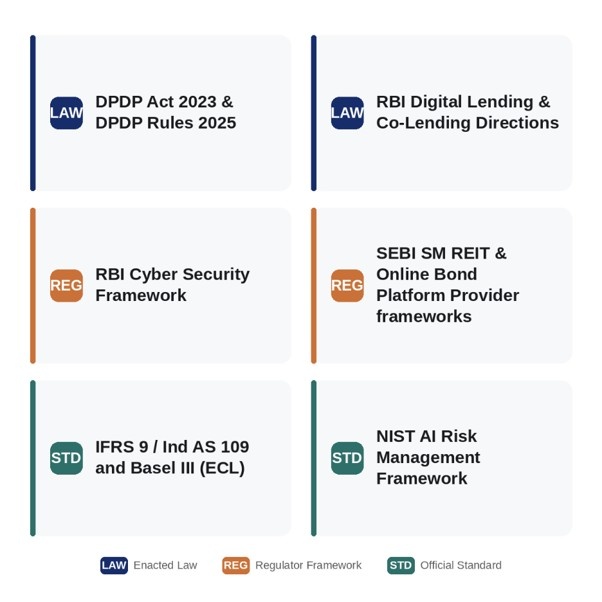
Data Privacy and Consent Architecture: the DPDP Act and Data Protection Impact Assessments
The data-retention paradox: RBI/PMLA rules vs. shorter DPDP limits
Cyber, Fraud, RegTech: the RBI Cyber Security Framework and ML-based mule-account detection
AI governance and model risk: explainability, bias review, and fairness
Skills Acquired:
Apply data privacy and consent principles under the DPDP Act.
Understand data-retention, cybersecurity and fraud risks.
Assess AI governance through explainability, bias and fairness checks.
Module 6: Unit Economics, Decisions & Analytics
Topics Covered:
CAC versus LTV in an embedded-finance world, and the end of subsidised growth
Modelling the co-lending Default Loss Guarantee: fees, default rates, and return on equity
Expected Credit Loss under IFRS 9 / Ind AS 109 and Basel III, read as a manager
Post-launch analytics: funnel drop-off, delinquency buckets, and cohort profitability
Skills Acquired:
Evaluate customer acquisition cost (CAC) and lifetime value (LTV).
Model co-lending economics and credit-loss exposure.
Analyse funnel performance, delinquencies and cohort profitability.
Module 7: FinTech Product Management
Topics Covered:
The FinTech Product Manager: Regulation by Design and Embedded Finance First
Product Requirement Documents with audit trails, across eKYC, AA, ULI, and agentic servicing
Skills Acquired:
Apply regulation-by-design to FinTech products.
Develop product requirement documents for eKYC, Account Aggregators and ULI.
Include audit trails and agentic servicing in product workflows.
FinTech Capstone Project
The programme includes a capstone project centred on developing a case for your own fintech product. You will work on three important parts of the product:
The capstone connects the programme’s focus on financial infrastructure, product management, regulation and business economics. It gives learners an opportunity to apply these areas to a fintech product concept.
Who Should Enrol in the Professional Certificate Programme in FinTech in the Age of AI?
The IIT Kharagpur fintech course is designed for professionals who want to understand the business, economic and regulatory aspects of financial technology.
1. Banking and Financial Services Experts Moving to Digital Jobs
This course is intended for management professionals coming from sectors like banking, NBFCs, insurance and broking who want to be more heavily involved in digital financial solutions or transition into fintech-oriented jobs.
2. Experienced FinTech Professionals
This programme helps people with fintech backgrounds in product, engineering, consulting, and strategy who need to understand business frameworks relating to digital financial services, product regulation and management.
3. Early-Tenure Professionals and Founder Aspirants
This course serves both fresh professionals who have only worked about 3 years and individuals contemplating launching their own fintech business or going into embedded finance.
Eligibility Criteria for Professional Certificate Programme in FinTech in the Age of AI
Candidates must meet the following eligibility requirement to apply for this fintech certification course from IIT Kharagpur:
Professional Certificate Programme in FinTech in the Age of AI Fee Structure
The total fee for the Professional Certificate Programme in FinTech in the Age of AI is following:
Who Teaches the Professional Certificate Programme in FinTech in the Age of AI?
The programme is offered by the Vinod Gupta School of Management, IIT Kharagpur. The faculty listed on the programme page include:
1. Abhijeet Chandra
Programme Director and Associate Professor, Vinod Gupta School of Management
Research areas include financial markets and risk management, financial economics, behavioural finance, corporate finance, accounting and corporate governance.
2. Chandra Sekhar Mishra
Professor, Vinod Gupta School of Management
Research areas include financial management, financial reporting and analysis, mergers and acquisitions, earnings management, business valuation and accounting analytics.
3. Ajay Kumar Mishra
Assistant Professor, Vinod Gupta School of Management
Research areas include market microstructure, asset pricing, banking regulations and corporate finance.
Certificate and IIT Kharagpur Executive Alumni Status
Learners who complete the Professional Certificate Programme in FinTech & AI receive a Professional Certificate from the Vinod Gupta School of Management, IIT Kharagpur. The programme also provides IIT Kharagpur Executive Alumni status.
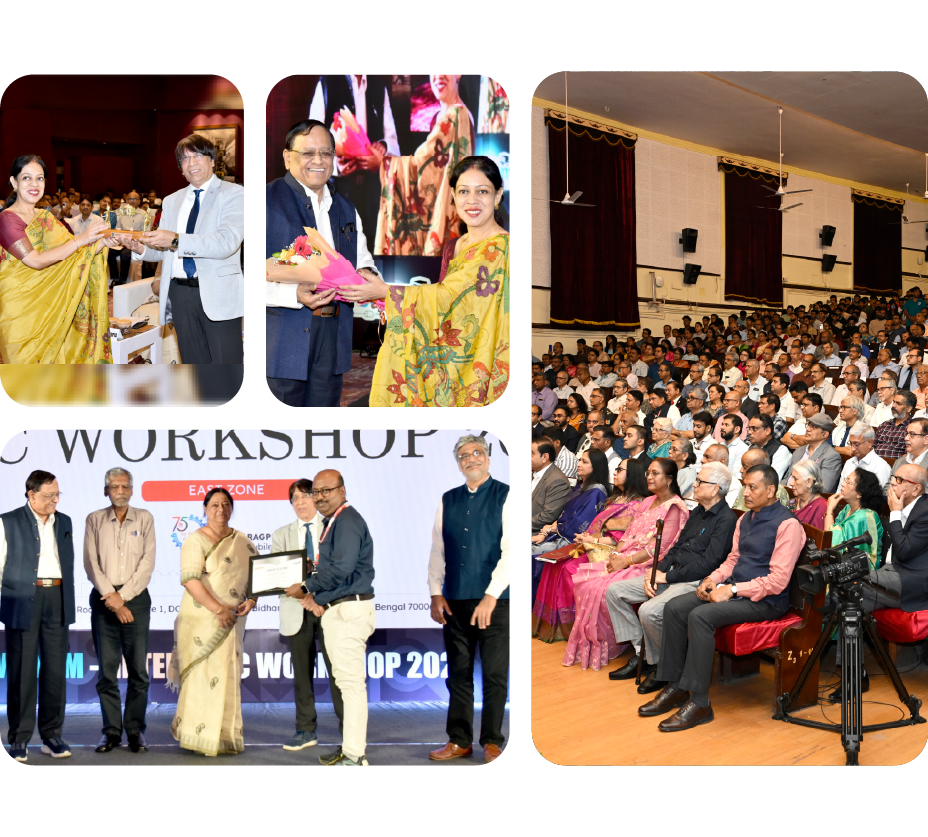
The programme concludes with an on-campus graduation ceremony at IIT Kharagpur. The certificate is presented by the Programme Director and VGSoM leadership. Learners who cannot attend the ceremony will receive their certificates by courier. Travel and accommodation expenses for attending the ceremony are borne by the learners.
How To Apply For IIT Kharagpur Fintech in the Age of AI Course
Follow these four steps to apply for the Professional Certificate Programme in FinTech in the Age of AI:
Submit Your Application: Fill in your details and complete the online application form.
Get Shortlisted: Your profile is reviewed. Shortlisted candidates receive a provisional offer letter.
Receive Your Offer: Review the provisional offer and programme fee structure.
Block Your Seat: Make the initial seat-blocking payment and submit the required documents to confirm enrollment.