



mobile logo 1

6 Months ✦ 100% Live Online

Executive Post Graduate Certificate in Quantum Computing & AI

Centre for Computational & Data Sciences (CCDS), IIT Kharagpur

Limited Seats Available

Nirf
University Ranking
75 Years Logo

About Applied Quantum & AI programme led by IIT Kharagpur

The Executive Post Graduate Certificate in Quantum Computing & AI is a six-month, 100% live online program which is offered by the Centre for Computational & Data Sciences (CCDS) at IIT Kharagpur.

This Quantum Computing and AI course is for professionals who want to know the ways in which quantum methods can benefit optimization, simulation, machine learning, and security. Besides theoretical content, the program also offers practical components dealing with quantum circuits, algorithms, and computing platforms.

This IIT Kharagpur AI and quantum computing course includes a foundational module that introduces candidates to mathematics, Python, machine learning, optimization, and cryptography. IIT Kharagpur professors conduct live online classes covering quantum states, circuits, gates, algorithms, and real quantum devices through practical training. Participants gain hands-on experience using simulators and real quantum hardware, along with software packages such as Python, Qiskit, PennyLane, PyTorch, and NVIDIA CUDA-Q. After completion, participants can attend an on-campus award ceremony and access the IIT Kharagpur Executive Education Alumni Network.

Hero background mobile

A production-first quantum programme, taught from the science up

100% live, faculty-led

100% live, faculty-led

Delivered entirely through live instruction - no outsourced instructors, only IIT Kharagpur faculty.

Led by CCDS, IIT Kharagpur

Led by CCDS, IIT Kharagpur

Led by the Centre for Computational & Data Sciences, IIT Kharagpur, and taught by faculty, with research in condensed-matter physics, quantum chemistry and atomic & many-body physics.

End-to-End AI Governance Curriculum

Real quantum hardware

Execute circuits on real quantum processors via IBM Quantum, qBraid and Qniverse - not just simulators.

No Coding. No Prior AI Required.

Curriculum progression

Foundations → Circuits → Hybrid Computation → Hardware → QML → Post-Quantum Security → Strategy.

7-Gate Capstone on a Real Healthcare Challenge

Portfolio & capstone

Ship working artefacts across the programme, culminating in an individual applied capstone with viva.

India-Focused Regulatory & Clinical Frameworks

Executive alumni status

Join the IIT Kharagpur Executive Education Alumni Network on completion.

Where quantum computing meets AI

AI is transforming what we compute; quantum is changing how we may compute it. This programme is built at that intersection - as much for AI and ML engineers as for quantum specialists.

Quantum machine learning

Quantum machine learning

View More

Quantum feature maps, kernels, QSVMs and variational classifiers - built in PennyLane and PyTorch, benchmarked against classical ML.

View less
Quantum + Generative AI

Quantum + Generative AI

View More

Quantum generative models, hybrid AI/quantum workflows, and an honest view of where quantum helps modern GenAI - and where it doesn't yet.

View less
LLM-assisted quantum dev

LLM-assisted quantum dev

View More

Use LLMs for quantum-code generation, parameter sweeps and backend selection - with human supervision built into the workflow.

View less
Hybrid quantum-classical AI

Hybrid quantum-classical AI

View More

Combine classical deep learning with quantum components in hybrid CPU/GPU/QPU pipelines across the major cloud platforms.

View less
Optimisation for AI/ML

Optimisation for AI/ML

View More

Formulate feature selection, scheduling and portfolio problems as QUBO/QAOA - the optimisation layer under many AI systems.

View less
Evidence-led evaluation

Evidence-led evaluation

View More

Matched parameter counts, ablations, dequantisation and classical baselines - the rigour AI practitioners already expect, applied to quantum.

View less

The Complete Curriculum -A structured path from your first qubit to strategy

Topic Covered

Topics

Maths, Python, ML & crypto basics

Linear algebra, probability, complex numbers

NumPy/Jupyter/Git; ML & optimisation

Crypto fundamentals

Learning Led by Distinguished Faculty

Prof. Sonjoy Majumder

Prof. Sonjoy Majumder

Professor - Department of Physics, IIT Kharagpur ✦ Research Areas: Atomic & molecular physics, relativistic atomic structure, quantum many-body systems - the foundations behind qubit behaviour.

Learning Led by Distinguished Faculty

Prof. Sabyashachi Mishra

Prof. Sabyashachi Mishra

Professor - Department of Chemistry, IIT Kharagpur ✦ Research Areas: Theoretical & computational quantum chemistry - directly relevant to quantum simulation and VQE.

Learning Led by Distinguished Faculty

Prof. Tamoghna Das

Prof. Tamoghna Das

Asst. Professor - Department of Physics, IIT Kharagpur ✦ Research Areas: Statistical & condensed-matter physics - grounding the programme in the principles behind quantum hardware and noise.

Course Fee: EPGC in Quantum Computing & AI

Flexible payment options and zero cost EMIs make your programme even more accessible.

Graduation with a minimum of 50% marks. B.Tech/ M. Tech, B.E/M.E (CS, IT, AI, ECE preferred), B.Sc/M.Sc (CS/Mathematics/Statistics), MCA/BCA. Candidates from other disciplines must have a minimum of 2 years of experience in the technology field

Total Fee

₹1,77,000

Block Your Seat Now At

₹10,000

EMI per Month

₹6,031

*Inclusive of taxes.

Prerequisite:

Comfortable writing Python functions and working with basic data structures; familiar with undergraduate-level mathematics (linear algebra, probability) and statistics behind common ML concepts. Prior quantum-computing knowledge is not required.

Develop and evaluate production- oriented quantum systems

You graduate with a portfolio of real, benchmarked quantum-AI artefacts you can demonstrate and extend.

Quantum Circuit + Grover

Quantum Circuit + Grover

View More

Entangled-state construction and a search algorithm run on real IBM Quantum hardware, with noise analysis.

View less
QAOA vs Classical

QAOA vs Classical

View More

A real combinatorial problem solved with QAOA and honestly compared against a classical optimiser.

View less
Noise & Mitigation Study

Noise & Mitigation Study

View More

Quantified comparison of noiseless, noisy and error-mitigated runs of the same circuit.

View less
Quantum Kernel + ML Hybrid

Quantum Kernel + ML Hybrid

View More

A quantum-kernel classifier on a real dataset, benchmarked against a classical baseline.

View less
PQC Migration Audit

PQC Migration Audit

View More

Assess a system's quantum-vulnerable crypto and draft a staged, crypto-agile migration plan.

View less
Individual Applied Capstone

Individual Applied Capstone

View More

Your signature end-to-end project - problem to benchmarked solution - defended in a viva.

View less

Capstone: One Problem. Run on Real Hardware

Take a real problem from formulation to a working, benchmarked quantum solution – executed on real quantum processors where supported, not just simulators – and defend it. Real-QPU execution is woven through the curriculum from Course 1 onward, so by the capstone you are fluent in it – graduating with quantum programs run on actual processors and results analysed honestly.

FRAME

FRAMEProblem → Baseline

BUILD

BUILDRun on real QPUs

BENCHMARK

BENCHMARKQuantum vs. Classical

DEFEND

DEFENDPresent. Report. Viva

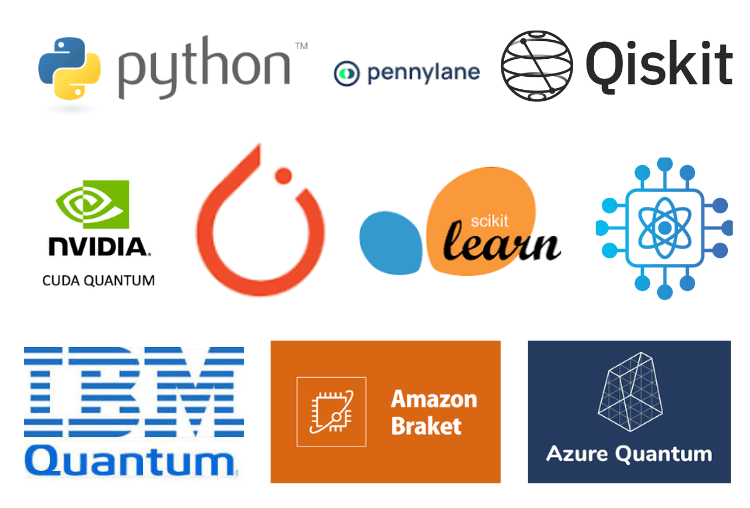
Tools and frameworks

Probable
Tools & Frameworks

Beyond a Certificate – Built for Career Impact

Earn recognised credentials and academic recognition.

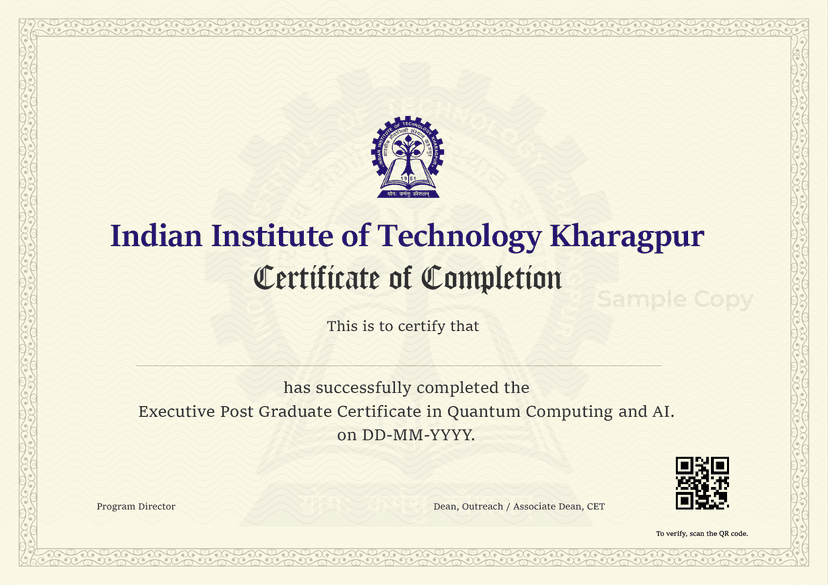
Certificate

On-Campus Graduation Ceremony

at IIT Kharagpur

The programme concludes with an on-campus award ceremony at IIT Kharagpur, where participants receive their certificates from the Programme Director and Institute leadership.

Faculty Interaction
Section image

Our Admission process

Admission Process for the EPGC in Quantum Computing & AI Programme with three easy steps!

  • 1

    Fill your details and complete your application.

  • 2

    Get shortlisted and Receive Offer Letter

  • 3

    Block your seat

What is the Executive Post Graduate Certificate in Quantum Computing & AI?

Key Highlights: Executive Post Graduate Certificate in Quantum Computing & AI

Fact

Value

Programme

Executive Post Graduate Certificate in Quantum Computing & AI

Offered by

Centre for Computational & Data Sciences (CCDS), IIT Kharagpur

Duration

6 months

Format

100% live online classes taught by IIT Kharagpur faculty; weekend sessions, 3 hours per week

Total fee

₹1,77,000 (inclusive of taxes)

Payment options

Block your seat with ₹10,000; EMI of ₹6,031 per month

Eligibility

Graduation with a minimum of 50% marks. B.Tech/M.Tech, B.E/M.E (CS, IT, AI, ECE preferred), B.Sc/M.Sc (CS, Mathematics or Statistics), MCA/BCA. Other disciplines require at least 2 years of technology experience

Prerequisites

Python functions, basic data structures, linear algebra, probability, and ML statistics

Curriculum

Foundations; quantum circuits and algorithms; hybrid computation; hardware and NISQ systems; quantum machine learning; post-quantum cryptography and AI security; quantum strategy and capstone

Capstone

Individual applied project with classical benchmarking, final presentation, and viva

Certificate

Executive Post Graduate Certificate awarded by IIT Kharagpur at an on-campus award ceremony upon successful programme completion

Course Instructors

Prof. Sonjoy Majumder, Prof. Sabyashachi Mishra, and Prof. Tamoghna Das, IIT Kharagpur

Weekly time commitment

Weekend classes, with 3 live hours per week across 24 weeks

Why Choose the IIT Kharagpur Quantum Computing & AI Course?

This Executive Post Graduate Certificate in Quantum Computing & AI program helps you to apply quantum computing principles to AI and ML by making a good understanding of algorithms, hardware limitations, and the problems these methods can solve. 

Some key features of this program among other IIT Kharagpur online courses are:

  • Credibility of IIT Kharagpur: Being the first Indian Institute of Technology in India, IIT Kharagpur ranks fifth in Engineering according to NIRF 2025 owing to a legacy of 75 years of academic excellence.

  • Faculty from IIT Kharagpur: The course includes expertise of faculty members in quantum physics and computational quantum chemistry.

  • Practice in Quantum Hardware: The course covers practical knowledge about quantum circuits hardware as well as simulators.

  • Quantum Computing & AI: The course covers quantum algorithms, hybrid quantum computing, and quantum machine learning.

  • Individual Capstone: You will come up with an idea, try it out, check the results, and give your feedback.

  • Executive Alumni Status: Once you complete the program, you will become a part of the IIT Kharagpur Executive Education Alumni ‍‍‍Network.

What Will You Learn In This Quantum Computing and AI Course?

This Executive Post Graduate Certificate in Quantum Computing & AI is of total 24 weeks and begins with a 3 week foundational bridge component, which helps you to build your basics, if you are new to this field. 

This IIT Kharagpur AI course have these modules:

Bridge: Foundations

Weeks -3 to 0 | Asynchronous learning with optional live support

Topics Covered:

  • Linear algebra, complex numbers, and probability

  • Python, NumPy, SciPy, Matplotlib, Jupyter, and Git

  • Machine learning and optimization basics

  • Cryptography, digital signatures, key exchange, and TLS

Skills Acquired:

  • Using Python for scientific computing

  • Applying mathematical foundations used in quantum computing

  • Understanding machine learning, optimization, and cryptography basics

Course 1: Quantum Foundations and Circuit Engineering

Weeks 1–4

Topics Covered:

  • Quantum states, measurement, gates, circuits, and entanglement

  • Qiskit, circuit simulation, and real quantum hardware

  • Quantum algorithms, including Deutsch–Jozsa and Grover's search

  • Qubit technologies, circuit transpilation, and noise

Skills Acquired:

  • Building and analysing quantum circuits

  • Using Qiskit to simulate and run circuits

  • Implementing basic quantum algorithms

Course 2: Hybrid Quantum Computation

Weeks 5–8

Topics Covered:

  • QUBO and Ising models for optimization problems

  • QAOA, VQE, and quantum simulation

  • Quantum and classical optimization methods

  • Hybrid CPU, GPU, and quantum workflows with cloud platforms

Skills Acquired:

  • Formulating optimization problems for quantum methods

  • Building and evaluating QAOA and VQE workflows

  • Comparing quantum results with classical approaches

Course 3: Quantum Hardware and NISQ Computing

Weeks 9–11

Topics Covered:

  • Qubit technologies, hardware connectivity, and circuit mapping

  • Decoherence, noise, fidelity, and quantum channels

  • Error mitigation methods

  • Quantum error-correction codes and fault-tolerant computing

Skills Acquired:

  • Understanding qubit technologies and hardware constraints

  • Assessing noise and error-mitigation methods

  • Understanding physical and logical qubits

Course 4: Applied Quantum Machine Learning

Weeks 12–15

Topics Covered:

  • Data encoding and quantum feature maps

  • Quantum kernels, variational classifiers, and quantum neural networks

  • PennyLane, PyTorch, trainability, and quantum generative models

  • Model evaluation against classical baselines

Skills Acquired:

  • Encoding data for quantum machine learning

  • Building quantum machine learning models

  • Evaluating results against classical methods

Course 5: Post-Quantum Cryptography and AI Security

Weeks 16–18

Topics Covered:

  • Quantum threats to public-key cryptography and AI data

  • NIST standards: ML-KEM, ML-DSA, and SLH-DSA

  • Hybrid cryptography and security of AI systems

  • Cryptographic migration and Quantum Key Distribution

Skills Acquired:

  • Understanding quantum-related security risks

  • Identifying systems that may need quantum-resistant protection

  • Understanding post-quantum methods and migration planning

Course 6: Quantum Strategy and Individual Capstone

Weeks 19–24

Topics Covered:

  • Quantum applications and use-case evaluation

  • Comparison with classical methods, including cost and resource needs

  • Platform and vendor assessment

  • Capstone development and final presentation

Skills Acquired:

  • Identifying suitable quantum-computing problems

  • Comparing quantum approaches with classical baselines

  • Presenting technical findings and limitations

Capstone: Design and Implement a Quantum Computing Solution

The individual capstone project encourages participants to identify a problem, come up with a solution that uses quantum mechanics principles, and perform a benchmark with a classical solution. Participants report their experiments together with the identified challenges. They present the paper and do a viva ‍‍‍individually.

Capstone Focus:

  • Select and formulate a problem

  • Build and test a quantum prototype

  • Compare results, resources, and costs

  • Document findings and limitations

  • Present the project and complete a viva

Tools and Frameworks Covered in Executive Post Graduate Certificate in Quantum Computing & AI

1. Quantum Circuit Design and Execution

Quantum circuits are built, the quantum computers are simulated and finally quantum circuits are executed as quantum circuits.

  • Qiskit and OpenQASM 3

  • IBM Quantum

  • qBraid and Qniverse

2. Quantum Machine Learning and Scientific Computing

Data is being prepared, experiments are conducted and models in machine learning and scientific computing fields are developed by quantum technologies.

  • Python, NumPy, and SciPy

  • Matplotlib, Jupyter, and Git

  • PennyLane and PyTorch

3. Hybrid Computing and Cloud Platforms

Focus on researching and developing computing workflows that utilize both classical (traditional) processors and quantum ‍‍‍resources.

  • NVIDIA CUDA-Q

  • IBM Quantum Runtime

  • AWS Braket and Azure Quantum

  • Quantum annealing platforms; CPUs and GPUs

4. Optimization and Quantum Algorithms

Working with methods for optimization and simulation.

  • QUBO and Ising models

  • QAOA and VQE

  • Quantum kernels and variational classifiers

  • MILP, CP-SAT, and metaheuristics

5. Post-Quantum Cryptography

Understanding standards used in quantum-resistant security planning.

  • ML-KEM (FIPS 203)

  • ML-DSA (FIPS 204)

  • SLH-DSA (FIPS 205)

  • Cryptographic libraries, hybrid cryptography, and migration planning

Who Should Enrol in the Executive Post Graduate Certificate in Quantum Computing & AI from IIT Kharagpur?

This program falls among the best IIT kharagpur courses for working professionals. It is suitable for you if you are a:

AI and Machine Learning Professionals

If you are currently working with machine learning models and want to learn about quantum kernels, variational classifiers, hybrid workflows, and comparison with classical baselines.

Software and Data Engineers

If you are working in software or data engineering, this IIT Kharagpur AI course will help you learn the basics of programming a quantum computer, circuit design, algorithms, and various quantum platforms.

Science and Engineering Professionals

If your current work involves modelling, simulation or computational problems, this course will help you to explore the quantum algorithms, optimization, and hardware limitations.

Researchers and R&D Professionals

If you work in research or technology development, this course will help you to evaluate quantum simulation, machine learning, hardware, and its potential applications.

Cybersecurity Professionals

If you are currently working in cybersecurity or cryptography, this course will help you to study quantum threats, post-quantum standards, and migration planning.

Eligibility Criteria for the IIT Kharagpur Executive Post Graduate Certificate in Quantum Computing & AI

Applicants should meet the following academic and technical requirements for the IIT Kharagpur Quantum Computing and AI course:

  • Graduation with a minimum of 50% marks

  • B.Tech/M.Tech or B.E/M.E in CS, IT, AI, or ECE are preferred 

  • B.Sc/M.Sc in Computer Science, Mathematics, or Statistics

  • MCA/BCA

  • Candidates from other disciplines must have a minimum of 2 years of experience in the technology field

Prerequisite:

Before enrolling, candidates should be comfortable with:

  • Writing Python functions and using basic data structures

  • Undergraduate mathematics, including linear algebra and probability

  • Basic statistics used in machine learning

Prior quantum-computing knowledge is not required. 

IIT Kharagpur Executive Post Graduate Certificate in Quantum Computing & AI Fees Structure

The Executive Post Graduate Certificate in Quantum Computing & AI fees structure is below:

Fee Component

Amount

Total Program Fee

₹1,77,000

Seat-Blocking Amount

₹10,000

EMI

₹6,031/month

If you are looking for a best course which cover quantum computing along with AI among the IIT kharagpur courses online, this course combines both in a single fee structure.

How To Apply For This IIT Kharagpur Quantum Computing And AI Course?

The process for applying in this Executive Post Graduate Certificate in Quantum Computing & AI is simple and can be completed only in three steps:

  1. Fill in your details and complete the application: Submit the required information to apply for the program.

  2. Get shortlisted and receive the offer letter: Shortlisted applicants receive an offer letter with the next steps.

  3. Block your seat: To finalize your enrollment and get a confirmed seat, pay the seat-blocking amount and that's it you are ‍‍‍in.

FAQs

Find answers to commonly asked questions.