

















mobile logo 1

8 Months ✦ 100% Live Online

Generative AI & Agentic AI Course - Executive Post Graduate Certificate

Department of Computer Science & Engineering, IIT Kharagpur

Limited Seats Available!

Nirf
University Ranking
75 Years Logo

About EPGC in Generative AI & Agentic AI

This is an 8-month, 100% live online programme from the Department of Computer Science & Engineering at IIT Kharagpur which is designed to build practical skills in Generative AI, Large Language Models, and Agentic AI.

Instead of treating Generative AI and Agentic AI as separate skills, which majorly generative AI courses do, the programme teaches learners the foundational concepts such as LLM fundamentals to RAG, fine-tuning and then moving to multimodal AI, AI agents, and production deployment.

The programme covers Generative AI, Agentic AI, deployment, performance optimisation, and AI safety through hands-on projects on RAG, fine-tuned LLMs, multi-agent systems, and GenAI APIs. Learners gain practical experience in PEFT, LoRA, and QLoRA, attend live faculty-led sessions at IIT Kharagpur, and complete an industry capstone with faculty mentorship. On completion, they can attend an on-campus award ceremony and access the IIT Kharagpur Executive Education Alumni Network.

Hero background mobile

A Production-First Generative AI and Agentic AI Programme led by IIT Kharagpur’s Computer Science Department

100% Live, Faculty-Led

100% Live taught by faculty

Delivered through 100 percent live instruction.

Partha Ghosh School of Leadership

Faculty Leadership

Taught by professors from the Department of Computer Science and Engineering, IIT Kharagpur.

6 Core Modules. 6 Real-World AI Systems

Academic Rigour

Research-backed instruction with strong theoretical grounding and applied relevance.

Foundations to GenAI, Agentic AI & Deployment

Curriculum Progression

Generative AI → Large Language Models → Customisation and Fine-Tuning → Retrieval-Augmented Generation → Agentic AI → Production Deployment.

Industry-Aligned Capstone & Projects

Industry Capstone & Projects

Two-week guided project under faculty mentorship.

Executive Certificate & Campus Recognition

Executive Alumni Status & Award Ceremony

On completion, join the IIT Kharagpur Executive Education Alumni Network with access to events, networking forums, campus visits, and an annual alumni newsletter.

Curriculum Highlights: Design, Build, & Deploy AI that works in Production

The curriculum also focuses on building agentic AI architectures and AI agents capable of executing multi-step tasks using large language models and external tools.

Research-Backed Credibility

Research-Backed Credibility

View More

Faculty publish in ICML, NeurIPS,ICCV, ACL and IEEE Transactions. The curriculum reflects active research, not tool trends

View less
100% Faculty-Led Learning

100% Faculty-Led Learning

View More

All sessions taught by IIT Kharagpur faculty. No outsourced instructors, only academic depth.

View less
End-to-End LLM Engineering and Deployment

End-to-End LLM Engineering and Deployment

View More

Learn how LLMs are built and how they behave in real systems. Build, serve & monitor with latency, cost & reliability in mind.

View less
Modern fine-tuning

Modern fine-tuning

View More

Master PEFT, LoRA & QLoRA to customise LLMs and SLMs for your use case. Evaluate gains against a baseline & iterate with confidence.

View less
Beyond GenAI to Agentic AI

Beyond GenAI to Agentic AI

View More

Move beyond chatbots to systems that plan, use tools & coordinate tasks. Build agent workflows you can measure, debug & maintain.

View less

The Complete Curriculum -A Structured Path to Generative AI and Agentic AI

Topic Covered

Topics

AI & Deep Learning Essentials

The Transformer Architecture

Working with Foundation Models

Learning Led by Distinguished Faculty

Dr. Sourangshu Bhattacharya

Dr. Sourangshu Bhattacharya

Programme Director and Lead Faculty  - Associate Professor ✦ Department of Computer Science and Engineering, IIT Kharagpur || Research Areas  - Artificial Intelligence and Machine Learning, Complex and Social Networks, Data and Web Mining. 

Learning Led by Distinguished Faculty

Prof. Niloy Ganguly

Prof. Niloy Ganguly

Core Faculty - Professor and Head ✦ Department of Computer Science and Engineering, IIT Kharagpur  || Research Areas  Artificial Intelligence and Machine Learning, Complex and Social Networks, Data and Web Mining, Natural Language Processing. 

Learning Led by Distinguished Faculty

Prof. Pawan Goyal

Prof. Pawan Goyal

Professor ✦ Department of Computer Science and Engineering, IIT Kharagpur  || Research Areas  Complex and Social Networks, Data and Web Mining, Language, Speech and Human–Computer Interaction. 

Learning Led by Distinguished Faculty

Dr. Plaban Bhowmick

Dr. Plaban Bhowmick

Associate Professor ✦ Department of Artificial Intelligence, IIT Kharagpur || Research Areas  Artificial Intelligence, Natural Language Processing, Digital Libraries, Machine Learning. 

Learning Led by Distinguished Faculty

Dr. Jiaul Hoque Paik

Dr. Jiaul Hoque Paik

Associate Professor ✦ Department of Artificial Intelligence, IIT Kharagpur || Research Areas  Natural Language Processing, Information Retrieval, Big Data Analytics, Artificial Intelligence and Machine Learning. 

Learning Led by Distinguished Faculty

Dr. Somak Aditya

Dr. Somak Aditya

Assistant Professor ✦ Department of Computer Science and Engineering, IIT Kharagpur || Research Areas  Artificial Intelligence and Machine Learning, Knowledge Representation and Reasoning, Probabilistic Logic, Statistical Relational Learning, Natural Language Understanding, Vision and Language, Language, Speech and Human–Computer Interaction. 

Learning Led by Distinguished Faculty

Dr. Debaditya Roy

Dr. Debaditya Roy

Assistant Professor ✦ Department of Computer Science and Engineering, IIT Kharagpur || Research Areas  Computer Vision, Neuro-Symbolic AI, Semantic Understanding of Images and Videos, Multimodal Language Models, Predictive Robotics, Autonomous Driving. 

Learning Led by Distinguished Faculty

Dr. Abhijnan Chakraborty

Dr. Abhijnan Chakraborty

Assistant Professor ✦ Department of Computer Science and Engineering, IIT Kharagpur || Research Areas  Responsible AI, AI for Social Good, Data and Web Mining, Social Networks. 

Learning Led by Distinguished Faculty

Dr. Koustav Rudra

Dr. Koustav Rudra

Assistant Professor ✦ Department of Artificial Intelligence, IIT Kharagpur || Research Areas  Responsible AI, AI for Social Good, Artificial Intelligence and Machine Learning in Healthcare, Information Retrieval, Natural Language Processing. 

EPGC in Generative AI & Agentic AI Course Fee

Flexible payment options and zero cost EMIs make your programme even more accessible.

Graduation with a minimum of 50% marks. B.Tech/ M. Tech, B.E/M.E (CS, IT, AI, ECE preferred), B.Sc/M.Sc (CS/Mathematics/Statistics), MCA/BCA. Candidates from other disciplines must have a minimum of 2 years of experience in the technology field

Total Fee

₹2,04,000

Block Your Seat Now At

₹10,000

EMI per Month

₹6,825

*Inclusive of taxes.

Prerequisite:

Can write Python functions and work with basic data structures. Has experience working with APIs (either consuming or building them). Comfortable reading technical documentation. Familiar with the basic mathematics and statistics behind common ML concepts

Develop and Deploy Production-Grade AI Systems

ENTERPRISE RAG SYSTEM

ENTERPRISE RAG SYSTEM

View More

RAG system with hybrid search and reranking. Designed to handle large document collections. Includes an evaluation pipeline to measure and improve accuracy.

View less
FINE-TUNED LLM

FINE-TUNED LLM

View More

An open-source LLM fine-tuned on domain-specific data using LoRA or QLoRA. Deployed as an API for real-world inference.

View less
MULTI-AGENT SYSTEM

MULTI-AGENT SYSTEM

View More

Agent-based systems that plan tasks, use tools, and coordinate across workflows. Built for multi-step execution and deployed end to end.

View less
DEPLOYED GENERATIVE AI API

DEPLOYED GENERATIVE AI API

View More

A production-ready API serving your model. Containerised, monitored, and built to handle real traffic.

View less
INDUSTRY CAPSTONE

INDUSTRY CAPSTONE

View More

A signature project developed from business problem to deployed solution, built under faculty mentorship.

View less

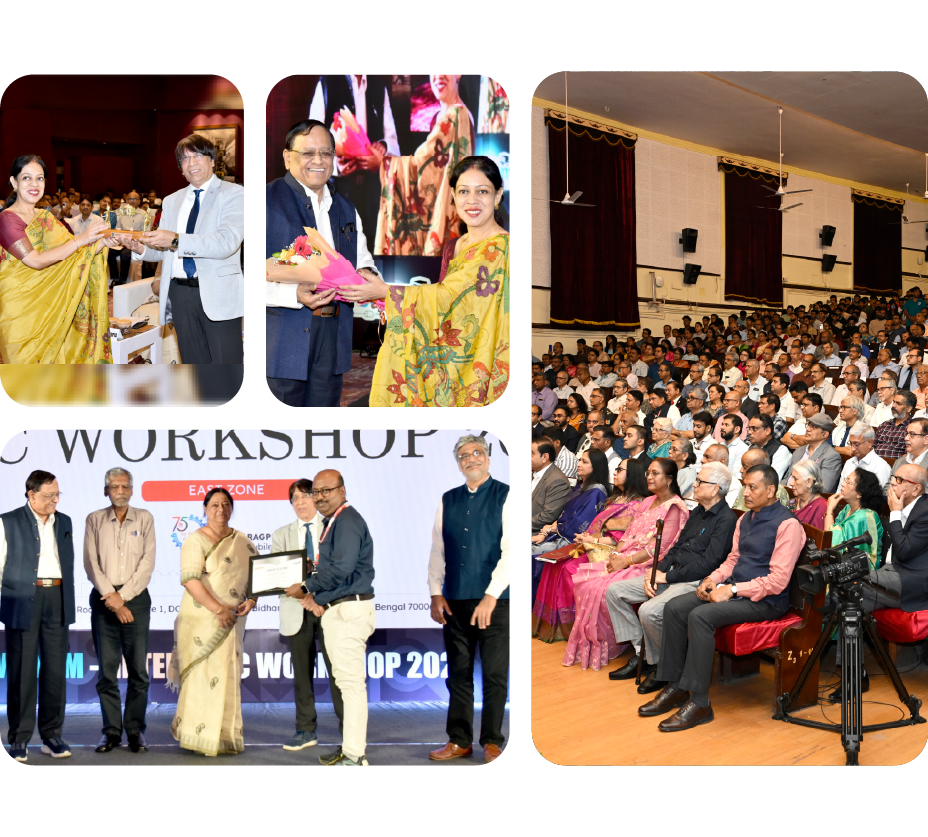
On-Campus Graduation Ceremony at IIT Kharagpur

The programme concludes with an on-campus award ceremony at IIT Kharagpur, where participants receive their certificates from the Programme Director and Institute leadership.

DEFINE

Faculty Interaction

End-to-end system design

Cohort Networking

Full-Stack - ML + GenAI + Agentic AI + RAG

The IIT Kharagpur Experience

Tools and frameworks

Probable
Tools & Frameworks

Beyond a Certificate — Built for Career Impact

Earn recognised credentials and academic recognition.

Certificate

On-Campus Graduation Ceremony

at IIT Kharagpur

The programme concludes with an on-campus award ceremony at IIT Kharagpur, where participants receive their certificates from the Programme Director and Institute leadership.

Faculty Interaction
Section image

Our Admission process

Admission Process for the Generative AI & Agentic AI Programme with three easy steps!

  • 1

    Fill your details and complete your application.

  • 2

    Get shortlisted and Receive Offer Letter

  • 3

    Block your seat

What is the Executive Post Graduate Certificate in Generative AI & Agentic AI?

Key Highlights: Executive Post Graduate Certificate in Generative AI & Agentic AI

Details

Programme

Executive Post Graduate Certificate in Generative AI & Agentic AI

Offered by

Department of Computer Science & Engineering, IIT Kharagpur

Duration

8 months

Format

100% live online classes taught by IIT Kharagpur faculty; recordings available after each session

Total fee

₹2,04,000 (inclusive of taxes)

Payment options

Block your seat with ₹10,000; no-cost EMI from ₹6,825 per month

Eligibility

Graduation with at least 50% marks (BTech/MTech, BE/ME, BSc/MSc in CS, Mathematics or Statistics, MCA/BCA). Other disciplines: at least 2 years of experience in the technology field

Prerequisites

Can write Python functions, work with basic data structures and use APIs

Curriculum

5 modules: GenAI and LLM foundations; prompting and RAG; LLM fine-tuning and alignment; multimodal and agentic AI; deployment, optimisation and AI safety

Capstone

Two-week guided industry project under faculty mentorship

Certificate

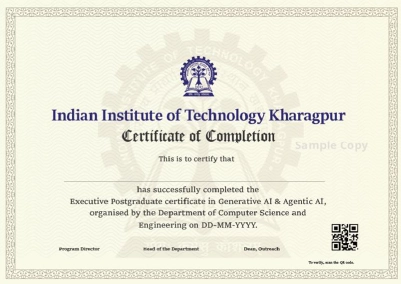
Executive Post Graduate Certificate issued by IIT Kharagpur, awarded at an on-campus ceremony

Programme Director

Dr. Sourangshu Bhattacharya, Associate Professor, Department of Computer Science and Engineering

Weekly time commitment

3 hours per week of live classes across 32 weeks 

Why Choose the IIT Kharagpur Generative and Agentic AI Course?

With many Generative AI certifications and Agentic AI certification available, this programme focuses on building the skills needed to take AI systems from concepts to production. This programme is different because:

  • IIT Kharagpur credibility: India's first IIT, ranked 5th in Engineering by NIRF 2025, with a 75-year academic legacy.

  • 100% faculty-led teaching: Every session is taught by IIT Kharagpur CSE and AI department faculty, not outsourced instructors.

  • Research-backed curriculum: Built by faculty publishing in ICML, NeurIPS, ACL, and IEEE Transactions.

  • Full-stack coverage: GenAI, fine-tuning, RAG, and Agentic AI sit alongside production deployment and AI safety.

  • On-campus recognition: The programme closes with an on-campus award ceremony and Executive Alumni status.

What Will You Learn in the Generative AI and Agentic AI course?

The Executive Post Graduate Certificate in Generative AI & Agentic AI course is structured across five modules and an industry capstone. The programme includes 96 hours of live faculty-led learning, with each module focused on building practical engineering skills.

Module 1: Foundations of Generative AI & LLMs

Weeks 1–6 | 18 Hours Live

Topics Covered:

  • AI and deep learning essentials

  • Neural network foundations for understanding LLM behaviour

  • Transformer architecture

  • Attention, tokenisation, embeddings, and positional encoding

  • Working with foundation models

  • Understanding models such as GPT, Gemini, LLaMA, and Mistral

  • Selecting foundation models based on capability, cost, and use case

Skills Acquired:

  • Understanding modern LLM architecture

  • Working with transformers and embeddings

  • Understanding how LLMs process language

  • Comparing foundation models

  • Making model choices based on technical requirements

Module 2: Advanced Prompting & RAG Systems

Weeks 7–12 | 18 Hours Live

Topics Covered:

  • Advanced prompt engineering

  • Systematic prompting patterns

  • Tool-calling prompts

  • Retrieval-aware prompts

  • Safety prompts and failure handling

  • RAG fundamentals

  • Chunking and retrieval architectures

  • Vector databases

  • Hybrid search

  • Re-ranking

  • RAG evaluation and debugging retrieval failures

Skills Acquired:

  • Designing advanced prompts

  • Building retrieval-based AI systems

  • Working with vector-based retrieval

  • Designing hybrid search pipelines

  • Improving retrieval quality through re-ranking

  • Evaluating and debugging RAG systems

Module 3: LLM Fine-Tuning & Alignment

Weeks 13–18 | 18 Hours Live

Topics Covered:

  • Fine-tuning fundamentals

  • Deciding between prompting, RAG, and fine-tuning

  • Parameter-Efficient Fine-Tuning (PEFT)

  • LoRA and QLoRA

  • Fine-tuning open models on focused datasets

  • Dataset preparation

  • Training runs

  • Model evaluation and iteration

Skills Acquired:

  • Choosing the right approach for LLM customisation

  • Preparing datasets for fine-tuning

  • Applying PEFT methods

  • Fine-tuning models using LoRA and QLoRA

  • Comparing model performance against a baseline

  • Evaluating and improving fine-tuned models

Module 4: Multimodal & Agentic AI

Weeks 19–24 | 18 Hours Live

Topics Covered:

  • Multimodal AI foundations

  • Text and image understanding

  • Image generation

  • Vision-language models

  • Agentic AI systems

  • Planning and reasoning

  • Tool use

  • Memory

  • Agent orchestration

  • Multi-agent workflows

Skills Acquired:

  • Building multimodal AI applications

  • Working with vision-language systems

  • Designing AI agents

  • Building workflows that can plan and use tools

  • Working with memory and agent orchestration

  • Designing multi-agent systems for business workflows

Module 5: Deployment, Optimization & AI Safety

Weeks 25–32 | 24 Hours Live

Topics Covered:

  • Production-grade RAG and agent orchestration

  • Taking RAG and agent systems from prototypes to production

  • Reliability and failure modes

  • Model serving and API development

  • vLLM-style serving concepts

  • FastAPI

  • Containerization

  • Monitoring

  • Performance baselining

  • Latency and cost management

  • Guardrails

  • Privacy and hallucination handling

  • Responsible and trusted Generative AI

  • Industry capstone project

Skills Acquired:

  • Taking GenAI systems towards production

  • Building and serving AI APIs

  • Working with FastAPI and containerisation

  • Monitoring AI systems

  • Measuring performance and reliability

  • Managing latency and costs

  • Applying guardrails and safety practices

  • Handling privacy and hallucination risks

  • Building and deploying an end-to-end GenAI system

Capstone: Build a Production-Ready AI System

The capstone project will bring together the skills covered across the five modules. Learners will integrate LLM customisation, RAG, Agentic AI workflows, and deployment into one end-to-end system. The project will be designed, built, evaluated, and deployed with faculty mentorship.

Capstone Focus:

  • Select a real-world problem

  • Design the AI system and architecture

  • Build the required RAG, LLM, or agent components

  • Add monitoring and safety measures

  • Evaluate system performance

  • Deploy the working solution

  • Present the final system and technical report

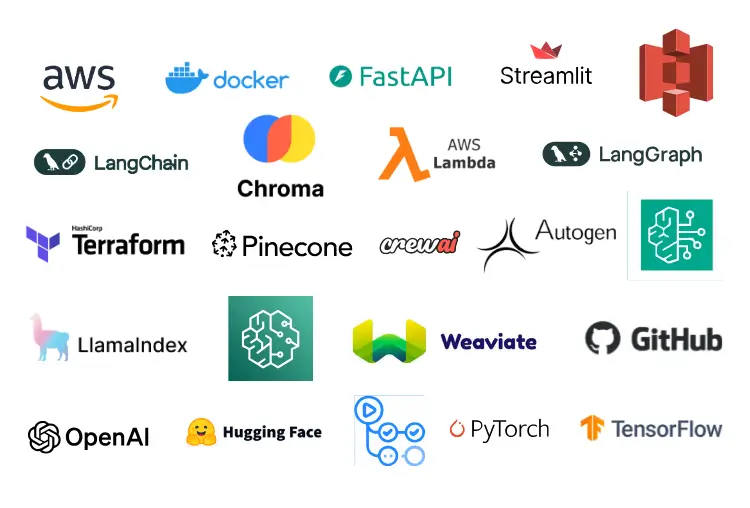
Tools and Frameworks Covered in the Agentic AI and GenAI Course

1. Agentic AI Frameworks and Orchestration

Build AI agents, connect tools, and manage multi-step workflows.

  • LangChain

  • LangGraph

  • CrewAI

  • AutoGen

  • LlamaIndex

2. Vector Databases and RAG Tools

Store and retrieve information for retrieval-augmented generation (RAG) applications.

  • Pinecone

  • Chroma

  • Weaviate

3. Generative AI Models and ML Frameworks

Work with AI models, model APIs, and machine learning libraries.

  • OpenAI

  • Hugging Face

  • PyTorch

  • TensorFlow

4. AI Application Development and APIs

Develop interfaces, APIs, and applications powered by GenAI and AI agents.

  • FastAPI

  • Streamlit

  • Dify

5. Cloud, Deployment and DevOps Tools

Deploy, manage, and maintain AI applications and supporting infrastructure.

  • AWS

  • Amazon S3

  • AWS Lambda

  • Docker

  • Terraform

  • GitHub

Who Should Enrol in this Executive Post Graduate Certificate in Generative AI & Agentic AI?

This Agentic AI and Generative AI course is especially relevant for:

Software / Backend Engineers

If you currently consume AI APIs rather than build them, this programme moves you toward building and deploying LLM-based systems yourself.

AI/ML and Data Professionals

If you already work with AI or ML models, this programme helps you build skills in Generative AI and Agentic AI system design.

Solution / Platform Architects

If you design technical systems, this programme helps you learn how to design AI systems for real-world use and production.

Technical Leads and Engineering Managers

If you guide AI projects or teams, this programme helps you build the technical understanding needed to evaluate AI systems and make informed decisions.

Experienced Technical Professionals

If you come from a technical background and want to move into Generative AI or Agentic AI engineering, this programme can help you build the skills for that transition.


Eligibility Criteria for the Executive Post Graduate Certificate in Generative AI & Agentic AI

Applicants should meet the following academic requirements to enroll in the IIT Kharagpur Generative AI and Agentic AI Course:

  • Graduation with a minimum of 50% marks

  • B Tech/M Tech, BE/ME in CS, IT, AI or ECE are preferred

  • BSc/MSc in CS, Mathematics or Statistics

  • MCA/BCA

  • Candidates from other disciplines should have at least 2 years of experience in the technology field

Prerequisite:

Before enroll, candidates should be able to: 

  • Write Python functions

  • Work with basic data structures

  • Consume or build APIs

  • Read technical documentation

  • Understand basic mathematics and statistics behind common ML concepts

IIT Kharagpur Executive Post Graduate Certificate in Generative AI & Agentic AI Fees Structure

The IIT Kharagpur Executive Post Graduate Certificate in Generative AI & Agentic AI course fees structure covers all five modules, the industry capstone, and the on-campus graduation ceremony at IIT Kharagpur. The fees breakdown for this Generative and Agentic AI course is below:

Fee Component

Amount

Total Programme Fee

₹2,04,000

Seat-Blocking Amount

₹10,000

EMI

₹6,825/month

Compared to most of the Gen AI and Agentic AI certifications fee structure, this programme falls among the best Generative AI and Agentic AI course which combines both skill sets in a single programme.

FAQs

Find answers to commonly asked questions.