
100% live, faculty-led
Delivered entirely through live instruction: 71 hours of teaching by IIT Kharagpur faculty.

6 Months ✦ 100% Live Online
Department of Mechanical Engineering, IIT Kharagpur

A hardware-first executive programme offered by the Department of Mechanical Engineering, IIT Kharagpur. The curriculum offers end-to-end training across robot kinematics, dynamics, control and motion planning, the three pillars of AI/ML (optimisation, fuzzy intelligence and deep learning), robot learning and real-world deployment.
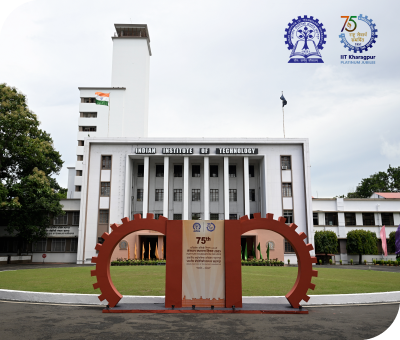
Established in 1951, IIT Kharagpur is India's first IIT and among the world's most respected engineering institutions, ranked 5th in Engineering by NIRF 2025. The programme draws directly on this depth to prepare engineers to design, build and deploy intelligent, autonomous machines.
Built where Robotics, AI, Optimisation and Control meet, with every method carried onto a physical robot, so you learn what actually works outside simulation.

Delivered entirely through live instruction: 71 hours of teaching by IIT Kharagpur faculty.

Delivered by the Department of Mechanical Engineering, where kinematics, dynamics and control are home ground.

Industrial cobots, drones and UAVs, healthcare and service, or defence and applied automation.

Kinematics → Dynamics → Control → Planning → Optimisation → Fuzzy → Deep Learning → Robot Learning → Deployment

Ship working artefacts every module, culminating in an individual capstone defended to faculty.

Build and validate a physical robot, not just a simulation.
From nature-inspired optimisation and fuzzy decision-making to deep learning, robot learning and vision-language-action models: the AI that turns a machine into an intelligent robot.

Formulate real engineering problems as constrained optimisation, tune genetic algorithms and swarms, and make defensible trade-offs with Pareto fronts.

Build controllers and decision systems that encode expert knowledge where data is sparse and every decision must be explainable.

Train, evaluate and debug deep models for perception, then compress and deploy them to edge hardware within a latency budget.

Teach robots from demonstrations and rewards, then carry the policy from simulation to real hardware.

Evaluate the foundation models that let robots follow natural-language instructions, including their failure modes.

Fuse cameras, LiDAR and IMUs into a perception stack, and run learned models on the robot itself.

Topic Covered
Topics
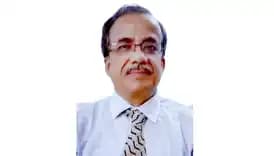
Prof. Dilip Kumar Pratihar

Prof. Homagni Saha

Prof. V. Pandu Ranga
Flexible payment options and zero cost EMIs make your programme even more accessible.
Graduation with a minimum of 50% marks. B.Tech/ M. Tech, B.E/M.E, B.Sc/M.Sc (CS/Mathematics/Statistics/Mechanics/Robotics/Physics), MCA/BCA. Candidates from other disciplines must have a minimum of 2 years of experience in the related technology field.
Total Fee
₹1,77,000
Block Your Seat Now At
₹10,000
EMI per Month
₹6,031
*Fees inclusive of taxes. EMI amount is indicative; terms from partner NBFC.
Prerequisite:
Able to program in Python and comfortable with undergraduate engineering mathematics. Prior robotics experience is not required; a self-paced 15-hour readiness bridge aligns everyone before Week 1.
Each module ends in a graded project you build, test and validate with evidence. Together they form a portfolio that takes you from first kinematic model to real-world deployment.
A URDF model of your robot with forward and inverse kinematics solved in code.
A simulated multi-body model with motors and gearboxes sized to a duty cycle.
A tuned controller running through ros2_control, with a written safety case.
Combine classical deep learning with quantum components in hybrid CPU/GPU/QPU pipelines across the major cloud platforms.
Formulate feature selection, scheduling and portfolio problems as QUBO/QAOA - the optimisation layer under many AI systems.

Matched parameter counts, ablations, dequantisation and classical baselines - the rigour AI practitioners already expect, applied to quantum.
Earn recognised credentials and academic recognition.
Top 10 percentile performers in each cohort receive a Certificate with Distinction, recognised on the credential itself.
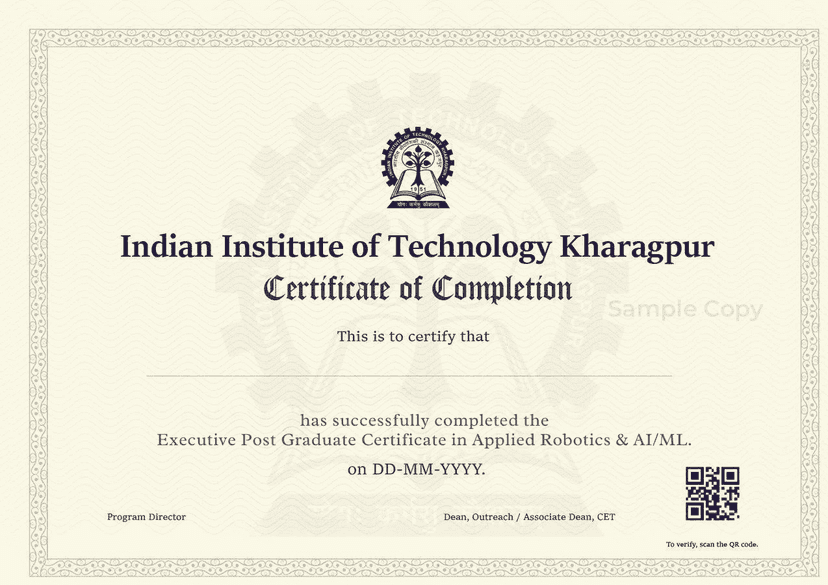
at IIT Kharagpur
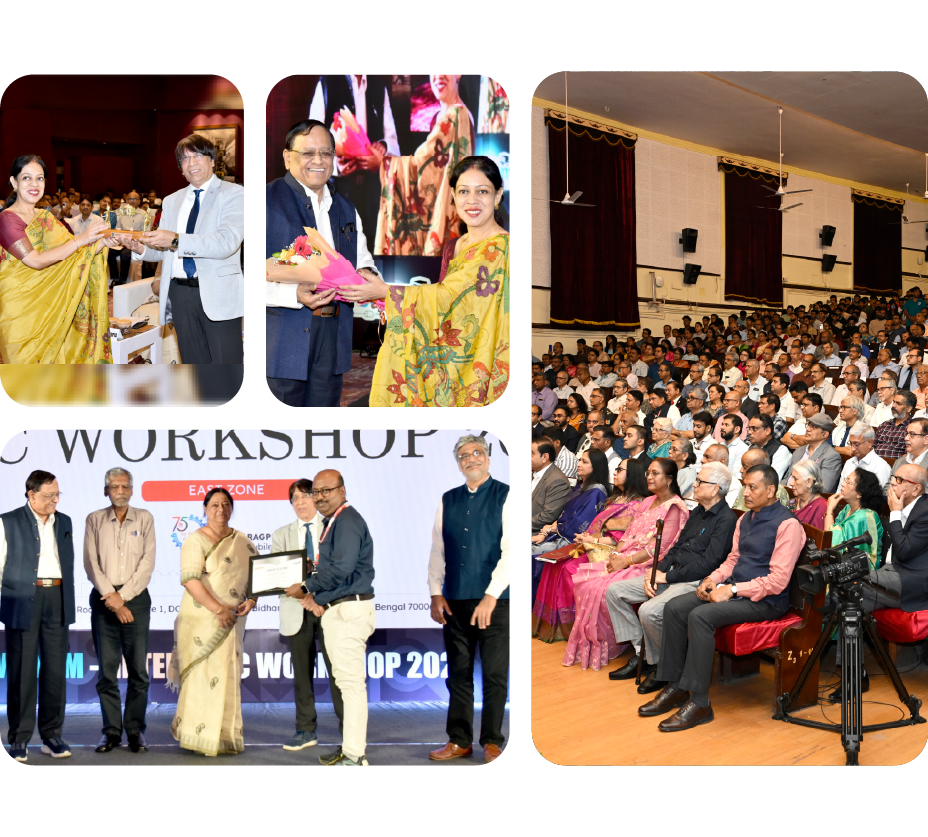
The programme concludes with an on-campus award ceremony at IIT Kharagpur, where participants receive their certificates from the Programme Director and Institute leadership.
Admission Process for the EPGC in Applied Robotics & AI/ML Programme with three easy steps!
Fill your details and complete your application.
Get shortlisted and Receive Offer Letter
Block your seat