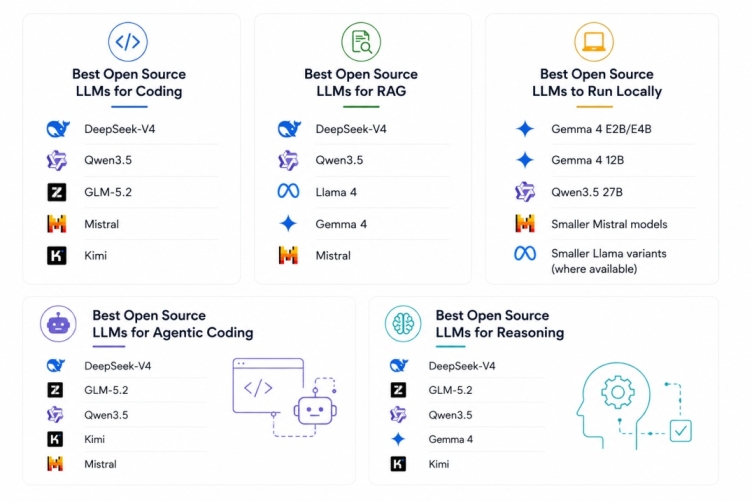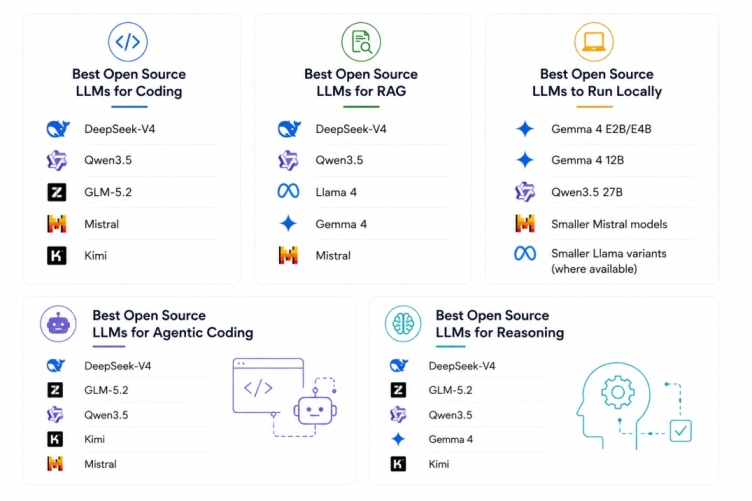


Quick Overview:
The best open source LLMs in 2026 include DeepSeek, Qwen, Llama, Gemma, Mistral, and GLM, each suited to different AI works and projects.
DeepSeek-V4 stands out for reasoning, coding, long-context applications, and AI agents, while Qwen3.5 offers flexible sizes and strong multilingual capabilities.
Gemma 4 and smaller Qwen and Mistral models are practical choices for local deployment, while Llama 4 offers a broad ecosystem and multimodal capabilities.
In this blog you will explore the best open source LLMs in 2026, their key features, use cases, comparisons, benefits, limitations, and how to choose the right model for your needs.
Best Open Source LLMs in 2026
Below is a quick comparison table for the best open source LLMs covered later in this blog. The model size and benchmarks are based on the current data, as they shift every month. So before selecting any model, check each vendor's model card before committing to one for production.
Model | Best For | Model Size | Context Window | Local Use | Fine-Tuning | Key Strength |
DeepSeek V4 | Reasoning and coding at frontier scale | 1.6T total (49B active) Pro; 284B total (13B active) Flash | Up to 1M tokens | Flash variant feasible on high-end workstations; Pro needs multi-GPU clusters | Yes, open weights | Frontier-level reasoning and coding at a fraction of proprietary API cost |
Kimi K2.6 | Agentic coding and multimodal tasks | 1T total, 32B active | 256K tokens | Needs serious multi-GPU hardware | Yes | Strong agent orchestration with native vision and video input |
GLM-5.1 | Long-horizon coding and agentic workflows | Roughly 750B total, 40B active | 200K to 203K tokens | Cloud or multi-GPU recommended | Yes | Leading open-weight coding benchmark scores at low API cost |
Qwen3.5 / Qwen3.6 | Coding and multilingual use across hardware tiers | Ranges from 4B to 397B, dense and MoE options | Up to 1M tokens on some variants | Small variants (4B to 35B) run well on consumer GPUs | Yes | Widest range of sizes, so there is a fit for almost any hardware budget |
Llama 4 (Scout, Maverick) | General-purpose apps and broad ecosystem support | 109B total (Scout) to 400B total (Maverick), MoE | Up to 10M tokens (Scout) | Scout fits on a single high-end GPU | Yes | Largest tooling and fine-tuning ecosystem of any open model family |
Gemma 4 | Lightweight and edge deployment | 2B to 31B, dense and MoE options | Up to 128K tokens | Runs comfortably on laptops and phones for smaller sizes | Yes | Fully Apache 2.0 licensed and genuinely practical on modest hardware |
Mistral Small 4 / Large 3 | Efficient multi-purpose deployment | 119B total, 6B active (Small 4); 675B (Large 3) | Up to 256K tokens | Small 4 runs on a single high-end GPU | Yes | Combines reasoning, multimodal input, and coding in one efficient model |
Which Open Source LLM Is Best Overall?
There is no single model that is best for every workload. The best open source LLMs depend upon your task and usage. Still you can consider these LLMs for different tasks:
DeepSeek-V4 is a strong overall choice when reasoning, coding, long context, and agentic tasks are priorities.
Qwen3.5 is particularly attractive when you want a broad range of model sizes and strong multilingual and coding capabilities.
For local deployment on more modest hardware, Gemma 4 is easier to consider because its family includes models from 2.3B to 31B.
For extremely long context, Llama 4 Scout and models such as GLM-5.2 and DeepSeek-V4 wins.
Now let’s explore some of the top open source LLMs which other peoples are considering in 2026.
Top Open Source LLMs to Consider in 2026
Before choosing any LLM for your project or task it is necessary to know about the key strengths and limitations of that model. The following models represent the open source LLMs most worth evaluating in 2026.
1. DeepSeek
Best for: Reasoning, coding, long-context applications, and AI agents.
Key strengths: DeepSeek's current V4 family includes Pro and Flash variants. V4 Pro has 1.6T total parameters with 49B active parameters, while V4 Flash has about 284B total parameters with 13B active parameters. Both support a 1M-token context window.
Hardware considerations: The large parameter counts make full local deployment demanding. Quantisation and specialised inference infrastructure can reduce the hardware requirement, but the flagship variants are not intended for typical consumer laptops.
Pros:
Strong reasoning and coding capabilities
1M-token context
Multiple model variants
Open-weight availability
Cons:
Flagship models require substantial hardware
Full-size deployment can be complex
Smaller local users may prefer more compact families
DeepSeek's V4 release is particularly relevant for developers building long-context and agentic applications.
2. Qwen
Best for: Coding, multilingual applications, general-purpose AI, and flexible deployment.
Key strengths: Qwen offers a broad model family covering different parameter sizes and workloads. Current Qwen3.5 open models include 27B, 35B-A3B, 122B-A10B, and 397B-A17B variants, with up to 256K context for these open models.
Hardware considerations: Smaller Qwen models can be deployed locally with considerably fewer resources than the flagship variants. Larger MoE models require substantially more memory and compute.
Pros:
Wide range of model sizes
Strong coding capabilities
Good multilingual support
Suitable for local and server deployment
Cons:
Larger variants require significant hardware
Choosing among many versions can be difficult
Capabilities and licensing should be checked for the specific checkpoint
Qwen is one of the strongest choices when you want flexibility rather than committing to a single model size.
3. Llama
Best for: General-purpose AI, multimodal applications, research, and large developer ecosystems.
Key strengths: Llama remains important because of its broad ecosystem, tooling, integrations, and community support. Llama 4 Scout supports multimodal inputs and a 10M-token context window, while Maverick provides a 1M-token context window.
Local deployment: Llama models can be downloaded and deployed using supported infrastructure. However, the largest variants require substantial computing resources.
Licensing considerations: Llama 4 uses the Llama 4 Community License rather than a conventional permissive open-source licence. Developers should review the applicable terms before commercial deployment.
Pros:
Large developer ecosystem
Strong tooling and community support
Multimodal capabilities
Very long context options
Cons:
Licensing is not the same as a standard permissive open-source licence
Large variants have high hardware requirements
Model selection can be complex
4. Gemma
Best for: Local AI, smaller deployments, reasoning, coding, and multimodal applications.
Key strengths: Gemma 4 is Google's current open-weight family and includes models designed for different compute environments. The family ranges from 2.3B to 31B parameters and supports multimodal capabilities.
Smaller-model/local use: Gemma 4's compact E2B and E4B variants make the family particularly relevant for edge and resource-constrained applications, while 12B, 26B, and 31B variants target more capable deployments.
Pros:
Wide range of model sizes
Strong capability-to-compute ratio
Multimodal support
Designed for local and server environments
Apache 2.0 licensing for Gemma 4
Cons:
Larger versions still need significant hardware
Google-specific terms and model documentation should be checked for the exact release
Smaller models naturally have lower capacity than flagship models
Gemma 4 is one of the more practical options when local deployment and hardware efficiency matter.
5. Mistral and Mixtral
Best for: Efficient inference, coding, enterprise applications, and self-hosted AI.
Efficiency: Mistral's current open model range includes compact Ministral models, Mistral Small 4, Mistral Medium 3.5, and Mistral Large 3. The company's model catalogue lists open models across several sizes and capabilities.
Model architecture/options: Mistral's ecosystem includes dense and mixture-of-experts architectures. Mixtral is the earlier MoE family that helped establish Mistral's reputation for efficient open models, while newer Mistral releases provide more current options.
Pros:
Strong efficiency across model sizes
Multiple deployment options
Open-weight models for self-hosting
Good coding and general-purpose capabilities
Cons:
Different models have different licences and specifications
Older Mixtral models may not be the best choice for new projects
Larger models still require considerable infrastructure
For a new deployment, compare the latest Mistral checkpoint with older Mixtral releases instead of automatically selecting Mixtral because of its popularity.
GLM and Other Frontier Open Models
GLM-5.2 is a significant current option for long-horizon work, with a 1M-token context and a model size of about 753B parameters. Its model repository is available under the MIT licence.
Other notable open-weight families include Kimi, MiniMax, and gpt-oss. The exact ranking changes rapidly as new checkpoints and benchmark results appear, so model selection should be based on current evaluations, licensing, hardware requirements, and the intended workload rather than a fixed “top 10” ranking.
After exploring the top open source LLMs, let’s find the Best LLM according to your use case.
Best Open Source LLMs by User and Use Case
Different workloads favour different model characteristics. Instead of asking which model is universally the best, it is more useful to ask which model best fits your application.