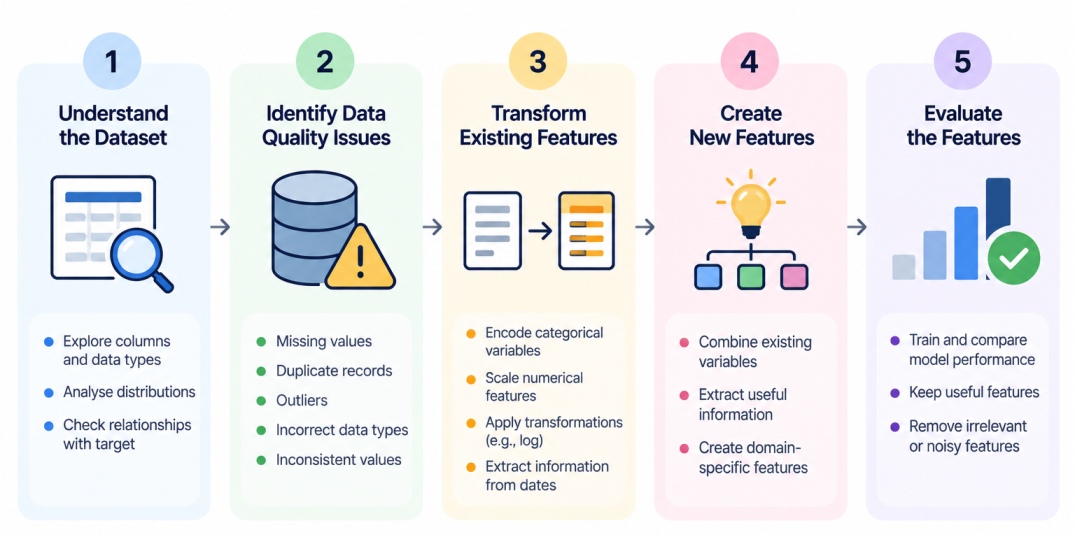
Step 1: Understand the Dataset
You have to start by understanding the available columns, their data types, distributions, and relationships with the target variable.
You can use techniques such as:
Descriptive statistics
Data visualization
Correlation analysis
Missing value analysis
Step 2: Identify Data Quality Issues
After understanding the dataset you have to check for:
Missing values
Duplicate records
Incorrect data types
Outliers
Inconsistent values
Irrelevant columns
These issues should be addressed before creating new features.
Step 3: Transform Existing Features
Then, you have to transform features into formats that machine learning algorithms can use effectively.
For example:
Convert categorical values into numerical values.
Scale numerical features when required.
Apply logarithmic transformations to highly skewed variables.
Extract useful information from dates.
Step 4: Create New Features
Then, you have to use the existing variables to create new features that may contain more useful information.
For example:
Date of Birth: Age
Purchase Date: Day, Month, Year
Total Sales and Number of Orders: Average Order Value
Height and Weight: BMI
Step 5: Evaluate the Features
At last, you will train the model with the engineered features and compare its performance with the original feature set. At this stage, not every new feature improves a model, some may add noise or unnecessary complexity.
Now that you have a good understanding of feature engineering basics, let’s explore the feature engineering techniques which are commonly used.
Also Read: K Means Clustering in Machine Learning: Algorithm, Steps, Examples, and Applications
Common Feature Engineering Techniques in Machine Learning
There are so many feature engineering techniques used depending on the type of data and machine learning problem. Some common techniques are:
1. Handling Missing Values
When you explore a dataset, you will find lots of missing values because it is common in real-life datasets. You can handle missing values by:
Removing rows or columns
Replacing missing numerical values with the mean
Using the median
Using the mode for categorical data
Applying more advanced imputation methods
For example, missing age values can be replaced with the median age of the dataset.
Also Read: Logistic Regression in Machine Learning: Algorithm, Types, Examples, and Applications
2. One-Hot Encoding
The one hot encoding is the most common feature engineering techniques, which converts categorical values into separate binary columns.
Imagine in dataset, a City column contains:
One-hot encoding can create:
City | Delhi | Mumbai | Pune |
Delhi | 1 | 0 | 0 |
Mumbai | 0 | 1 | 0 |
Pune | 0 | 0 | 1 |
Here:
This helps the ML model to understand categories without assuming that one category is bigger or smaller than another. For example, the model will not assume that Pune is greater than Delhi just because the categories are converted into numbers.
3. Label Encoding
The label encoding technique converts categories into numbers. Each category gets a unique numerical value.
For example:
Here, the numbers represent an order. Low comes before Medium, and Medium comes before High.
The label encoding works good when categories have a clear order, such as:
Low, Medium, High
Beginner, Intermediate, Advanced
Poor, Average, Good, Excellent
For categories that do not have an order, such as City or Colour, one hot encoding is usually more suitable.
Also Read: Clustering in Machine Learning: Types, Algorithms, Examples, and How It Works
4. Feature Scaling
Feature scaling changes numerical features so they are on a similar scale. For example, suppose a dataset has:
The salary values are much larger than the age values. Some machine learning algorithms may give more importance to salary because of its larger numbers.
Two common methods of feature scaling are:
Standardization: Changes the values so they have a mean close to 0 and a standard deviation close to 1.
Normalization: Changes the values to a fixed range, usually between 0 and 1.
Feature scaling is useful for algorithms that are affected by the size of numerical values, such as KNN, SVM, and some neural networks.
5. Log Transformation
Log transformation is a feature engineering technique used to handle highly skewed numerical data.
For example, income data may contain many people with average incomes and a few people with very high incomes. These extremely high values can make the data uneven.
It is commonly used for features such as:
Income
Sales
Population
House prices
6. Binning
Binning is a feature engineering technique that groups continuous numerical values into different ranges or categories. This makes the data easier to understand and can help a model identify patterns within different groups.
For example, instead of using exact ages, you can group them as:
18–25: Young
26–40: Adult
41–60: Middle-aged
61+: Senior
7. Date and Time Feature Extraction
Date and time data can contain useful information for a machine learning model. You can extract specific parts of a date or time and use them as separate features.
For example: 2026-09-21 10:30 AM
This can be converted into:
Year: 2026
Month: September
Day: 21
Hour: 10
Day of the week: Monday
Weekend: No
These features can help a model identify patterns based on when an event happens. This technique is commonly used for sales, finance, transportation, and time-series data.
Also Read: Supervised vs Unsupervised Learning: Differences, Examples, and Applications
8. Mathematical Transformations
Mathematical transformations use existing features to create new and more useful features. For example, you can calculate:
Profit = Revenue - Cost
Or:
Average Purchase = Total Purchase Amount / Number of Orders
These new features can give the machine learning model more useful information and help it identify patterns in the data.
9. Interaction Features
Interaction features in feature engineering combines two or more variables to capture relationships between them.
For example: House Size × Number of Rooms
It can create a feature that represents the relationship between property size and room count.
10. Text Feature Engineering
Text data can be transformed into numerical features using feature engineering techniques such as:
Bag of Words
TF-IDF
Word embeddings
Text length
Word count
Character count
For example, the number of words in a customer review can be used as a feature for a text classification model.
Now let’s understand this implementation of feature engineering in machine learning through Python which helps you to understand the topic practically as well.
How to Perform Feature Engineering in Python?
Python provides several libraries for feature engineering, including Pandas, NumPy, and scikit-learn. Let’s consider a simple dataset containing customer information:
import pandas as pd
data = {
"Age": [22, 35, 42, 28],
"Income": [30000, 55000, 70000, 45000],
"City": ["Delhi", "Mumbai", "Pune", "Delhi"]
}
df = pd.DataFrame(data)
print(df)
Output:
Age Income City
0 22 30000 Delhi
1 35 55000 Mumbai
2 42 70000 Pune
3 28 45000 Delhi
1. Creating a New Feature
You can create a new feature using existing columns.
df["Income_per_Age"] = df["Income"] / df["Age"]
print(df)
Output:
Age Income City Income_per_Age
0 22 30000 Delhi 1363.636364
1 35 55000 Mumbai 1571.428571
2 42 70000 Pune 1666.666667
3 28 45000 Delhi 1607.142857
2. One-Hot Encoding in Python
Using Pandas:
df_encoded = pd.get_dummies(df, columns=["City"])
print(df_encoded)
Output:
Age Income Income_per_Age City_Delhi City_Mumbai City_Pune
0 22 30000 1363.636364 True False False
1 35 55000 1571.428571 False True False
2 42 70000 1666.666667 False False True
3 28 45000 1607.142857 True False False
3. Feature Scaling in Python
You can use StandardScaler from scikit-learn:
from sklearn.preprocessing import StandardScaler
scaler = StandardScaler()
df[["Age", "Income"]] = scaler.fit_transform(
df[["Age", "Income"]]
)
print(df)
Output:
Age Income City
0 -1.300723 -1.371989 Delhi
1 0.433574 0.342997 Mumbai
2 1.367427 1.371989 Pune
3 -0.500278 -0.342997 Delhi
Now that you have learned Python implementation, let’s apply the feature engineering in machine learning by yourself with exercise below.
Strengthen your data science skills with the Executive Post Graduate Certificate in Applied Data Science & Agentic AI. Learn to work with data, AI, and intelligent agents to build practical solutions for real-world business challenges.
Feature Engineering Exercise
Try this exercise to practise the feature engineering techniques you have learned.
Given the following dataset:
import pandas as pd
data = {
"Age": [21, 29, 35, 42, 50],
"Income": [25000, 40000, 55000, 75000, 90000],
"City": ["Delhi", "Mumbai", "Delhi", "Pune", "Mumbai"],
"Orders": [2, 4, 5, 8, 10],
"Total_Spending": [5000, 12000, 18000, 32000, 50000]
}
df = pd.DataFrame(data)
print(df)
Your Tasks
Create a new feature
Apply One-Hot Encoding
Create Age Groups
18–25 → Young
26–40 → Adult
41–60 → Middle-aged
Apply Feature Scaling
Check the final dataset
Challenge: Try completing all five tasks without looking at the previous examples.
Now let’s understand what tools and libraries you can use with python for feature engineering in machine learning.
Popular Feature Engineering Tools and Libraries
You can use so many tools for feature engineering in machine learning including Pandas, NumPy, Scikit-learn and more. Let’s understand each of them in detail:
1. Pandas
Pandas is widely used for:
2. NumPy
NumPy is a Python library used for numerical and mathematical operations. It can help you create, transform, and combine features.
NumPy is widely used for:
Performing mathematical calculations
Creating new features
Applying mathematical functions
Working with numerical arrays
Handling numerical data efficiently
Transforming existing features
3. Scikit-learn
Scikit-learn provides tools for:
4. Feature-engine
Feature-engine is a Python library designed specifically for feature engineering and preprocessing tasks. It provides transformers for missing data, categorical variables, numerical variables, outliers, and feature selection.
5. tsfresh
tsfresh is a Python library used to automatically extract useful features from time-series data.
It can calculate many features from raw time-series data, such as:
Now let’s understand what are the advantages and disadvantages of feature engineering for machine learning.
Advantages and Disadvantages of Feature Engineering
Feature engineering can make data more suitable for machine learning, but it also requires careful decisions.
Advantages of Feature Engineering
Can improve model performance.
Converts raw data into meaningful features.
Helps models identify useful patterns.
Can make complex data easier to use.
Supports different types of machine learning algorithms.
Can reduce the impact of irrelevant information.
Disadvantages of Feature Engineering
Can require significant time and domain knowledge.
Poorly designed features can reduce model performance.
Feature engineering can introduce data leakage.
Too many features can increase model complexity.
Some transformations may not generalise to new data.
Different models may benefit from different types of features.
Conclusion
So, what is feature engineering in machine learning in simple terms? It is the process of transforming raw data into useful features that help a machine learning model learn patterns more effectively. It can involve creating new variables, transforming existing data, encoding categories, and extracting useful information.
Using the right feature engineering techniques can improve model performance and make data easier to work with. However, features should be created carefully to avoid unnecessary complexity, data leakage, and poor generalization.