



Quick Overview:
Applied AI is the use of artificial intelligence tools such as machine learning, NLP, and computer vision to address real-world issues with measurable outcomes.
This includes problem definition, data preparation, model selection and training, testing, deployment and monitoring.
Applications include: fraud detection, medical image analysis, predictive maintenance, product recommendations and demand forecasts.
Applied AI delivers automation and enhanced decision assistance but requires quality data, technical competence, monitoring, and appropriate governance.
In this blog you will explore what is applied AI, along with its working, components, difference between applied AI and Generative AI, real world applications and benefits & challenges.
Applied AI is changing how businesses solve problems, automate processes, and make data-driven decisions. The IIT Kharagpur - Executive Programme in Technology & AI Leadership helps you build the leadership perspective needed to evaluate AI opportunities and guide technology adoption across business functions.
What Is Applied AI?
Applied AI refers to the application of current AI techniques (e.g. machine learning, Natural Language Processing, computer vision, generative models) to to solve specific problems in real businesses and real settings.
So what is applied AI in one line? It is AI that has been put to work on a defined task with a measurable outcome.
The easiest way to understand what is applied AI is to compare it with research AI.
Research AI is concerned with "how can we make our models better?" and "how can we create new algorithms to improve the capabilities of what machines can learn?" Applied AI is concerned with "how can we use these models to reduce cost, save time, reduce risk or improve decision making in this specific area."
Let’s understand this more using an real life applied AI example:
Imagine we operate an online store and wish to reduce client churn. Data Scientists collect data on purchases, support tickets and logins. They train a model that can anticipate which consumers are likely to leave. The marketing team then send out a special offer to the highest risk group. This model is only part of the solution. The data pipeline, business objective, sending out the offer and measuring the outcomes make this applied AI.
How Does Applied AI Work?
Understanding how applied AI works helps to make it more easy to understand. Most applied AI projects follow this basic flow:
State the problem: Identify the exact business target, i.e. reducing the number of late deliveries by a given percentage.
Data gathering & preparation (Feature engineering): Collecting the right data from databases, sensors, papers or apps. This is then cleaned and formatted.
Model selection & training: Select the type of model you want to develop (predictive, linguistic or vision) and train or fine tune your model on the data.
Testing & evaluation: Test the model against real examples; compare to your existing procedure.
Deployment: Connect your model to your application, dashboard or process so that people/systems can use the results.
Monitoring and improvement: Track for accuracy, cost and business effect. Update your model with changes in data.
Working Python Example
The code below is a small applied AI example. It trains a model to predict customer churn on synthetic data and then turns the predictions into a business action, a retention offer for the highest-risk customers. It runs as written with scikit-learn, pandas, and NumPy installed.
import numpy as np
import pandas as pd
from sklearn.ensemble import GradientBoostingClassifier
from sklearn.metrics import roc_auc_score
from sklearn.model_selection import train_test_split
rng = np.random.default_rng(7)
n = 5000
customers = pd.DataFrame({
"tenure_months": rng.integers(1, 60, n),
"monthly_spend": rng.normal(60, 20, n).clip(10, None),
"support_tickets_90d": rng.poisson(1.2, n),
"days_since_last_login": rng.exponential(10, n),
})
# Business reality: unhappy, inactive, short-tenure customers churn more
risk = (
0.6 * customers["support_tickets_90d"]
+ 0.15 * customers["days_since_last_login"]
- 0.05 * customers["tenure_months"]
)
customers["churned"] = (rng.random(n) < 1 / (1 + np.exp(-(risk - 1.5)))).astype(int)
X = customers.drop(columns="churned")
y = customers["churned"]
X_train, X_test, y_train, y_test = train_test_split(X, y, test_size=0.25, random_state=7)
model = GradientBoostingClassifier(random_state=7).fit(X_train, y_train)
scores = model.predict_proba(X_test)[:, 1]
print("AUC:", round(roc_auc_score(y_test, scores), 3))
# The applied step: turn predictions into an action the business can take
at_risk = X_test.assign(churn_probability=scores).nlargest(5, "churn_probability")
at_risk["action"] = "Send retention offer"
print(at_risk[["tenure_months", "support_tickets_90d", "churn_probability", "action"]].round(2).to_string())
Output:
AUC: 0.864
The model achieves an AUC of around 0.86 on this synthetic data. The bottom lines highlight how we move from predictions to decisions. This is the essence of what is applied AI. As you can see the value of the model comes from the actions that the business makes based on the scores. This isn’t real data so do not take this as a benchmark.
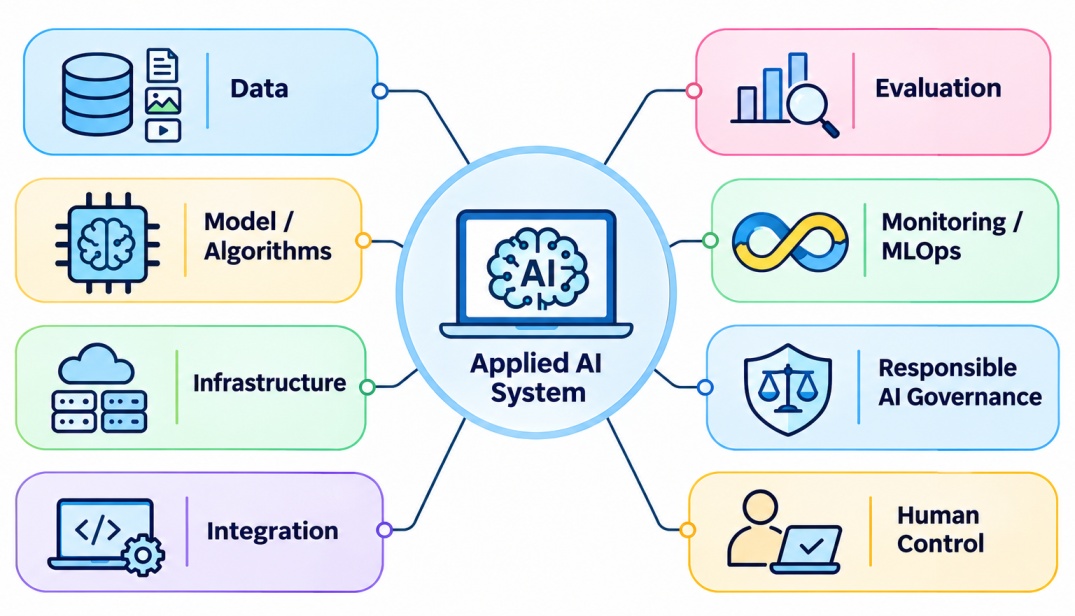
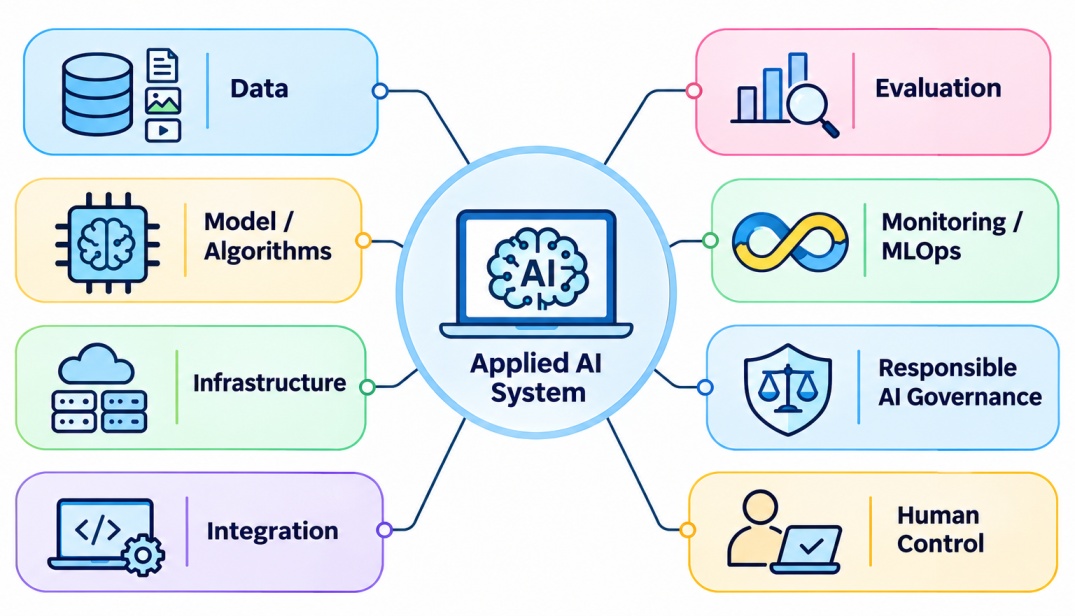
Now after understanding the working of applied AI, now let’s explore the components involved in practical applied AI systems.
Key Components of an Applied AI System
Practical AI will have several pieces working together to collect raw data and create value from that data.
Below are the key components of applied AI: