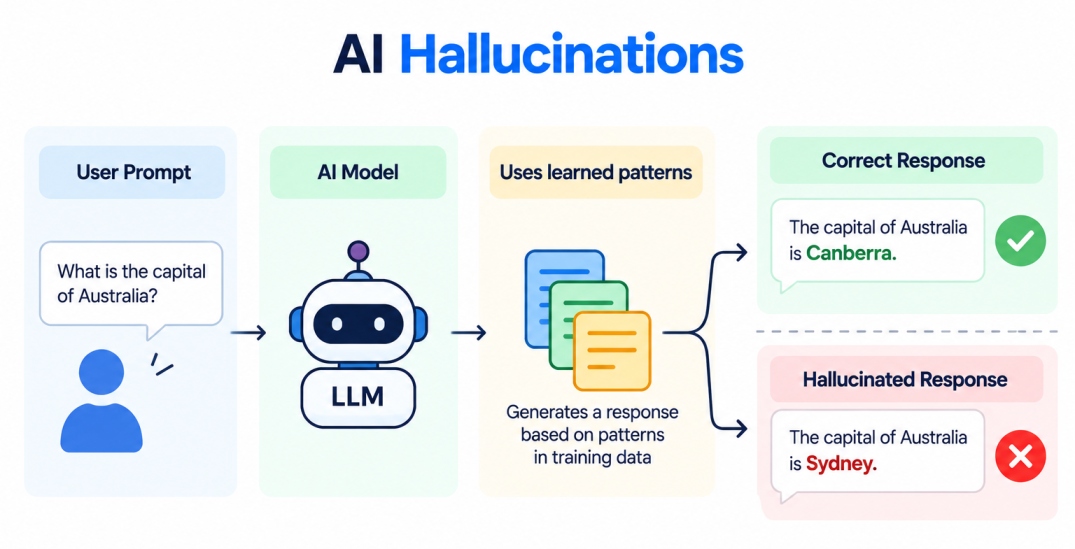
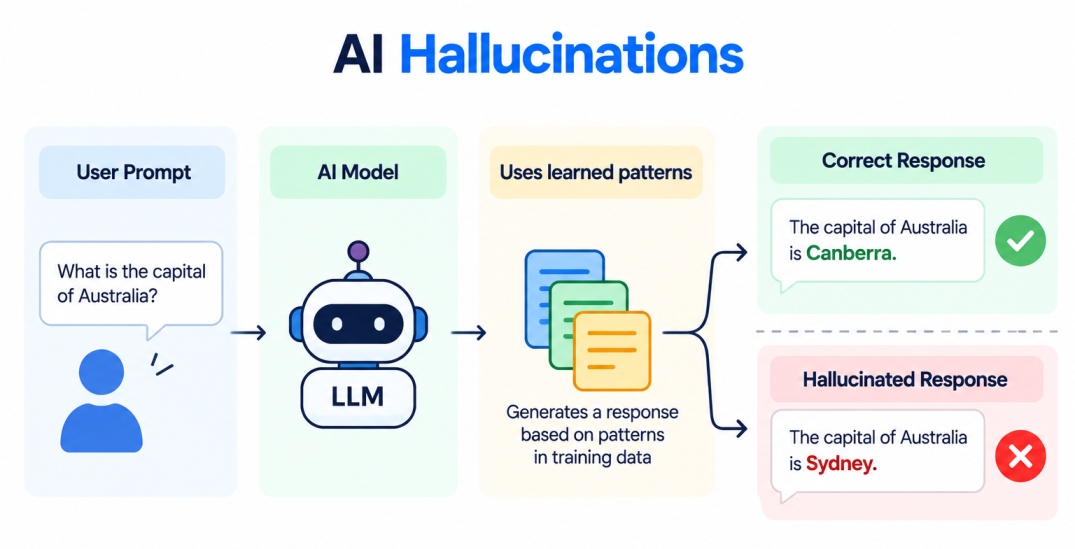
In 2024, a Stanford University study published a report where researchers evaluated AI models for legal work and asked about case law, citations, and legal facts. During the research the AI models hallucinated between 17% and 34% of the time, which is a major number for such critical work.
Also Read: Linear Regression in Machine Learning: Types, Algorithm, and Implementation
How Do AI Hallucinations Happen?
AI models do understand any information in the way that humans do. LLMs generates the response by identifying patterns of data on which it was trained and predicting what information should come next which is basically next-token prediction.
Below are some common factors which contribute to hallucinations in AI:
Incomplete or outdated training data: An AI model which does not have access to the latest information which the user is asking.
Gaps in training data: If the model does not have the information on a topic, it may generate an answer based on the related pattern.
Vague prompts: Unclear or incomplete instructions can lead to inaccurate responses.
Complex questions: Questions involving multiple steps, calculations, or reasoning can increase the possibility of errors.
Lack of reliable context: Without sufficient source information, an AI model may generate plausible but unsupported details.
Confident language generation: AI can present an incorrect answer in a fluent and confident manner, making the error difficult to notice.
Now let’s understand this with the help of real life AI hallucinations examples which gives you a more clear understanding about the topic.
Example of Hallucinations in AI
One of the most well-known examples of AI hallucination happened in the 2023 U.S. federal court case Mata v. Avianca.
In this AI hallucinations case, two lawyers of New York used ChatGPT to prepare a legal brief to make their case strong which included six fake court cases. ChatGPT had created the case names, quotes, and legal details, even though none of them actually existed. After recognizing this by the court, the judge fined each lawyer with a fine of $5,000. The case shows how AI hallucinations can cause serious problems when AI-generated information is used in professional work.
Similar AI hallucination incidents have happened since then.
In 2024, an Air Canada chatbot gave a customer incorrect information about a bereavement fare refund. The chatbot said the customer could claim the discount later, even though the policy did not exist. A tribunal held Air Canada responsible for the chatbot's response.
Google's AI Overviews also faced criticism after suggesting that people add glue to pizza sauce. The answer was linked to a satirical post that the AI had treated as a reliable source.
Also Read: K Means Clustering in Machine Learning: Algorithm, Steps, Examples, and Applications
Now let’s understand what different types of AI Hallucinations are there.
Types of AI Hallucinations
AI hallucinations can appear in different forms depending on how the generated information becomes inaccurate. Understanding these types can make it easier to identify and address hallucinations in AI-generated responses.
1. Factual Hallucinations
Factual hallucinations occur when an AI model states something as true that is simply, verifiably wrong, such as citing an incorrect date, statistic, or scientific fact with full confidence. This is the most commonly reported category of hallucination overall, and it is often the hardest for a casual reader to catch, since the false statement is usually delivered in exactly the same tone as a correct one.
2. Fabricated Information
Fabricated information occurs when an AI generates details that do not exist.
For example, an AI system might invent:
Because the generated information may contain realistic names, dates, and descriptions, users may not immediately recognize that it is fabricated.
3. Citation and Source Hallucinations
Citation and source hallucinations involve inventing academic papers, legal cases, news articles, or URLs, often complete with plausible author names, publication years, and quotes. The Mata v. Avianca case is the best example, but this category also includes the failure mode of citing a real source for a claim it does not actually support.
Also Read: Logistic Regression in Machine Learning: Algorithm, Types, Examples, and Applications
4. Contextual Hallucinations
Contextual hallucinations in AI occur when an AI misunderstands or ignores information provided in the prompt.
For example, if a user asks an AI to summarize a document and the response introduces information that is not present in the document, the model may be producing a contextual hallucination.
5. Logical or Reasoning Hallucinations
Logical or reasoning hallucinations occur when an AI produces an incorrect conclusion even when some of the information used in the response is correct.
For example, an AI may correctly identify several facts but combine them incorrectly and arrive at an unsupported conclusion.
These hallucinations can occur in:
After exploring the New York Court example, you must be thinking how risky these AI Hallucinations are. So now let’s explore some of the risks associated with hallucinations in AI.
Also Read: Clustering in Machine Learning: Types, Algorithms, Examples, and How It Works
Risks of AI Hallucinations
AI hallucinations can create different risks depending on how and where AI is used. Some common risks include:
Misinformation: Incorrect AI-generated information can spread false claims, especially when users share responses without verification.
Poor Business Decisions: Businesses using AI for analysis, reporting, or decision support may make poor decisions if inaccurate information is treated as reliable.
Academic Issues: Students and researchers may unknowingly use fabricated citations, incorrect facts, or unsupported claims in academic work.
Legal and Compliance Risks: Incorrect AI-generated information can create compliance or legal risks when used in areas requiring accurate documentation and professional judgement.
Security Risks: In technical environments, incorrect AI-generated code or configuration advice can introduce vulnerabilities or create unexpected system behaviour.
Loss of Trust: Repeated inaccurate responses can reduce users' confidence in AI systems, particularly when the errors are difficult to detect.
How to Detect AI Hallucinations?
AI-generated information should not automatically be treated as accurate. Users can use different methods to detect whether the response generated by AI is accurate or not.
Detection Method | What You Should Do |
Check the facts | Verify important facts, numbers, quotes, and claims using reliable and independent sources. |
Verify citations | Ask the AI for its sources. Check that the sources actually exist and support what the AI has said. |
Look for contradictions | Check whether the response contains conflicting information, incorrect calculations, or numbers that do not add up. |
Do not trust confidence | AI can sound very confident even when it is wrong. Treat confident answers as claims that still need checking. |
Use expert review | For law, medicine, finance, and other high-stakes topics, have a qualified professional review the information before you act on it. |
Cross-check with another AI | Ask another AI model to check the claims. If the two models give different answers, verify the information more carefully. |
Now let’s explore how to prevent hallucinations in AI, which helps you to use only correct or accurate information.
Also Read: Supervised vs Unsupervised Learning: Differences, Examples, and Applications
How to Prevent AI Hallucinations?
AI hallucinations cannot always be eliminated completely, but their frequency and impact can be reduced through better prompting, reliable data, retrieval systems, evaluation, and human verification. Below are some methods by which you can reduce hallucinations in AI:
Method | How It Helps |
Use reliable sources | Give the AI verified documents and sources to work from instead of asking it to rely only on its existing knowledge. |
Lower the temperature | A lower temperature reduces randomness in the AI's responses, which can make answers more consistent and less likely to contain made-up details. |
Give clear context | Provide complete and relevant information in your prompt. This helps the AI understand the task and reduces the chance of missing or invented details. |
Avoid forcing answers | Do not force the AI to provide a fixed number of examples, sources, or answers when it may not have enough reliable information. |
Allow the AI to say "I don't know" | Tell the AI that it can express uncertainty or say when it does not have enough information. This can reduce made-up answers. |
Add human review | Have a person check AI-generated content before using it, especially when incorrect information could cause serious problems. |
By searching or using external resources AI hallucinations can be reduced a lot. So now let’s explore how RAG helps in reducing hallucinations.
Role of Retrieval-Augmented Generation (RAG) in Reducing AI Hallucinations
RAG can help reduce AI hallucinations by providing the language model with relevant information from an external knowledge source before generating an answer.
RAG reduces the AI Hallucinations by following this workflow:
A user submits a query.
The system searches a knowledge base for relevant information.
Relevant documents or passages are retrieved.
The retrieved information is provided to the AI model as context.
The model generates a response based on the retrieved information.
For example, an organization could connect a chatbot to its internal policies and documentation. When an employee asks a question, the system retrieves relevant documents and uses them as context for generating the answer.
However, the RAG also does not guarantee that hallucinations will be reduced or eliminated. Some poor quality documents, irrelevant retrieval results, incomplete knowledge bases, or incorrect generation still leads to inaccurate responses. So, for eliminating the hallucinations in AI with the help of Retrieval-Augmented Generation (RAG), you can evaluate the response, monitoring and must do a human verification where the accuracy is required.
Strengthen your data science skills with the Executive Post Graduate Certificate in Applied Data Science & Agentic AI. Learn to work with data, AI, and intelligent agents to build practical solutions for real-world business challenges.
Conclusion
So, what does it mean when AI hallucinates? AI hallucinations occur when AI systems generate inaccurate, unsupported, or fabricated information. They can include incorrect facts, invented sources, contextual misunderstandings, and flawed reasoning.
Understanding AI hallucinations, checking important outputs, using reliable sources, writing clear prompts, and applying techniques such as RAG can help reduce their impact. As AI becomes more widely used, knowing how to identify and manage hallucinations is an important part of using these systems responsibly.