

































What Is the Executive Post Graduate Certificate in AI-Native Software Engineering?
Programme at a Glance
What Is AI Native Software Engineering?
AI native software engineering involves developing, testing and executing software that includes AI in the process, and often in the product as well. A programmer can use a coding agent to create a feature. They can also be developing an app which functions fundamentally based on an LLM or a retrieval system.
It is necessary to distinguish these two terms because they both use this term:
AI native development is using AI assistants and coding agents in all stages of the software development life cycle: planning, writing, reviewing, testing, debugging and documenting.
AI-native application engineering is developing applications where the core functionality depends on LLMs, retrieval and agents.
Both aspects are covered in this IIT Kharagpur AI native software engineering course. You will develop with AI-assisted development and you will build an application that involves frontend, backend, retrieval, agents, evaluation and deployment.
AI Native Software Engineering vs Traditional Software Development
The fundamentals don't change between both. Version control, system design, testing and security still matter. What changes is where the effort goes. Below is a clear difference between both:
Why Choose the IIT Kharagpur AI Native Software Engineering Course?
1. Design One Unified AI Application
In this course, we do not study unrelated projects but one AI native application that integrates frontend, backend, retrieval systems, and AI agent. This allows students to see how the different parts of an AI application interact.
This way, applicants get a good understanding of how individual components of the AI application interact.
2. Learn AI Coding Assistant With Engineering Judgment
Even though AI coding assistants are able to create some code, this code is not always correct.
Therefore, in order to learn about these coding assistants, it is important to design a functionality manually, use an AI coding assistant to generate the code and analyze it after.
3. Learn How To Build Production-Ready LLM Infrastructure
It is not enough to make a request to a model. An AI application requires other components such as backend, error handling, cost management, and ways to deal with failure of models/services.
In this course, applicants will be building an AI backend which routes requests to different LLMs depending on the cost, latency, and complexity of the request.
4. Learn RAG and Context Engineering
Information that is sourced externally is tied to the language models through RAG. The choosing and structuring the information that is supplied to the LLM is called context engineering.
Subjects that include retrieval, context engineering, vector/hybrid retrieval, multilingual pipelines, evaluation, and RAGAS/LLM-as-judge are covered in this curriculum.
5. Explore Coding Agents, MCP, and Multi-Agent Workflows
Agentic engineering and protocols are covered under this program. Candidates learn about the way agents use tools as well as connect to external services via APIs and MCP.
There is also an independent AI ops agent that uses LangGraph and MCP. The case contains controls for human approval, prompt injection protection, and logging.
6. Build Reliable, Secure, and Governable AI
AI models need to be assessed and controlled even after being deployed. The results produced by AI models can be inconsistent due to problems with retrieving information, dangerous inputs, and changes to the model.
These topics are discussed in the curriculum.
What Skills Does an AI Native Engineer Need?
An AI native engineer requires both the skillset for software development and the ability to operate within AI coding tools, LLMs, retrieval, agents, and evaluations.
These skills are linked to various modules in the programme’s curriculum.
What Will You Learn in the Executive Post Graduate Certificate in AI-Native Software Engineering?
The programme begins with a Foundations Bridge and continues through five core modules. Each module contributes to the development of an integrated AI-native system.
AI-Native Foundations Bridge
The Foundations Bridge assesses each learner's programming readiness and identifies gaps in shared software engineering foundations.
Topics Covered:
Python or TypeScript/React readiness, based on the learner's background
Docker fundamentals
REST APIs
SQL
Full-stack integration
Skills Acquired:
Identifying gaps in programming and development knowledge
Working with the required software engineering foundations
Connecting frontend and backend components
Practical Exercise: Every learner completes a mandatory two-hour integration checkpoint that involves building a working full-stack mini-system.
Module 1: Building AI-Native Interfaces, Vibe Coding & Real-Time Systems
Topics Covered:
Evaluate foundation models (Claude, GPT-4o, Gemini, Llama, DeepSeek) using cost, capability, and risk.
Build Next.js App Router with Server/Client Components, streaming SSR, TypeScript strict mode.
Implement WCAG 2.1 AA accessibility with axe-core testing.
Build real-time LLM streaming with Vercel AI SDK, loading states, confidence indicators.
Deploy on Vercel with 80%+ test coverage and CI/CD via GitHub Actions.
Skills Acquired:
Building interfaces for AI-powered applications
Applying coding assistance to development tasks
Reviewing generated code before using it
Identifying implementation and security issues
Understanding real-time AI application workflows
Module 2: Production-Grade LLM Infrastructure
Topics Covered:
Design FastAPI backend with Pydantic v2 typed validation and RFC 7807 error handling.
Integrate OpenAI and Anthropic SDKs with streaming, structured outputs, prompt versioning.
Build resilient AI services: circuit breakers, fallback chains, timeout management.
Process Indian documents: PAN, GST invoices, Aadhaar via vision models + OCR.
Instrument per-request cost attribution, user-level spend alerts, async processing.
Skills Acquired:
Understanding the architecture of an LLM-powered backend
Considering cost and latency when routing requests
Recognising ways to handle model and service failures
Understanding cost tracking for AI application usage
Connecting LLM services with application infrastructure
Module 3: Retrieval, Context Engineering & Evaluation
Topics Covered:
Only SDKs and HTTP calls.
Design an abstraction layer resilient to LangChain/LlamaIndex version churn.
Implement multi-tenant retrieval with pgvector, row-level security.
Add multilingual retrieval via Bhashini, with fallback to open-source embedding models where API coverage is incomplete.
Evaluate with RAGAS (faithfulness, relevancy, precision, recall) + CI regression gates.
Skills Acquired:
Connecting retrieved information with LLM responses
Understanding different retrieval approaches
Organising context for AI applications
Evaluating retrieval and generated responses
Understanding automated evaluation and regression checks
Module 4: Agentic Engineering & Protocol Design
Topics Covered:
Design the perceive-reason-act-observe loop; React and plan-and-execute patterns.
Build stateful agents with LangGraph: state machines, tool contracts, checkpointing.
Build an MCP server with authentication, least-privilege permissions, audit logging.
Design prompt-injection-aware tools; survey emerging A2A and browser-use patterns.
Implement human approval gates (>₹1K), escalation workflows, multi-agent coordination.
Integrate WhatsApp Business API, UPI, GST validation, DigiLocker.
Skills Acquired:
Understanding how AI agents connect to tools and services
Structuring multi-step AI workflows
Exploring MCP-based integrations
Understanding how human approval can be included in agent workflows
Identifying security considerations for agentic applications
Module 5: AI Systems Reliability, Security & Governance
Topics Covered:
Langfuse: alerting, SLA dashboards, cost anomaly detection.
Semantic caching with Redis (40-60% savings).
Intelligent model routing + budget enforcement.
CI/CD evaluation gates blocking regressions.
Semantic prompt versioning + model-version tracking.
Zero-downtime deployment of complete system.
OWASP LLM Top 10 + Promptfoo red-teaming (30+ tests).
Skills Acquired:
Identifying reliability and security risks in AI systems
Understanding adversarial testing
Applying evaluation and regression checks
Recognising the role of cost monitoring and routing
Understanding data protection controls for AI applications
Capstone: The Proof
As part of capstone, learners will have to construct a full-scale AI-native system with the help of a real-world problem. The program suggests such possible domains as fintech, e-commerce, health care, and enterprise SaaS.
Capstone Phases:
Define: Define the problem and project scope.
Architect: Plan the whole solution which includes the frontend, backend, AI elements, retrieval and deployment.
Build: Develop the application through AI-powered full-stack engineering.
Deploy: Prepare for deployment, monitoring, and governance.
Skills Acquired:
Translating a business problem into a software system design
Connecting frontend and backend components with AI systems
Building retrieval and agentic workflows
Evaluating system performance, accuracy, cost, and reliability
Preparing an application for deployment
Explaining engineering choices and system controls
What Will You Build During the AI Native Software Engineering Course?
The course consists of creating portfolios of AI applications and a capstone. Each capstone consists of a concentration on a specific piece of the AI-native engineering workflow.
1. AI-Native Commerce Dashboard
It is designed for use in a direct to consumer workflow with the use of AI to make listings, pricing and SEO content.
Skills demonstrated: AI native interfaces, workflow design, accessibility, OAuth security, and CI/CD.
2. Production-Grade AI Backend Infrastructure
It is built using FastAPI as a way to route requests through different LLMs based on cost and latency.
Skills demonstrated: LLM infrastructure, backend development, model routing, reliability, and cost tracking.
3. Enterprise Knowledge & Reasoning System
This system uses multi-hop RAG on commerce data. It includes vector, hybrid, and graph-aware retrieval, as well as multilingual retrieval and RAGAS evaluation.
Skills demonstrated: RAG, retrieval techniques, context engineering, multilingual retrieval, and evaluation.
4. Autonomous AI Operations Agent
This is an agent that solves problems and automatically completes processes with human-in-the-loop controls. It leverages LangGraph and MCP and has prompt injection defenses and audit logs.
Skills demonstrated: Agentic engineering, tool invocation, protocol design, workflow automation, and security controls.
5. Production Readiness, Reliability & Governance
This particular scenario revolves around readying AI applications for production. This involves peak traffic simulation, intelligent model routing, cost management, adversarial testing, and DPDP compliance.
Skills demonstrated: AI security, monitoring, reliability, adversarial testing, and data protection.
6. GitHub Portfolio
As part of the program, there is a GitHub portfolio with clean repository, CI/CD, evaluation gates, prompt versioning, and README.
Skills demonstrated: Repository organisation, testing workflows, documentation, prompt version tracking, and software delivery practices.
How Does the AI Native Development Course Address Indian Engineering Use Cases?
The programme includes examples linked to Indian documents, services, languages, costs, and data protection requirements. These use cases connect AI-native software engineering with practical engineering needs.
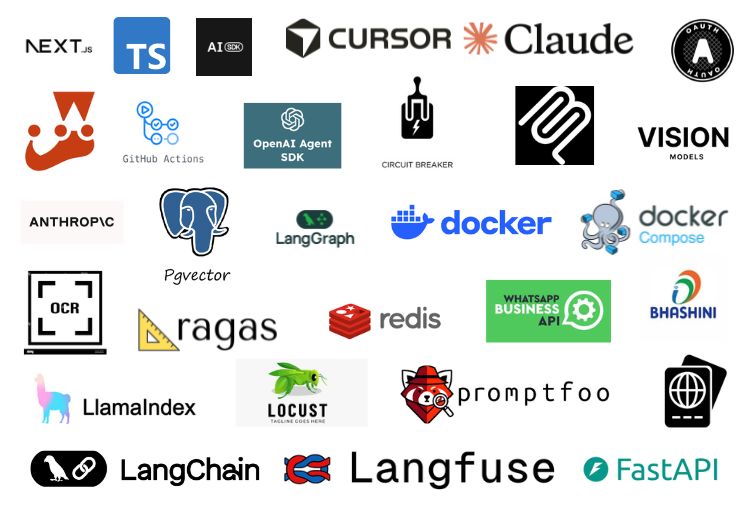
Tools and Technologies Covered in the Executive Post Graduate Certificate in AI-Native Software Engineering
Below is a complete list of tools and technologies covered in this Executive Post Graduate Certificate in AI-Native Software Engineering:
Who Should Enrol in the Executive Post Graduate Certificate in AI-Native Software Engineering?
The IIT Kharagpur AI Native Software Engineering course suits you best if you are:
Backend Engineers
If you create APIs, backend services or data-oriented software, you will learn about LLM infrastructure, retrieval, agentic workflows, costs accounting and production control. These areas link AI functionalities with backend engineering.
Full-Stack and Frontend Engineers
If you build frontend and backend applications, you will learn about AI-natives interfaces and how they integrate with LLMs, retrieval and agent functionalities. Application security, evaluation and deployment will be viewed in the context of the overall system.
Platform and Software Engineers
If you develop system architecture, infrastructure and software delivery, the course deals with backend reliability, model routing, evaluation gates, monitoring and governance. These topics pertain to the engineering aspects of running AI-powered applications.
Tech Leads Who Still Write Code
Tech leads who head a development team yet keep themselves engaged in coding and architecture will benefit from the IIT Kharagpur software engineering course in grasping AI-assisted development and the engineering controls required for AI-driven applications.
Who May Not Find This Programme Suitable?
The program on AI native software engineering is meant for those who have practical experience in software development. Those who are beginners in programming or just want a technical overview of AI will find it unsuitable.
The right alternative depends on your goal:
New to programming or looking for broader AI foundations: Consider the Executive Post Graduate Certificate in Applied AI & Machine Learning. Check its programming prerequisites before applying.
Interested in managing AI products rather than building the systems: Consider the Executive Post Graduate Certificate in Building AI Products, Systems & Services.
A leader who wants to make AI strategy and governance decisions without hands-on coding: Consider the Executive Programme in Technology & AI Leadership.
Eligibility Criteria for the Executive Post Graduate Certificate in AI-Native Software Engineering
Applicants must meet the academic eligibility requirements and software development prerequisites before enrolling in the IIT Kharagpur software engineering course.
Academic Eligibility
Graduation with at least 50% marks.
B.Tech/M.Tech or B.E/M.E, preferably in Computer Science, Information Technology, Artificial Intelligence, or Electronics and Communication Engineering.
B.Sc/M.Sc in Computer Science, Mathematics, or Statistics.
MCA or BCA.
Candidates from other disciplines must have at least two years of experience in the technology field.
Prerequisites
At least two years of professional software development experience.
Proficiency in Python or JavaScript/TypeScript.
Executive Post Graduate Certificate in AI-Native Software Engineering Fees Structure
The fees structure for the AI native software engineering course from IIT Kharagpur is:
The total programme fee is inclusive of taxes. The EMI starts at ₹6,031 per month and may vary according to the selected plan.
How to Apply for the Executive Post Graduate Certificate in AI-Native Software Engineering?
For applying for Executive Post Graduate Certificate in AI-Native Software Engineering you must follow the following steps:
Complete the application: Fill in your details and submit the application form.
Receive a provisional offer: Shortlisted applicants receive a provisional offer letter.
Block your seat: Pay the seat-blocking amount and submit the required documents.
Complete enrolment: After document verification, pay the balance amount to confirm enrolment.